Implementation, Action and Annual Investment Plan
Chapter 6 converts the Integrated Ecosystem Development Strategy (IEDS) in Chapter 3 into a sequenced delivery system, using the Balanced Scorecard (BSC) in Chapter 5 and the KPI definitions and calibration rules in Chapter 4. It connects strategic objectives to funded Programmes–Activities–Projects (PAPs), accountable delivery owners, measurable milestones and corrective action. The ten-year investment envelope is a planning scenario, not an approved appropriation; proposed milestones are not completed commitments.
IEDS is implemented as one connected system across the five Bangsamoro Economic and Investment Ecosystem (BEIE) clusters: Foundations → Enablers → Transformers → Connectors, supported by Financiers throughout. Foundations protect the productive resource base; Enablers address infrastructure, energy, connectivity, institutional and skills constraints; Transformers add value through processing, certification and enterprise development; Connectors link production to logistics and markets; and Financiers mobilise suitable public, private, development and Shariah-compliant capital. Moral Governance, resilience, inclusion and peace are cross-cutting operating conditions.
Chapter 6 separates three evidence classes: (1) official statistics and administrative records, verified by the relevant data owner; (2) stakeholder-validation evidence, including the 76 consented survey responses in the linked validation snapshot, used to inform priorities and learning; and (3) management assumptions and proposed targets, clearly labelled until verified and approved. Survey responses are not automatically official baselines. Each KPI must have a definition, unit, baseline year, territorial coverage, authoritative data owner, source, refresh frequency and validation method. Missing observations are recorded as missing, not as zero.

6.1.1 Ecosystem synchronisation
The sequence follows Chapter 3’s systems finding: separate implementation of the Halal Economy Dominance Strategy (HEDS), Green Economy Monetisation Strategy (GEMS) or Infrastructure-First Enabling Strategy (IFES) would leave other constraints unresolved. IEDS integrates their strongest elements and sequences them according to dependencies. The early priority is not to delay all productive investment until every constraint is removed; it is to test each project against the upstream conditions it needs—reliable power and logistics, lawful land access, capable workers, standards, financing, safeguards and credible offtake—and to fund those conditions alongside the project where justified.
Chapter 2 identified systems risks including Limits to Growth, Fixes that Fail, Growth and Underinvestment, Shifting the Burden, Success to the Successful and Drifting Goals. Chapter 3 maps these to leverage points. Implementation should therefore measure not only activities completed but whether capabilities and causal links are working: logistics costs, energy reliability, accepted certification, realised investment, export performance, productive employment and inclusive territorial outcomes.
6.1.2 Adaptive management
The BSC is the management spine linking leading indicators (skills, infrastructure and process readiness) to stakeholder outcomes and financial results. The BIF-Net network, supported by a proposed Secretariat / Orchestration Office within MTIT–Bureau of Investments, should maintain the common PAP and investor-project pipeline, coordinate issue resolution and prepare performance reports. It does not replace statutory ministerial authority, the budget process, procurement rules or legally designated investment-incentive and approval processes.
- KPI variance greater than 15%: investigate the cause and submit a time-bound corrective action plan; do not change a target silently.
- Budget utilisation above 90% while agreed outputs are materially delayed: reconcile financial and physical progress and refer the case to the authorised budget or project authority.
- A PAP passes its approved end date without completion: record the delay, dependency and revised forecast; assign an accountable owner and escalation date.
- A critical dependency is not met: re-sequence the dependent PAP or apply a documented readiness gate; do not assume that downstream investment is automatically cancelled.
- Quarterly BSC review: examine linked indicators across Learning and Growth, Internal Process, Stakeholder and Financial perspectives.
The 15% and 90% thresholds are proposed management rules, not statutory requirements. They should be calibrated during Phase 1 against indicator volatility, contract conditions and applicable financial-management rules.
6.1.3 Accountability and transparency
Each PAP must have one accountable lead agency, named delivery focal point, approved scope, budget source, schedule, outputs, outcome contribution, geographic coverage, safeguards, procurement route, upstream dependencies and escalation route. The MTIT–Bureau of Investments is the initiating and coordinating unit for BIRD and investment facilitation; sector ministries, provincial and local government units, and other competent institutions retain their respective mandates. Reporting should use authorised government channels and a public-facing BIRD/BIF-Net dashboard, while respecting commercial confidentiality, personal data, security-sensitive information and applicable disclosure rules.
6.2 Implementation framework: governance and coordination architecture
The governance arrangement must connect policy direction, delivery, investment facilitation, financing and independent performance verification without creating duplicate approval gates. Chapter 7 recommends reconciling the draft Investment Code, proposed BIF-Net Executive Order and any proposed coordination structures through legal review. The structure below is therefore a proposed operating model for implementation planning; formal powers, membership and reporting lines remain subject to the applicable legal instruments and approval processes.

6.2.1 Governance roles
| Level | Accountable body or role | Core responsibility | Key outputs |
|---|---|---|---|
| Policy and legislative oversight | Bangsamoro Parliament and competent executive authorities | Consider required legislation, approve appropriations through applicable processes, and provide policy direction within their mandates. | Legislative decisions; approved budget; formal policy direction. |
| Investment facilitation coordination | BIF-Net network, supported by a proposed Secretariat / Orchestration Office within MTIT–Bureau of Investments | Maintain a common investment-project pipeline; coordinate inter-agency issue resolution; track investor cases, service standards, dependencies and delivery commitments; prepare consolidated reports. | Case log; pipeline register; escalation notes; quarterly coordination report. |
| Sector and cluster delivery | Relevant line ministries, attached agencies and project owners, coordinated through the five BEIE clusters | Deliver approved sector outputs; secure technical approvals and safeguards; manage procurement, contracts and operational readiness; report KPI evidence. | Completed outputs; verified outcomes; risk and dependency updates. |
| Territorial facilitation | Provincial and local government units and designated investment focal points; proposed provincial nodes where approved | Provide location-specific information, coordinate local permits and community engagement, identify project constraints and capture territorial results. | Local project profiles; investor issue log; community and equity indicators. |
| Data ownership and verification | Authoritative administrative data owners; BPDA and other competent planning/evaluation partners according to mandate; independent evaluators where commissioned | Validate definitions, baselines and reported results; distinguish outputs from outcomes; evaluate without assuming operational ownership of source data held elsewhere. | Verified indicator series; evaluation findings; published data-quality notes. |
BIF-Net is the investment-facilitation network. A proposed Secretariat / Orchestration Office is an operating function to support that network, not a separate statutory approving body. Chapter 7 recommends one reconciled policy-coordination arrangement across the draft Investment Code and proposed BIF-Net Executive Order. Its final name, membership, decision rights and relationship with existing bodies must be confirmed through legal drafting. A separate “command centre” should not be assumed to exist unless formally authorised.
6.2.2 Coordination and escalation mechanisms
Project and investor case management. Each priority case receives a unique reference, lead agency, next action, due date, unresolved dependency and escalation path. BIF-Net tracks the case from enquiry through registration, approvals, implementation, operation and aftercare. Statutory approvals remain with the authority legally responsible for them.
Cluster working sessions. Quarterly forums use the five BEIE clusters to resolve shared constraints and review dependencies. They are coordination arrangements, not additional permission stages. A cluster forum may recommend a change; the authorised agency makes the decision.
Shared digital register. The register should connect PAP identifiers, BSC objectives, KPI identifiers, budget lines, project-readiness gates, source documents and investor case references. Integration with PSA, certification and other administrative systems must be labelled “planned” until data-sharing agreements, privacy controls, interfaces, system ownership and error-handling have been confirmed.
Territorial equity review. Twice-yearly review should compare approved allocations, actual expenditure, delivered outputs and outcomes by province and eligible locality. Chapter 7’s proposed allocation floor for lagging and island areas remains a policy proposal pending formal adoption. It must define the denominator, eligible areas, treatment of multi-province projects, safeguards and review process. Use a consistent post-Sulu territorial baseline in regional aggregates; do not impute observations missing from the source.
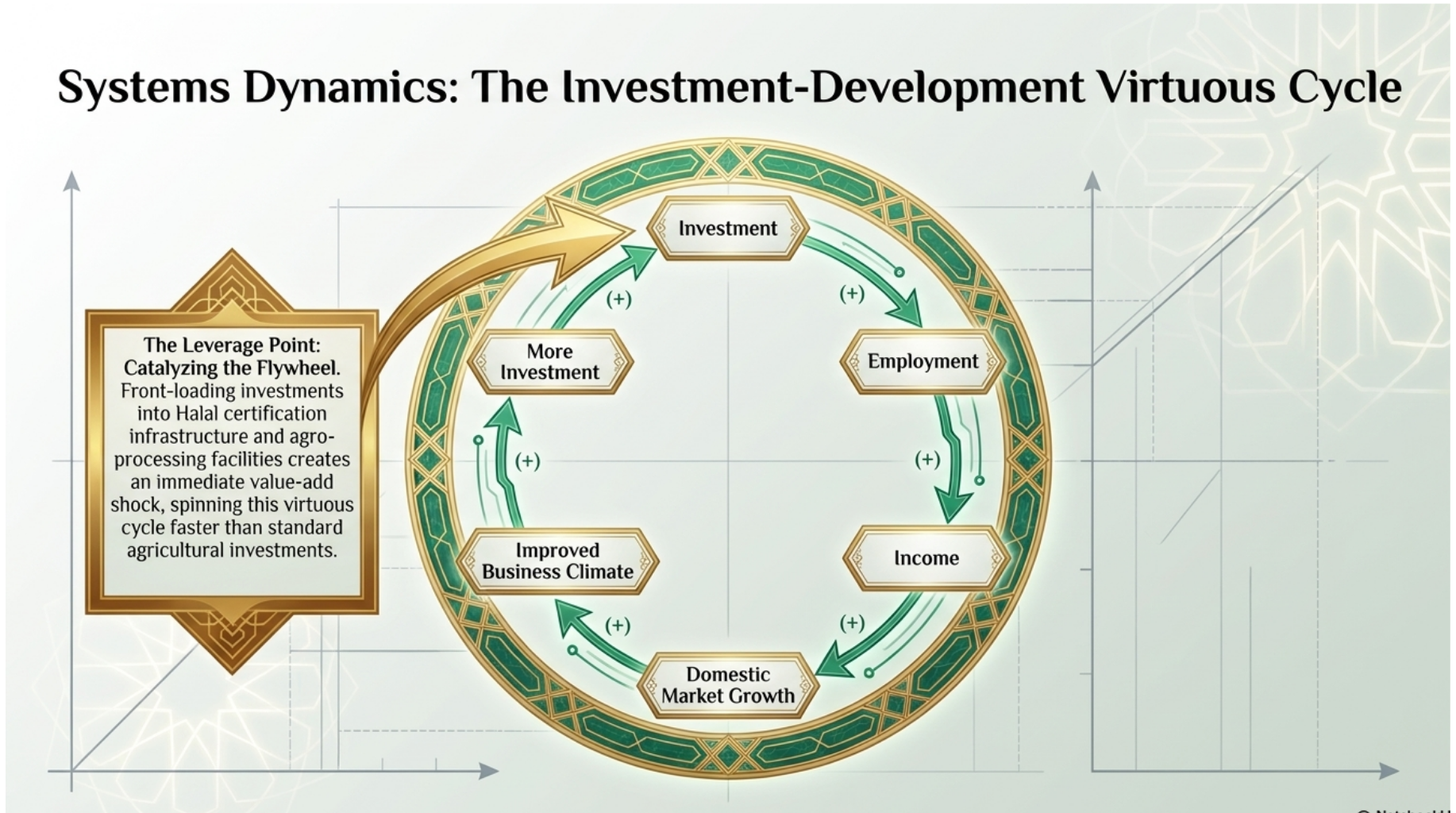
6.3 Phased implementation roadmap (2026–2035)
The phases operationalise Chapter 3’s IEDS sequencing and Chapter 5’s leading-to-lagging indicator logic. Dates and financial ranges are planning parameters to be reconciled with the approved Annual Investment Programme, project readiness and annual BSC reviews. A later phase is not authorised merely because its planned start date has arrived.

6.3.1 Phase 1: Foundations and enabling conditions (2026–2028)
Phase 1 prioritises the constraints identified in Chapters 2 and 7: infrastructure and logistics; energy reliability; institutional coordination; skills and digital access; a verified baseline register; standards and certification readiness; lawful land access; and project preparation. The intention is to remove binding constraints while advancing productive projects whose own prerequisites are demonstrably met.
The following milestones are proposed planning milestones, not confirmed delivery commitments. Agency roles, dates, costs and status must be validated with each accountable project owner before being presented as approved or “in progress”.
| Milestone | Indicative lead / partners | Planning window | Cost status | Evidence of completion |
|---|---|---|---|---|
| Reconcile the Investment Code, proposed BIF-Net Executive Order and coordination model | MTIT–Bureau of Investments; competent legal and executive authorities | 2026–2027 | To be costed and validated | Approved legal instrument; published roles and decision rights. |
| Establish the baseline register and version-controlled PAP pipeline | MTIT–Bureau of Investments; BPDA; PSA-RSSO BARMM and data owners | 2026–2027 | To be costed and validated | Indicator dictionary, data-owner sign-off and dated baseline register. |
| Prepare priority infrastructure and energy projects, including relevant interconnection and mini-grid investments | Competent energy, infrastructure and sector authorities | 2026–2028 | Project-specific feasibility and financing required | Feasibility, design, safeguards, permits, financing plan and verified milestones. |
| Strengthen halal assurance and certification capacity | Competent halal authority; MTIT; relevant science, standards and enterprise partners | 2026–2028 | Proposed; confirm costing | Published certification process, trained personnel, quality system and recognition roadmap. |
| Advance the Forestry Code, applicable joint issuances and community safeguards for green-economy instruments | MENRE, MILG, Parliament and affected local/community stakeholders | 2026–2028 | Proposed; confirm costing | Lawful approvals, consent and benefit-sharing safeguards where applicable, and monitoring design. |
| Pilot digital investment facilitation and investor aftercare | MTIT–Bureau of Investments; MICT and competent permit-issuing agencies | 2026–2028 | Proposed; confirm costing | End-to-end service map, published service standards, case data and user feedback. |
| Designate territorial investment focal points, including island and underserved areas | MTIT–Bureau of Investments; provincial and local government units | 2027–2028 | Subject to approved operating model | Coverage map, service charter, staffing and referral pathway, first quarterly report. |
6.3.2 Phase 2: Value addition and market formation (2029–2031)
Phase 2 deepens the integration of Foundations, Enablers and Transformers while building Connector and Financier capacity. Candidate priorities include halal agro-processing and enterprise support, cold-chain and storage systems, traceability and standards recognition, climate-resilient production, commercially sound tourism, and Shariah-compliant finance. Each candidate requires a documented investment case rather than being treated as a guaranteed output of the roadmap.
| Candidate milestone | Indicative lead / partners | Planning window | Scale-up condition | Outcome indicator |
|---|---|---|---|---|
| Develop priority halal and agro-industrial value chains, including the proposed Halal Park where feasible | BEZA, MTIT and enterprise partners | 2029–2031 | Verified site, utilities, safeguards, tenant/buyer interest and operating model | Value-added output; productive enterprise survival; export sales. |
| Extend halal certification and conformity-assessment capability | Competent halal authority; MTIT; relevant standards bodies | 2029–2031 | Quality assurance, accreditation pathway and recognition requirements confirmed | Accepted certificates; compliant firms; reduced certification time. |
| Scale green-economy projects, including PES or carbon initiatives where legally and technically eligible | MENRE and relevant local/community institutions | 2029–2031 | Legal authority, measurement/reporting, safeguards, benefit-sharing and buyer/registry requirements met | Verified environmental outcomes and net revenue after transaction costs. |
| Expand Islamic finance and risk-sharing products through eligible regulated providers | Relevant regulated financial institutions and competent partners | 2029–2031 | Regulatory compliance, demand, risk assessment and provider business case | Financing reached; repayment/sustainability; access for MSMEs and underserved areas. |
| Build logistics, cold-chain and corridor links to BIMP-EAGA and prospective GCC buyers | Relevant infrastructure, trade, customs and private-sector partners | 2029–2031 | Route economics, throughput, standards, buyer contracts and logistics reliability | Post-harvest loss; logistics cost; repeat export orders. |
6.3.3 Phase 3: Consolidation and global integration (2032–2035)
Phase 3 strengthens value chains and institutions that have demonstrated performance in earlier phases. Priorities may include broader market recognition for halal products where relevant bodies confirm eligibility; higher-value exports; safeguarded green-economy revenue streams; applied research and innovation; and commercially viable financial products accessible to enterprises and communities. International endorsements, mutual-recognition arrangements, revenue values and visitor targets are outcomes to pursue, not guaranteed deliverables.
| Outcome area | Indicative lead / partners | Target horizon | Evidence required | BSC connection |
|---|---|---|---|---|
| GRDP, poverty, employment, investment and export outcomes | Relevant statistical and administrative data owners; MTIT–Bureau of Investments for investment pipeline data | 2035 | Comparable territorial series; approved KPI definitions; annual verified results. | Financial and Stakeholder perspectives. |
| Halal market recognition and cross-border trade | Competent halal authority; MTIT; national and international counterparts | 2032–2035 | Formal recognition decisions; compliant exporters; customs/export records. | Stakeholder and Financial perspectives. |
| Green-economy revenue and environmental outcomes | MENRE and participating local/community institutions | 2032–2035 | Verified credits or PES contracts, transaction costs, benefit-sharing and ecological monitoring. | Financial, Stakeholder and Internal Process perspectives. |
| Innovation and higher-value production | Relevant research, standards, education and sector institutions | 2032–2035 | Operational research partnerships, enterprise adoption and measured productivity/value addition. | Learning and Growth and Financial perspectives. |
| Financial-system depth and inclusion | Regulated financial institutions and competent public partners | 2032–2035 | Verified asset, financing and inclusion series, with location and beneficiary disaggregation. | Stakeholder and Financial perspectives. |
The 2035 targets specified in Chapters 4 and 5—including GRDP of ₱550 billion or more, annual investment approvals of ₱15 billion or more, export growth, poverty below 20% and at least 20,000 jobs—remain strategic targets to assess against verified baselines, consistent territorial coverage and the stated price basis. Chapter 7 treats the GRDP growth path as conditional on comparable series and explicit assumptions. The mid-term review should re-estimate the path rather than lowering targets silently or reporting nominal values as real growth.
6.3.4 Indicative investment envelope and financing strategy
The ₱120–160 billion envelope is the indicative decade-long investment requirement presented in Chapters 1 and 3. It is not a single approved budget and should not be described as a confirmed fiscal commitment. Table 6-5 is an illustrative financing scenario only; shares must be replaced by verified appropriations, signed co-financing agreements or documented private investment commitments as these become available.
| Potential source | Illustrative share | Amount at ₱120–160B envelope | Evidence required before counting as financing |
|---|---|---|---|
| BARMM appropriations and other regional public resources | 35% assumption | ₱42–56B | Approved annual appropriations, eligible budget lines and demonstrated fiscal space. |
| National government programmes | 25% assumption | ₱30–40B | Confirmed programme eligibility, agency endorsement and approved allocations; fiscal incentives are not cash financing. |
| Official development assistance and climate finance | 30% assumption | ₱36–48B | Approved project concepts, lender/partner decisions, financing terms and safeguards. |
| Private capital, public–private partnerships and Islamic finance | 10% assumption | ₱12–16B | Bankable project preparation, market appetite, due diligence and documented commitments. |
6.4 Programmes, activities and projects (PAPs)
The PAP register translates Chapter 3’s strategic options into delivery packages and links each package to the BSC in Chapter 5 and KPI definitions in Chapter 4. The 25 entries below form a representative pipeline from the current working register, not a complete investment plan, an approved project list or a full costing of the ₱120–160 billion envelope. Each entry must be validated with its accountable owner and tagged with a stable PAP identifier before inclusion in the authoritative register.
Unique identifier; strategic objective and BSC perspective; BEIE cluster and leverage point; responsible agency and accountable focal point; province/locality; scope and beneficiaries; start/end dates; lifecycle cost and annual cash flow; funding status and source; procurement route; permits, land, safeguards and climate/security risk; upstream dependencies; deliverables; KPI links; data source; reporting frequency; current status; variance; corrective action; and decision history.
6.4.1 Representative PAP pipeline by BSC perspective
| BSC perspective / BEIE cluster | Strategic objective | Representative PAP | Indicative lead (to validate) | Indicative cost (₱M) | Register status |
|---|---|---|---|---|---|
| Financial / Transformers | Value-added halal production | Bangsamoro Halal Park development (Matanog) | BEZA / MTIT / private partners | 1,500 | Reported as in progress; owner evidence required |
| Financial / Transformers | Halal certification and market recognition | Halal certification recognition and readiness programme | Competent halal authority / MTIT | 85 | Proposed |
| Financial / Foundations | Environmental stewardship and green revenue | REDD+ project preparation and registration, where eligible | MENRE / local and community partners | 120 | Proposed |
| Financial / Foundations | Payments for ecosystem services | PES framework and project pipeline | MENRE / MILG / local and community partners | 45 | Proposed |
| Financial / Financiers | Shariah-compliant finance and inclusion | Islamic finance access and provider partnership | Eligible regulated providers / competent partners | 200 | Validate provider, location and financing status |
| Financial / Connectors | Access to regional and GCC markets | Export corridor and buyer-linkage development | MTIT / MAFAR / relevant national partners | 35 | Proposed |
| Financial / Transformers | Integrated farm-to-market value chains | Seaweed processing investment, Tawi-Tawi | MAFAR / private partners | 180 | Proposed |
| Financial / Connectors | Export market access and traceability | Digital traceability and export-readiness support | MTIT / MICT / competent standards bodies | 65 | Proposed |
| Stakeholder / Cross-cutting | Investor satisfaction and retention | Investor aftercare and grievance channel | MTIT–Bureau of Investments / competent agencies | 12 | Confirm mandate, service standards and cost |
| Stakeholder / Transformers | MSME participation in certified value chains | MSME halal certification support | Competent halal authority / MTIT | 95 | Proposed |
| Stakeholder / Cross-cutting | Inclusive job creation | Jobs and local-sourcing assessment protocol | MTIT–Bureau of Investments / MOLE / project owners | 18 | Proposed |
| Stakeholder / Financiers | Access to community finance | Digital Islamic microfinance pilot | Eligible regulated providers / partners | 55 | Proposed |
| Stakeholder / Cross-cutting | Territorial equity | Provincial investment facilitation focal points | MTIT–Bureau of Investments / LGUs | 40 | Subject to approved model and coverage |
| Internal Process / Enablers | Streamlined investment facilitation | Digital registration and permitting journey | MTIT–Bureau of Investments / MICT / permit authorities | 75 | Verify scope and integration status |
| Internal Process / Transformers | Conformity-assessment capacity | Quality-assurance labouratory feasibility and deployment | Competent halal authority / MOST / MTIT | 110 | Proposed; feasibility required |
| Internal Process / Enablers | Energy and infrastructure access | Interconnection and critical infrastructure support | Competent energy and infrastructure authorities | 6,670 | Verify scope; avoid double counting |
| Internal Process / Cross-cutting | Inter-agency synchronisation | BIF-Net Secretariat, case management and performance dashboard | MTIT–Bureau of Investments / BPDA / MICT | 30 | Proposed; not a separate statutory body by assumption |
| Internal Process / Foundations | Green-economy legal readiness | Forestry and PES policy implementation support | MENRE / MTIT / competent legislative bodies | 8 | Subject to legal status and safeguards |
| Internal Process / Enablers | Reduce post-harvest and logistics losses | Farm-to-market roads, cold chain and storage | MPW / MAFAR / LGUs / private operators | 800 | Proposed; link to commodity pipeline |
| Learning and Growth / Transformers | Halal sector capability | Halal workforce training and certification | Competent halal authority / MTIT / TESDA | 45 | Proposed |
| Learning and Growth / Financiers | Islamic finance skills | Islamic finance professional development | Relevant regulated providers / education partners | 25 | Proposed |
| Learning and Growth / Enablers | Functional and digital literacy | Digital literacy centres linked to enterprise needs | MICT / education partners / LGUs | 150 | Proposed |
| Learning and Growth / Foundations | Green-economy expertise | Local capacity for PES, safeguards and monitoring | MENRE / MILG / local partners | 35 | Proposed |
| Learning and Growth / Enablers | Digital public-service capability | Bangsamoro e-governance platform integration | MICT / MTIT / public-service owners | 220 | Confirm system owner, costs and milestones |
| Learning and Growth / Cross-cutting | Investment facilitation capability | Training and standards for investment facilitation staff | MTIT–Bureau of Investments / training partners | 15 | Proposed |
6.4.2 PAP hierarchy, readiness and financial tracking
The PAP register uses three linked levels: Programme (a portfolio with a shared outcome), Project (a time-bound intervention with scope, cost and an accountable owner) and Activity (a defined action or work package). Activities must roll up to project deliverables, and projects to programme outcomes and named BSC objectives. A programme name or planned budget is not evidence that financing has been secured.
| Level | Definition | Required record |
|---|---|---|
| Programme | Set of projects contributing to a shared strategic outcome. | Outcome logic, portfolio owner, target population/location, total indicative cost and programme-level KPIs. |
| Project | Time-bound intervention with defined scope and deliverables. | Feasibility, project owner, lifecycle and annual cost, financing status, procurement plan, safeguards and milestones. |
| Activity | Specific task contributing to a project deliverable. | Task owner, due date, cost basis, completion evidence and dependency links. |
The dashboard should calculate separately: estimated project cost; approved budget; financing committed; financing disbursed; expenditure to date; remaining authorised budget; physical progress; output completion; outcome performance; and variance. Financial utilisation and physical progress must be read together. Status colours are management conventions, not substitutes for accounting, procurement or audit rules.
- Approved budget: amount formally authorised for the applicable period and purpose.
- Commitment: amount covered by a valid contract or other recognised obligation.
- Disbursement / expenditure: actual payments and recorded expenditure, presented according to the applicable accounting basis.
- Financial utilisation: expenditure divided by the comparable approved budget for the same period.
- Physical progress: verified achievement against the approved work plan; it is not inferred from spending.
- Outcome performance: verified change in the linked KPI, using the agreed baseline and method.
- Delayed PAP: a PAP with a missed approved milestone or end date, with the reason and recovery plan recorded.
6.5 First-year action plan (October 2026–September 2027)
The first-year plan prioritises the actions that make the wider portfolio executable: legal and governance reconciliation; the baseline and PAP register; readiness checks for infrastructure and productive projects; investor case management and aftercare; territorial validation; and the first quarterly performance cycle. Dates below are proposed planning windows, not confirmed commitments. Costs must be validated against approved budget lines and cannot be added to the ten-year envelope without checking for duplicated scope.
| Window | Priority action | Accountable lead / partners | Completion evidence | Cost status | Linked recommendation |
|---|---|---|---|---|---|
| Oct–Nov 2026 | Confirm the BIF-Net operating model and reconcile the draft Investment Code with the proposed Executive Order. | MTIT–Bureau of Investments; competent executive and legal authorities | Legally reviewed governance map, role matrix and decision log. | To be validated | Chapter 7 A1–A3 |
| Oct–Dec 2026 | Open the canonical baseline register and verify the six headline KPIs and their relationship to the full KPI dictionary. | MTIT–Bureau of Investments; BPDA; PSA-RSSO BARMM and data owners | Signed indicator specifications, baseline year, data-source links and data-quality log. | To be validated | Chapter 7 B1, D3 |
| Oct 2026–Jan 2027 | Build the consolidated PAP pipeline, including location, lifecycle costing, annual cash flow, financing status and critical dependencies. | MTIT–Bureau of Investments; BPDA; relevant project owners | Versioned register with unique identifiers and reconciliation of overlapping scopes. | To be validated | Chapter 7 B2, C1 |
| Nov 2026–Mar 2027 | Assess energy, logistics, digital access and skills constraints against the specific value chains they enable. | Competent sector ministries and project owners; MTIT–Bureau of Investments for pipeline coordination | Readiness score, dependency map, feasibility and safeguards status for each priority project. | Project-specific | Chapter 7 A6, B4–B5 |
| Jan–Mar 2027 | Pilot investor case management and aftercare with published service standards and lawful escalation routes. | MTIT–Bureau of Investments; relevant permit-issuing agencies | Case register, referral protocol, response-time metrics and investor-feedback procedure. | To be validated | Chapter 7 C4–C5 |
| Jan–Jun 2027 | Repeat validation with stronger participation from island provinces, underserved localities and private enterprises. | MTIT–Bureau of Investments; BPDA; provincial and local partners | Documented participation plan, response profile, limitations and findings. | To be validated | Chapter 7 D2 |
| Quarterly from Q1 2027 | Publish the first BSC-linked dashboard and review risk triggers, financial/physical progress and corrective actions. | BIF-Net Secretariat / Orchestration Office; data owners and project leads | Quarterly dashboard, variance decisions, action owners and due dates. | Within approved operating budget once confirmed | Chapter 7 D3–D5 |
| By Sep 2027 | Complete the first annual BSC review and revise the Year 2 PAP portfolio using verified results and available financing. | MTIT–Bureau of Investments; BPDA and competent oversight bodies | Published annual report; approved Year 2 PAP changes and rationale for material target revisions. | To be validated | Chapter 7 B2, D1, D4–D5 |
6.6 Monitoring, evaluation and learning (MEL) framework
MEL closes the implementation loop between IEDS (Chapter 3), KPI definitions and benchmarks (Chapter 4), the BSC and causal pathways (Chapter 5), and the institutional recommendations (Chapter 7). It should produce decision-useful evidence, not simply a record of expenditure and activities. The six Pareto-style headline KPIs are a concise management navigation layer, not a statistically proven claim that six indicators explain a fixed share of IEDS impact. They complement the full KPI and PAP registers.
6.6.1 Dashboard architecture and data controls
The BIRD MEL dashboard is a proposed shared reporting layer. Data refresh frequency must reflect the source system: administrative project data may be updated more frequently where authorised and technically supported; official statistical series update according to their publication cycles. Avoid describing a data feed as automatic or real-time until the data-sharing agreement, source owner, connector and error-handling procedure have been tested.
Show KPI status, verified versus provisional data, approved budget and expenditure, physical progress, critical dependencies and overdue corrective actions. Every headline value links to its source, owner, reference date and calculation.
Show baseline, latest actual, annual milestone and terminal target across Financial (30%), Stakeholder (25%), Internal Process (25%) and Learning and Growth (20%). Review the five causal pathways from Chapter 5 and test whether leading capabilities are associated with expected stakeholder and financial outcomes.
For each PAP, display accountable owner, location, cost and financing status, approved dates, procurement and safeguard status, physical progress, expenditure, expected outcome, dependencies and recovery action. Separate planned, submitted, approved, committed, disbursed and realised values.
Track enquiry-to-project conversion, service timelines, aftercare cases, grievance resolution, realised investment, jobs and local sourcing where measurable. Disaggregate eligible indicators by province and locality, sex and age where appropriate, enterprise size and other relevant inclusion dimensions, subject to privacy and data-quality controls.
6.6.2 Review cadence and reporting responsibilities
| Frequency | Review | Coordination / accountable participants | Decision product |
|---|---|---|---|
| Monthly, where data support it | Operational pipeline and critical dependencies | BIF-Net Secretariat / Orchestration Office; PAP leads | Updated cases, risk log and matters requiring escalation. |
| Quarterly | KPI variance, BSC causal pathways, budget versus physical progress, risk triggers | MTIT–Bureau of Investments, relevant data owners and PAP leads | Quarterly performance note; corrective action plan with owners and deadlines. |
| Twice yearly | Cross-cluster sequencing, project readiness and territorial equity | BEIE cluster participants; provincial/local partners; competent planning bodies | Re-sequencing recommendations and territorial delivery review. |
| Annually | BSC assessment, PAP portfolio and annual investment programming | MTIT–Bureau of Investments; BPDA and competent budget/oversight bodies | Annual performance report and next-year PAP recommendations for approval. |
| 2030 mid-term review | Independent assessment of assumptions, delivery and outcomes | Competent oversight bodies with independent evaluators | Published findings, recalibrated forecasts and approved Phase 3 priorities. |
| 2035 terminal review | End-of-roadmap performance and sustainability | Competent statistical, planning and oversight bodies | Final evaluation and evidence-based successor-roadmap proposal. |
The review cycle follows the BSC causal chain from Learning and Growth to Internal Process, Stakeholder and Financial outcomes. A low investor-satisfaction score, for example, should prompt investigation of service performance, skills and agency hand-offs before an intervention is selected. A rise in approvals should not be interpreted as realised capital, jobs or exports without verification of implementation and operations.
6.6.3 Adaptive management and systemic risk
Adaptation must be evidence-led and recorded. A variance triggers diagnosis, not an automatic punitive action. Before changing a target, cutting an incentive or reallocating a budget, the accountable body should classify the cause, assess legal and contractual constraints, consult affected parties where appropriate, identify second-order effects and record the decision.
| Risk / signal | Threshold or evidence | Required diagnostic step | Response and authority |
|---|---|---|---|
| Data quality or target drift | Missing source, unexplained definition change, or variance over 15% for two reporting periods | Verify data owner, definition, territory, price basis, timing and calculation. | Publish a data-quality note; submit target or method changes for approval through the designated governance route. |
| Financial progress outpaces physical progress | High expenditure with milestone slippage or weak output evidence | Reconcile payments, physical verification, variations and procurement records. | Refer to the authorised project, budget, procurement or audit authority; agree a recovery plan or other lawful action. |
| Critical upstream dependency fails | Energy, road, port, land, permit, safeguard, skills, certification or finance is not ready | Assess the effect on project viability, sequencing and operating costs. | Re-sequence or phase the dependent PAP; make the readiness decision transparent. |
| Climate or environmental shock | Hazard event, material production losses or a new risk assessment | Reassess exposure, vulnerability, continuity and ecosystem impact. | Apply approved resilience measures, contingency procedures and risk-financing mechanisms where available. |
| Security or conflict-sensitivity concern | Verified incident, community concern, investor withdrawal or project-access constraint | Use appropriate conflict-sensitive assessment and protect sensitive information. | Refer to competent security and local authorities; adjust implementation lawfully and safely. |
| Investor service failure | Unresolved case beyond published service standard or repeated bottleneck | Map the process and identify the agency hand-off or rule causing delay. | Escalate through BIF-Net to the responsible authority and publish an anonymised systemic-issue update. |
Every material intervention records: triggering evidence; root-cause classification; options considered; expected effect on other BSC perspectives and BEIE clusters; decision authority; responsible owner; due date; resource implications; stakeholder/community implications; and follow-up evidence.
6.6.4 Data governance and transparency
The BIRD register should identify the source of each published value and distinguish public indicators from confidential investor and commercially sensitive project details. The MTIT–Bureau of Investments should coordinate public-facing investment-pipeline and facilitation information within its remit; financial and procurement disclosures should be published by competent authorities through authorised channels; provincial and local partners should publish validated local delivery information through their own channels. No single dashboard should be described as the source of record until its legal and technical ownership has been established.
Data governance arrangements should specify stewardship, access roles, validation, versioning, correction procedures, retention and publication rules. Personal data, commercially confidential records, security-sensitive information and protected community data must be handled in line with applicable law and agreed protocols. Public dashboards should use aggregated or anonymised information where needed.
- Baseline verification: formal target tracking starts only when definition, unit, territory, baseline year, source owner and verification method are documented.
- Target traceability: approved changes to targets, dates or cost assumptions are versioned with reasons; historical values remain auditable.
- Variance classification: distinguish data-quality, implementation, financing, dependency and external-shock variances before assigning a corrective action.
- Dependency management: PAPs are monitored individually and as links in the IEDS causal sequence.
- Results discipline: report inputs, activities, outputs, outcomes and impacts separately; do not claim causation from correlation alone.
- Public accountability: publish annual BIRD implementation and performance reporting, including data limitations, territorial allocation and delivery, risks, corrective actions and reasons for material re-sequencing.
References
Bangsamoro Planning and Development Authority (BPDA). (2023). 2nd Bangsamoro Development Plan 2023–2028. BARMM Government. https://knowledge.bpda.bangsamoro.gov.ph/
Bureau of Investments, Ministry of Trade, Investments and Tourism (MTIT)–BARMM. (2026). Investment approval tracking system: Q1 2026 report.
Department of Energy. (2025). Bangsamoro electrification status report 2025. DOE-BARMM Field Office.
Department of Information and Communications Technology. (2025). BARMM broadband connectivity assessment. DICT-MICT Joint Survey.
Kaplan, R. S., & Norton, D. P. (1992). The balanced scorecard — Measures that drive performance. Harvard Business Review, 70(1), 71–79.
Kaplan, R. S., & Norton, D. P. (1996). The balanced scorecard: Translating strategy into action. Harvard Business Press.
Meadows, D. H. (1999). Leverage points: Places to intervene in a system. Sustainability Institute.
Ministry of Finance and Budget Management–BARMM. (2025). BARMM Provincial Economic Trends: A provincial breakdown of growth and challenges (Economic Brief, Issue No. 1, Series of 2025). MFBM Economics Division. https://mfbm.bangsamoro.gov.ph
Ministry of Information and Communications Technology–BARMM. (2025). Bangsamoro e-Governance Master Plan (BEGMP): Salient points and strategic milestones. MICT.
Ministry of Trade, Investments and Tourism–BARMM. (2025). Bangsamoro Halal Industry Development Plan (BHIDP) 2025–2030. MTIT.
Ministry of Trade, Investments and Tourism–BARMM. (2026). Bangsamoro MSME Development Plan 2026–2032: Salient features. MTIT-ETD.
National Economic and Development Authority. (2023). Philippine Development Plan 2023–2028. NEDA.
Philippine Statistics Authority–RSSO BARMM. (2025). BARMM's economy expands by 2.7 percent in 2024. https://rssobarmm.psa.gov.ph
Senge, P. (1990). The Fifth Discipline: The art and practice of the learning organization. Doubleday.
Silva, A. M. (2026, April). Reimagining BARMM's economic sectors: Building an integrated investment roadmap (2026–2036). AS Strategic Insights. https://asilvainnovations.github.io/barmm-investment-roadmap/ieb.html
Silva, A. M., & Unsi, M. (2026). The Emerging Bangsamoro: A Hub for Resilient and Ethical Growth—Strategic Investment Analysis Report. AS Strategic Insights.
Standards and Metrology Institute for Islamic Countries. (2021). Strategic Plan 2021–2030. Organisation of Islamic Cooperation.
United Nations Development Programme. (2023). Sustainable Development Goals monitoring framework for autonomous regions. UNDP Philippines.