Introduction — Background, Purpose, Anchors and Methodology
A. Background and Rationale: From Post-Conflict Recovery to Investment Destination
The Bangsamoro Autonomous Region in Muslim Mindanao (BARMM) was formally established on 26 February 2019, following the ratification of the Bangsamoro Organic Law (Republic Act No. 11054, 2018) in the plebiscite held earlier that year. The region is more than an administrative reorganisation. It is a political settlement that seeks to turn decades of armed conflict into a durable framework for self-governance, cultural affirmation and economic self-determination.
The region enters the roadmap period with clear evidence of progress and of continuing constraints. On the first-semester measure, poverty incidence among families fell from 55.9 percent in 2018 to 34.8 percent in 2023 (PSA, 2023). On the full-year measure, it fell from 28.0 percent in 2021 to 23.5 percent in 2023, still among the highest of all regions (PSA, 2024). The improvement is substantial, but poverty remains a central development constraint.
The economy is growing again after a slow 2024. Gross Regional Domestic Product (GRDP) grew 2.7 percent in 2024, after 4.3 percent in 2023. In 2024, services accounted for 42.0 percent of GRDP; agriculture, forestry and fishing for 32.4 percent; and industry for 25.6 percent (PSA-RSSO BARMM, 2025). Growth then accelerated to 5.0 percent in 2025, the sixth fastest of the country's 18 regions (MindaNews, 2026). This structure means that value addition, infrastructure, market access, human capital and finance have to be considered together rather than as separate sector programmes.
Investment activity is also rising. Investment approvals reached ₱5.1 billion in the first four months of 2026 (BBOI, 2026). Approvals, however, are not the same as realised capital formation or broad investor confidence. BIRD therefore treats investor confidence as an outcome to be measured through administrative and market indicators, not inferred from a single approval figure.
Provincial trajectories differ. Lanao del Sur was the fastest-growing province in 2023, at 5.02 percent, and grew 4.0 percent in 2024, supported by the SPDA Agro-Industrial Development Program and anchor investments such as DoleFil's ₱306 million pineapple facility. Maguindanao del Norte grew fastest in 2024, at 4.1 percent, on the strength of a services-led economy and growing industrial capacity (MFBM, 2025). Basilan was declared free of the Abu Sayyaf Group on 9 June 2025, a milestone that improves the conditions for normal investment activity (PIA, 2025).
The Bangsamoro Investment Roadmap Development (BIRD) 2026–2035 is MTIT's ten-year strategic framework for investment-led, inclusive and sustainable economic transformation. It builds on the region's productive assets and institutional context: agriculture and fisheries, halal identity and enterprise, a strategic position in BIMP-EAGA, renewable-energy resources, cultural assets, human capital and emerging Islamic finance. The roadmap does not assume that comparative advantage automatically becomes investment advantage. It focuses on the enabling conditions, linkages and execution capabilities needed to turn assets into investable opportunities and broad-based economic outcomes.
B. Scope, Coverage and Temporal Horizon
B.1 Geographic Scope
The roadmap covers BARMM as now constituted: five provinces (Lanao del Sur, Maguindanao del Norte, Maguindanao del Sur, Basilan excluding Isabela City, and Tawi-Tawi), the Special Geographic Area (SGA) and Cotabato City. Sulu has been outside BARMM since the Supreme Court decision of 9 September 2024 (Supreme Court of the Philippines, 2024). Cotabato City, the regional seat of government and the main commercial centre, is treated as a distinct urban node. Each province is profiled through the Bangsamoro Economic and Investment Ecosystem (BEIE) Framework to analyse sectoral linkages and identify priority investment corridors.
B.2 Sectoral Coverage
The roadmap addresses six priority investment sectors, the same six used in the stakeholder workshops, together with the green economy as an emerging cross-cutting pillar. Each is mapped to the BEIE Framework's five functional clusters.
| Priority sector | BEIE cluster | Key investment areas |
|---|---|---|
| Agro-industry | Foundations → Transformers | Rice, corn, coconut, rubber and seaweed processing; cold chain; farm-to-market linkages |
| Halal economy | Transformers | Halal processing, certification and testing; halal parks; export market linkages |
| Tourism and cultural economy | Connectors | Halal tourism, cultural heritage, eco-tourism, Lake Lanao |
| Energy and utilities | Foundations / Enablers | Renewable generation, Zamboanga–Basilan interconnection, island mini-grids, household electrification |
| Infrastructure, logistics and connectivity | Enablers | Farm-to-market roads, ports, digital broadband, BIMP-EAGA corridors |
| Services (health, education, finance, digital) | Enablers / Financiers | Human capital, Islamic finance, e-governance, digital literacy |
| Green economy (cross-cutting pillar) | Foundations / cross-cutting | Carbon credits, payments for ecosystem services, REDD+, sustainable forestry, eco-tourism fees |
B.3 Temporal Scope and Three-Phase Architecture
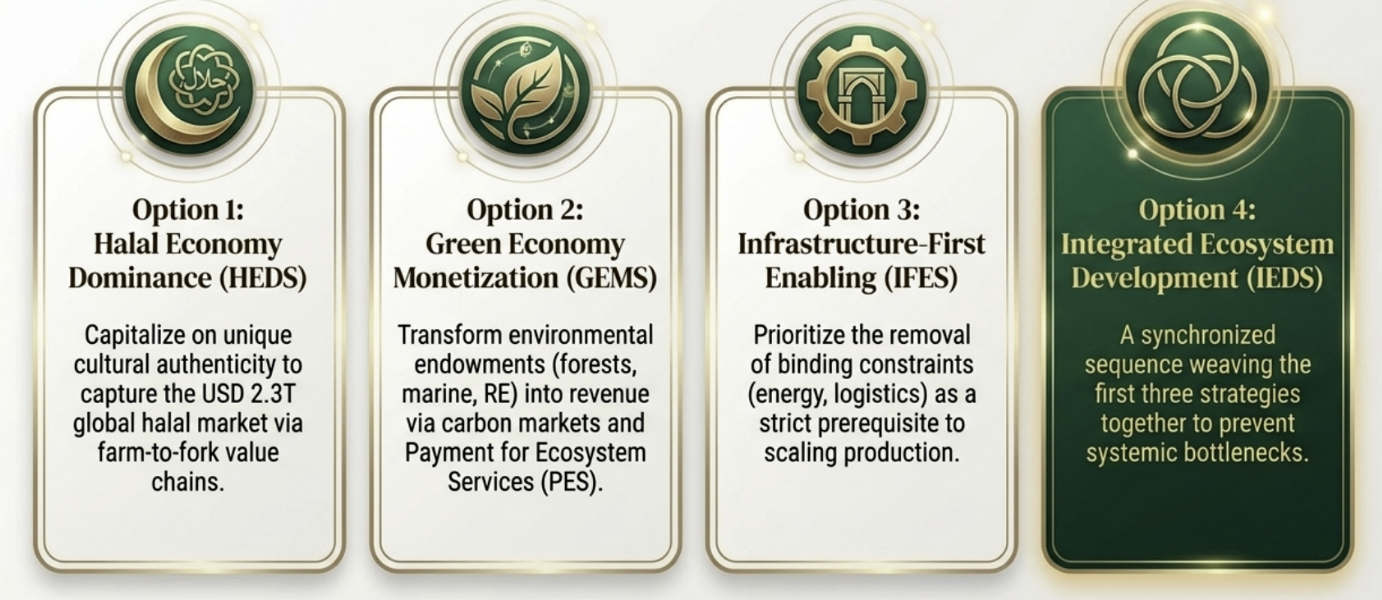
The roadmap spans 2026–2035 in three implementation phases, sequenced by investment readiness and system dependencies. The indicative public catalytic envelope is ₱120–160 billion across the decade. The Integrated Ecosystem Development Strategy (IEDS) connects the strategic options and sets the implementation sequence. All amounts remain subject to project readiness, financing, safeguards, feasibility and annual budget decisions.
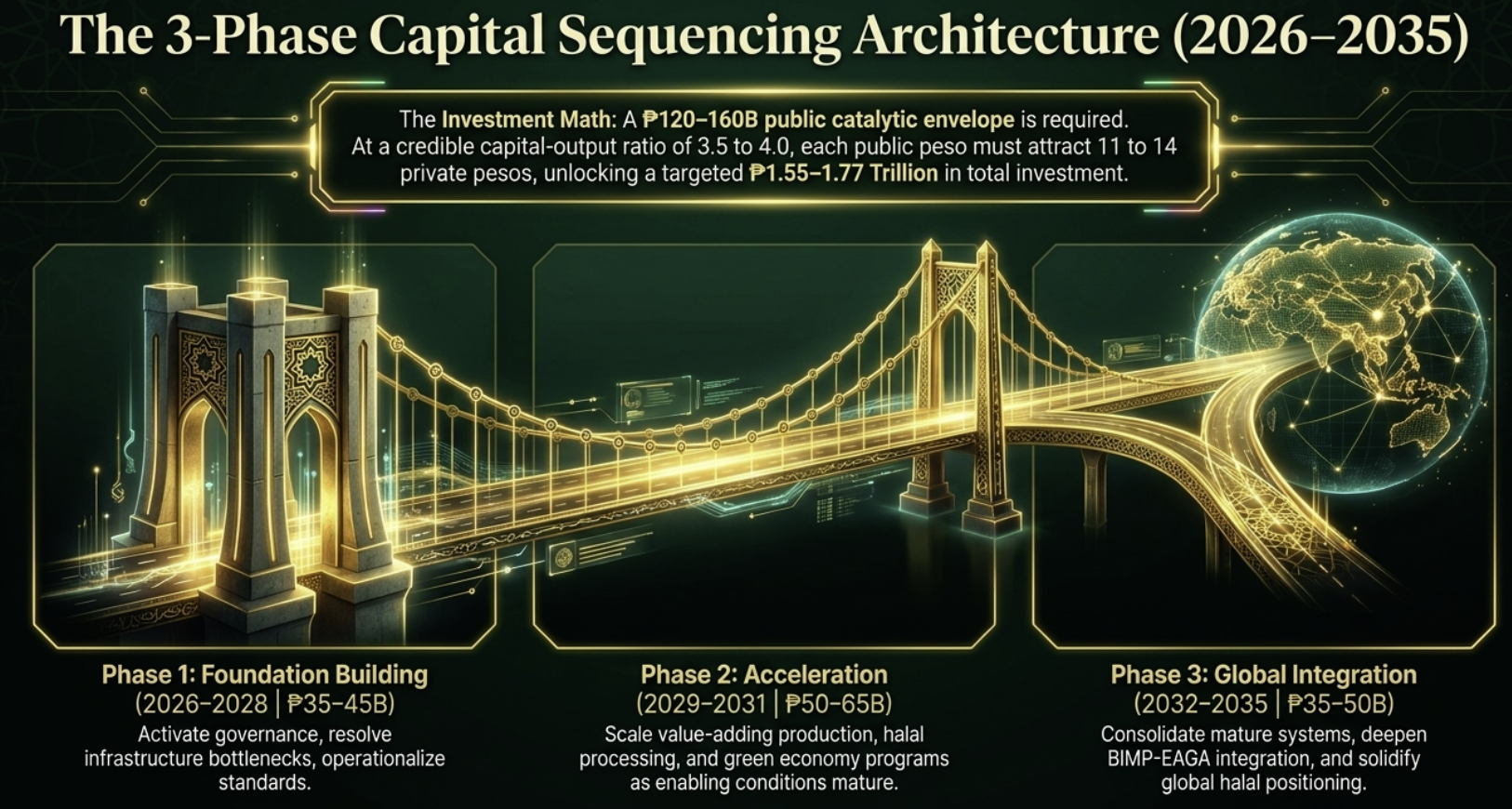
| Phase | Period | Envelope | Strategic focus | Key deliverables |
|---|---|---|---|---|
| Phase 1: Foundation Building | 2026–2028 | ₱35–45B | Governance and enablers | Enact the Forestry Code and sign JMC No. 2026-01; operationalise the halal certification authority with OIC/SMIIC-aligned processes; launch one-day digital business registration; advance the Zamboanga–Basilan interconnection; fund farm-to-market roads; establish BIF-Net and its coordination protocols |
| Phase 2: Acceleration | 2029–2031 | ₱50–65B | Transformers and green economy | Operationalise the Bangsamoro Halal Park; register REDD+ and activate payments for ecosystem services; extend Islamic banking to all provincial capitals; deploy cold-chain and logistics hubs; scale TVET–industry alignment; raise functional literacy towards 70 percent |
| Phase 3: Consolidation and Global Integration | 2032–2035 | ₱35–50B | Connectors and ecosystem maturity | Secure OIC endorsement and an SMIIC mutual recognition arrangement; reach ₱500M+ annual green revenue; deepen BIMP-EAGA integration; reach ₱550B+ GRDP and poverty below 20 percent; 90 percent household electrification (100 percent by 2040) and 85 percent broadband coverage |
C. Purpose of the Investment Roadmap Development
The BIRD 2026–2035 translates the Bangsamoro Government's investment-promotion mandate into a coherent, evidence-informed roadmap. It connects policy, investment facilitation, sector development, infrastructure, finance, market access and implementation governance, so that individual projects contribute to a functioning investment ecosystem. The roadmap is a decision and coordination framework. It does not replace project feasibility studies, statutory approvals, annual appropriations or agency mandates.
The roadmap serves five related purposes:
1. Integrated analytical framework. Provide a research-based, policy-oriented framework that combines provincial insight, global trends, workshop outputs and multi-sector analysis, kept ecosystem-based by the BEIE Framework and Strat Planner Pro.
2. Evidence-based strategic guidance. Guide policymakers, planners and investors over the decade with strategies grounded in verified PSA-BARMM data, stakeholder evidence and international benchmarks (OIC/SMIIC, ESG, PDP 2023–2028).
3. High-leverage opportunity identification. Identify the investment opportunities and interventions where a small change at the right point produces a large, system-wide effect (Meadows, 1999).
4. Measurable target architecture. Set measurable targets and monitoring mechanisms aligned with international standards, national priorities and Bangsamoro objectives, operated through the Balanced Scorecard and the MEL Dashboard.
5. Synchronised ecosystem development. Replace scattered, siloed interventions with synchronised development, using TOWS and systems archetypes so that strategies reinforce one another across clusters.
D. Guiding Principles
Six guiding principles shape analysis, strategy, implementation and learning. They work as operating rules for investment facilitation and public decision-making. Where they carry measurable indicators, targets remain subject to baseline verification and periodic calibration.
| Principle | Operational definition | Application in BIRD | KPI target (2035) |
|---|---|---|---|
| Moral Governance | Transparency, accountability and Islamic ethics as the operating system | Public disclosure; investor ombudsman; anti-corruption safeguards | 100% procurement disclosure |
| Ecosystem Thinking | Interconnected clusters, not isolated silos | BEIE Framework; inter-cluster linkage mapping | All projects cluster-tagged |
| Cultural Authenticity | Halal, Islamic finance and heritage as competitive advantages | Halal certification; Islamic finance; cultural tourism | 5,000+ halal-certified MSMEs |
| Environmental Stewardship | Green economy as opportunity, not compliance cost | Forestry Code; REDD+; PES; carbon markets | ₱500M+ green revenue |
| Inclusivity | Equitable benefit-sharing across all segments | MSME programmes; focus on IDPs, women and youth; anchor linkages | <20% poverty; 60% MSME participation |
| Data-Driven Decision-Making | Verified data and stakeholder evidence | PSA integration; workshop synthesis; KPI benchmarking | Quarterly dashboard updates |
E. Regulatory and Policy Anchors
The BIRD 2026–2035 operates within a legal and policy framework that spans three tiers: national legislation, BARMM-specific instruments, and regional and international frameworks. These anchors align the roadmap with national priorities, international standards and the region's autonomous governance structure.
E.1 National Legislation and Issuances
Bangsamoro Organic Law (Republic Act No. 11054, 2018). The BOL establishes BARMM's autonomous government and directs it to promote investment and create a favourable climate for business in the region (Article XIII, Section 24). It provides the legal basis for region-specific policies on investment facilitation, halal development and economic zones, within the Constitution and applicable national laws.
CREATE MORE Act (Republic Act No. 12066, 2024). CREATE MORE sets the national fiscal incentive framework that applies to registered enterprises in BARMM: income tax holidays, the special corporate income tax, the enhanced deductions regime, duty and VAT incentives, and the RBE local tax. Its enhanced deductions for research and development, training, power and domestic inputs directly support the Enablers and Transformers clusters.
2026 Strategic Investment Priority Plan (Memorandum Order No. 47). The SIPP defines the activities eligible for incentives nationwide. It includes area-specific priority activities for BARMM, namely halal tourism and investment operations of Islamic banks under RA 11439 (Office of the President, 2026). Widening this BARMM list is a policy objective of the roadmap (Chapter 7).
Islamic Banking Law (Republic Act No. 11439, 2019). The law provides the framework for Islamic banks and Shariah-compliant financial services. The Bangko Sentral ng Pilipinas licenses and supervises Islamic banks; the Bangsamoro Government's role is to build demand, project pipelines, Shariah-governance capacity and public-sector use of Islamic instruments.
Republic Act No. 11550 (2021). The law divided the former Maguindanao province into Maguindanao del Norte and Maguindanao del Sur, enabling province-specific investment strategies.
E.2 BARMM-Specific Legal and Policy Instruments
2nd Bangsamoro Development Plan (BDP) 2023–2028. The BDP sets medium-term development priorities and sectoral targets. It is the primary planning document that the BIRD operationalises through investment facilitation strategies (BPDA, 2023).
Bangsamoro Investment Code (draft). The draft Code, as of 22 April 2026, sets out the regional framework for investment incentives, the roles of investment promotion agencies, an investment development council and non-fiscal support (MTIT, 2026a). Its harmonisation with CREATE MORE and with BIF-Net is addressed in Chapter 7.
Proposed Executive Order on the Bangsamoro Investment Facilitation Network (BIF-Net). The proposed order establishes BIF-Net as the inter-agency investment facilitation framework and creates a Regional Green Lane for Strategic Investments, with MTIT-BoI as permanent secretariat (Office of the Chief Minister, 2026).
Bangsamoro Halal Industry Development Plan (BHIDP) 2025–2030. The BHIDP sets the strategy for the halal ecosystem, certification infrastructure and export market linkages (MTIT-BARMM, 2025). It is the primary operational plan for halal investment in the Transformers cluster.
Bangsamoro Sustainable Energy Master Plan (BSEMP). The BSEMP reports a renewable share of generation of 75.86 percent and sets the pathways for renewable development, grid connection and electrification (MENRE-BARMM, 2024). It anchors energy investments in the Foundations and Enablers clusters.
Bangsamoro Forestry Code (pending). The Code was pending before the interim Parliament's Committee on Environment, Natural Resources and Energy; its enactment now rests with the first elected Parliament. It will set the legal basis for sustainable resource use, value-added forest products and access to environmental markets, including REDD+ and payments for ecosystem services.
Draft MENRE–MILG Joint Memorandum Circular No. 2026-01. The draft circular, for signature, sets frameworks for carbon credit programmes, payments for ecosystem services and eco-tourism user fees as revenue mechanisms for local governments and communities. Its adoption is a Chapter 7 recommendation.
E.3 Regional and International Frameworks
BIMP-EAGA EGL Sub-Committee Strategic Plan 2025–2028. The Brunei Darussalam–Indonesia–Malaysia–Philippines East ASEAN Growth Area (BIMP-EAGA) Environment, Green Economy and Land Use plan provides a regional framework for green economy integration and cross-border trade (BIMP-EAGA, 2024). Tawi-Tawi's proximity to Sabah and the SGA's position on the central Mindanao corridor give BARMM natural trade advantages within the growth area.
Philippine Development Plan (PDP) 2023–2028. The PDP sets national priorities and indicators against which BARMM's contribution is aligned and monitored (NEDA, 2023).
OIC/SMIIC standards. The Standards and Metrology Institute for Islamic Countries (SMIIC) provides the main international framework for halal standards and for the accreditation of halal certification bodies, guiding BARMM's certification infrastructure and market-access strategy (SMIIC, 2021).
ASEAN Economic Community Strategic Plan 2026–2030. Adopted in May 2025 under the ASEAN Community Vision 2045, the plan succeeds the AEC Blueprint 2025 as the regional integration framework that BARMM engages through BIMP-EAGA (ASEAN, 2025).
UN Sustainable Development Goals. The SDGs inform the roadmap's inclusive growth strategies, particularly Goals 1 (no poverty), 8 (decent work and economic growth), 9 (industry, innovation and infrastructure) and 13 (climate action).
| Framework | Tier | Relevance to BIRD | Status (October 2026) |
|---|---|---|---|
| Bangsamoro Organic Law (RA 11054) | National | Autonomous governance and investment mandate | Enacted |
| CREATE MORE Act (RA 12066) | National | Fiscal incentive framework | Enacted |
| 2026 SIPP (MO No. 47) | National | Incentive-eligible activities; BARMM-specific list | In force |
| Islamic Banking Law (RA 11439) | National | Shariah-compliant finance framework | Enacted; BSP-regulated |
| Division of Maguindanao (RA 11550) | National | Province-specific planning | Enacted |
| 2nd BDP 2023–2028 | BARMM | Medium-term development priorities | Approved |
| Bangsamoro Investment Code | BARMM | Incentives and facilitation mechanisms | Draft (22 April 2026) |
| Proposed BIF-Net Executive Order | BARMM | Inter-agency facilitation; Regional Green Lane | Draft (2026) |
| BHIDP 2025–2030 | BARMM | Halal ecosystem and export strategy | Approved |
| BSEMP | BARMM | Renewable energy and electrification pathways | Approved |
| Bangsamoro Forestry Code | BARMM | Sustainable resource use and carbon markets | Pending |
| MENRE–MILG JMC No. 2026-01 | BARMM | Carbon credits, PES, eco-tourism fees | Draft; for signature |
| BIMP-EAGA EGL Plan 2025–2028 | Regional | Cross-border trade and green economy | Regional plan |
| PDP 2023–2028 | National | National development alignment | National plan |
| OIC/SMIIC standards | International | Halal standards and accreditation | International standard |
| AEC Strategic Plan 2026–2030 | Regional | ASEAN economic integration | Adopted 2025 |
| UN SDGs | Global | Inclusive and sustainable growth | Global framework |
Status reflects the documents in the BIRD evidence base. Bills not enacted by the interim Parliament should be confirmed with the Parliament Secretariat for refiling requirements.
F. Analytical Frameworks and Methodology
The BIRD 2026–2035 uses two complementary analytical frameworks, the Bangsamoro Economic and Investment Ecosystem (BEIE) Framework and the Strat Planner Pro Architecture, to provide methodological rigour, systems-level analysis and actionable outputs. This section introduces both frameworks, the five-step methodology that integrates them, and the stakeholder process that supplied much of the evidence.
F.1 The Bangsamoro Economic and Investment Ecosystem (BEIE) Framework
The BEIE Framework moves investment analysis away from isolated sectoral silos towards an integrated view of how economic clusters interact and reinforce one another. Grounded in systems-based economic theory, it organises BARMM's economy into five functional clusters, anchored by moral governance and supported by four cross-cutting enablers: tourism and culture, peace and security, human capital, and environmental sustainability (Silva, 2026a).
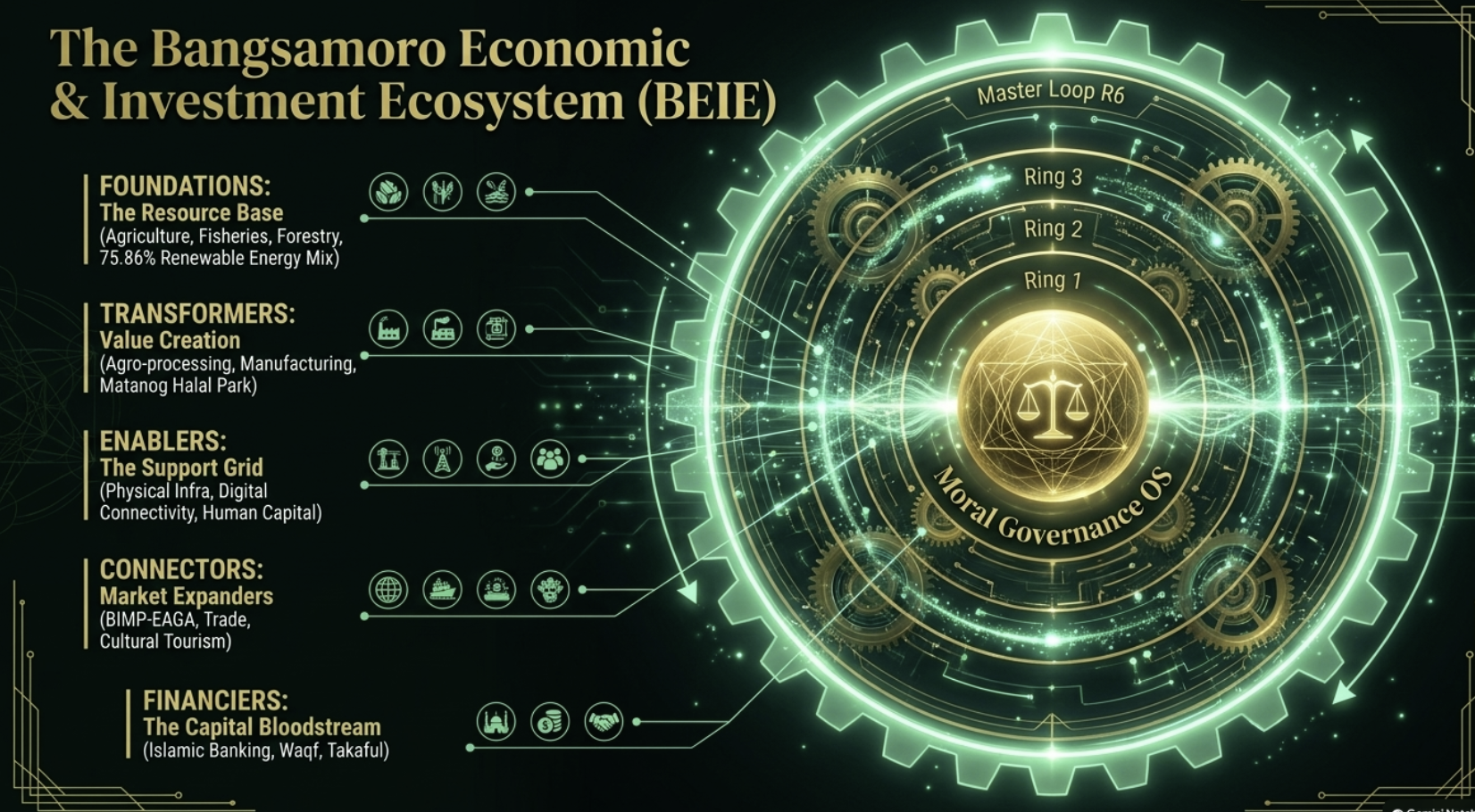
The framework's core insight, that BARMM's sectors are deeply interconnected and that treating them in isolation wastes effort and opportunity, is a governance imperative as much as an analytical finding. The five clusters are set out in Figure 1-3 and Table 1-5.
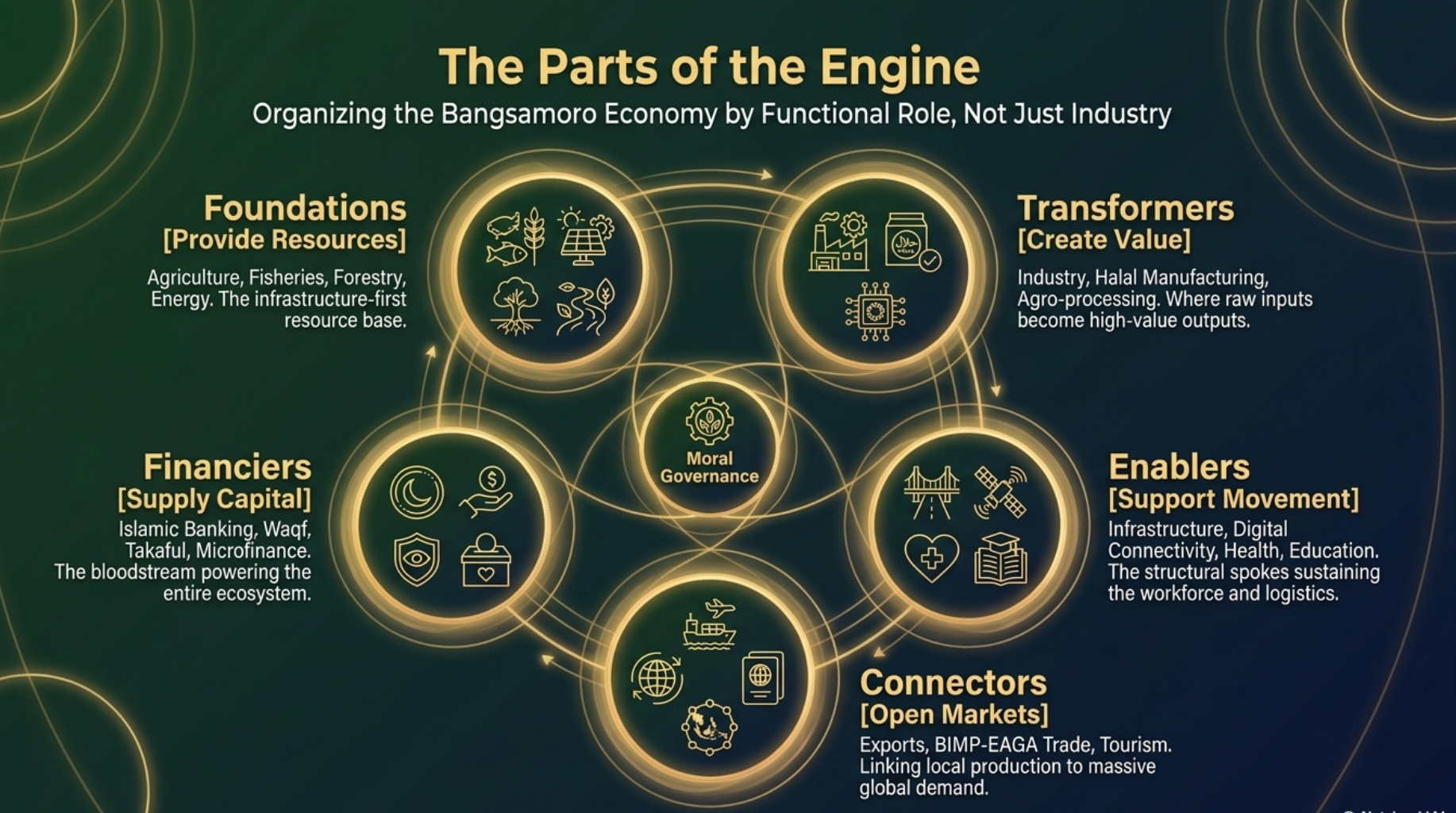
| Cluster | Key components | Key actors | Strategic function |
|---|---|---|---|
| Cross-cutting operating systems | Moral governance, resilience, inclusivity, peace | Bangsamoro Parliament, OCM, MILG, MPOS, civil society, development partners | Determine whether all clusters function effectively, equitably and sustainably |
| C1: Foundations | Agriculture, fisheries, forestry, energy, environment | MAFAR, MENRE, SPDA, LGUs, producer organisations | Resource base supplying inputs to all other clusters |
| C2: Transformers | Industry, manufacturing, logistics, halal processing | MTIT, BBOI, BEZA, halal certification authority, anchor investors | Value-adding transformation of Foundation resources |
| C3: Enablers | Infrastructure, health, education, human capital | MPW, MOTC, MBHTE, MOH, MICT | Physical, digital and human infrastructure that makes value creation viable |
| C4: Connectors | Tourism, digital connectivity, trade, BIMP-EAGA | MTIT, BEZA, MOTC, MICT, BIMP-EAGA partners | Market access and regional and global integration |
| C5: Financiers | Islamic banking, takaful, waqf, microfinance | MFBM, Al-Amanah Islamic Investment Bank, BSP (regulator), IsDB, cooperatives | Capital access aligned with Shariah principles |
F.2 The Strat Planner Pro Architecture
The Strat Planner Pro Architecture (Silva, 2026b) provides the planning and roadmapping architecture for the BIRD 2026–2035. It integrates five analytical layers, namely SWOT analysis, systems thinking and mapping, the strategy matrix, metrics and KPI benchmarking, and the Balanced Scorecard, so that diagnosis becomes measurable, time-bound implementation.
Tool 1: SWOT analysis with quantified indices. Strengths, weaknesses, opportunities and threats are identified with stakeholder attribution and variable classification, then scored with a distinct formula for each quadrant (see Chapter 2 for the full diagnostic).
• RIStrengths = (Impact × Likelihood) / 5 — scale 0.2–5, resilience capacity
• RIOpportunities = √(Impact × Likelihood) — scale 1–5, resilience through exploitation
• RiskWeaknesses = Impact × Likelihood — scale 1–25, internal risk exposure
• VIThreats = (Impact² × Likelihood) / 25 — scale 0.04–5, external vulnerability
Tool 2: Systems thinking and systems mapping. Causal loop diagrams map reinforcing and balancing feedback loops. Systems archetype analysis identifies recurring patterns such as Limits to Growth, Fixes that Fail, Shifting the Burden and Tragedy of the Commons that determine where intervention has the most leverage (Senge, 1990; see Chapter 2).
Tool 3: Strategy matrix (TOWS). The TOWS matrix matches internal strengths and weaknesses with external opportunities and threats to generate SO, WO, ST and WT strategies. Each strategic option is evaluated with a seven-criteria weighted scoring matrix (see Chapter 3).
Tool 4: Metrics benchmarking and KPI calibration. Strategic objectives are translated into KPIs with baselines, targets and data sources, benchmarked against international standards (OIC/SMIIC, ESG, SDGs), national targets (PDP 2023–2028) and Bangsamoro objectives (see Chapter 4).
Tool 5: Balanced Scorecard (BSC). The BSC translates strategy into measurable outcomes across four perspectives (Financial, Stakeholder, Internal Process, and Learning and Growth), linking capability investments to economic and inclusion outcomes. The scorecard is developed in Chapter 5; implementation, annual programming and MEL in Chapter 6; and policy and institutional recommendations in Chapter 7.
F.3 Five-Step Methodology for Strategy Formulation
The BIRD 2026–2035 applies a five-step methodology that integrates the BEIE Framework and the Strat Planner Pro Architecture. Each step builds on the previous one, so that the analysis is rigorous, stakeholder-informed and systems-aware.
| Step | Analytical activity | Core tools | Primary output | Chapter |
|---|---|---|---|---|
| 1. Context and ecosystem diagnosis | Establish the economic, institutional, demographic, environmental and spatial context; map the five BEIE clusters. | BEIE Framework; PEDSET context analysis; provincial profiles; stakeholder evidence | Context diagnosis and BEIE cluster architecture | 2 |
| 2. Quantified SWOT and systems mapping | Quantify strengths, weaknesses, opportunities and threats; test causal relationships and recurring patterns; identify leverage points. | Canonical SWOT formulas; CLDs; systems archetypes; Meadows leverage points | Cluster diagnostics, systems maps and leverage-point implications | 2 |
| 3. Strategy formulation and sequencing | Translate diagnostics into TOWS strategies, strategic options and a phased investment sequence using a documented decision aid. | TOWS; seven-criteria decision aid; BEIE dependencies; phasing logic | Strategic options, leverage architecture and roadmap sequencing | 3 |
| 4. Metrics and KPI calibration | Define indicators, baselines, targets, data owners and variance rules; separate verified baselines from analytical or stakeholder-derived assumptions. | KPI framework; benchmark alignment; calibration governance; MEL logic | Calibrated KPI architecture and monitoring rules | 4 |
| 5. Execution, implementation and policy feedback | Translate strategy into causal objectives, implementation actions, annual investment programming and policy recommendations, with feedback into planning cycles. | BSC; causal pathways; PAPs; MEL; BIF-Net coordination; policy review | Scorecard, implementation system, annual action plan and policy agenda | 5–7 |
F.4 Stakeholder Engagement and Workshop Process
The BIRD 2026–2035 was built from the ground up. It started with regional working sessions, moved through the provinces, and was then checked through a region-wide validation survey. At each stage the Strat Planner Pro Framework's participatory data-collection method guided the work. Participants did not only comment on a draft: they wrote the problem statements, opportunities, priorities and pathways that the roadmap analyses. The process ran in four stages (Figure 1-6).
20 June 2026 · Isabela CityLanao del Sur and Basilan; BEIE cluster conversations
Stage 1: Regional workshops (January–February 2026)
Two rounds of regional workshops brought together representatives of Bangsamoro ministries, offices and agencies (BMOAs), the private sector (small and medium enterprises and major businesses) and development partners. Working in sector groups, participants applied five Strat Planner Pro tools in sequence to six investment sectors: agro-industry, halal, tourism, energy and utilities, infrastructure, and services. Each tool took the previous tool's output as its input (Table 1-7).
| Workshop | Guiding question | What participants produced |
|---|---|---|
| 1. Sectoral challenges | What holds investment back in each sector, and why? | Problem statements (what, where, who), effects on the sector, root causes and supporting evidence |
| 2. Sectoral opportunities | How can each challenge become an opportunity for joint action? | Opportunity and investment areas, possible programmes, partner institutions and time horizons |
| 3. Opportunity prioritisation | Which opportunities should come first? | Opportunities placed on an impact-and-feasibility matrix (Do first, Plan and advocate, Nice to have, Park), with the top three to five presented in plenary and justified by impact and feasibility |
| 4. Industry SWOT | What are each industry's strengths, weaknesses, opportunities and threats? | A structured SWOT for each sector |
| 5. Industry strategy | What is the pathway from today's situation to the desired outcome? | A description of the current situation, three sequenced milestones and expected outcomes for each sector |
Stage 2: Mainland provincial workshop, Cotabato City (24 March 2026)
The process then moved to the provinces. On 24 March 2026, a workshop in Cotabato City brought together BMOAs, local government units (LGUs) and private-sector participants from Maguindanao del Norte, Maguindanao del Sur and the Special Geographic Area (SGA). It used the same participatory method to test the regional findings against provincial conditions.
Stage 3: Provincial workshops with BEIE cluster conversations (May–June 2026)
On 12 May 2026, a provincial workshop for Lanao del Sur was held in Marawi City. On 20 June 2026, a workshop for Basilan followed the same design. It was held in Isabela City, which lies outside BARMM, and the discussion covered the BARMM part of the province. Both sessions strengthened the method in two ways:
- discussion was organised around the clusters of the Bangsamoro Economic and Investment Ecosystem (BEIE), so participants looked at how sectors depend on one another rather than treating each in isolation;
- each workshop started from a prepared Provincial Economic and Investment Outlook, which gave participants a shared base of data and context before they began (MTIT, 2026b).
Both workshops drew a wide range of government, LGU and private-sector stakeholders.
Stage 4: Validation survey (3–20 August 2026)
The BIRD Validation Survey tested the workshop findings and the roadmap's draft logic with a wider audience. All 76 responses carry final consent under the Data Privacy Act of 2012. No responses came from Basilan or Tawi-Tawi. Basilan is covered by its June workshop, and Tawi-Tawi by secondary data until its workshop results are integrated (BIRD Validation Survey, 2026).
From participation to analysis
The planning team synthesised the workshop outputs and survey responses through the Strat Planner Pro architecture:
- quantified SWOT scoring;
- causal loop diagrams and systems archetypes;
- leverage-point analysis;
- the TOWS strategy matrix;
- the Balanced Scorecard.
The team then formulated the four strategic options and scored them against seven weighted criteria, which led to the recommended Integrated Ecosystem Development Strategy (IEDS). Findings were cross-checked against PSA-BARMM data, the provincial economic and investment outlooks, and relevant national and international benchmarks.
The roadmap therefore combines three kinds of evidence: official statistics, stakeholder evidence and systems analysis. Each is kept distinct. Where evidence is incomplete or may change, the roadmap marks the item for baseline verification, feasibility assessment or later calibration rather than presenting an assumption as fact.
Video resources
URL: https://youtu.be/UCi2dVUmSbE
Duration: about 15 minutes
Description: An overview of the BIRD 2026–2035 strategic vision, covering the BEIE Framework, the five analytical tools, the phased implementation architecture and the call to action for investors and development partners.
URL: https://youtu.be/Li7lpyWWMcE
Duration: about 12 minutes
Description: A closer look at the BEIE context-analysis method, explaining how the five functional clusters interact and how the cross-cutting operating systems determine ecosystem performance.
Continue reading
Chapter 2: Deep Presencing Within and Across Contexts
References
ASEAN. (2025). ASEAN Economic Community strategic plan 2026–2030. ASEAN Secretariat. https://asean.org/wp-content/uploads/2025/05/07.-AEC-Strategic-Plan-2026-2030_adopted.pdf
Bangsamoro Board of Investments. (2026). Investment approvals reach ₱5.1 billion in the first four months of 2026 [Press release]. Bangsamoro Government. https://bangsamoro.gov.ph
Bangsamoro Planning and Development Authority. (2023). 2nd Bangsamoro Development Plan 2023–2028. Bangsamoro Government. https://knowledge.bpda.bangsamoro.gov.ph
BIMP-EAGA. (2024). Environment, Green Economy and Land Use (EGL) Sub-Committee strategic plan 2025–2028. BIMP-EAGA Facilitation Center.
BIRD Validation Survey. (2026). Consented responses, 3–20 August 2026 (n = 76) [Data set]. BOI-MTIT and AS Strategic Insights.
Bureau of Investments–Ministry of Trade, Investments and Tourism. (2026). BIRD 2026–2035 workshop records: Regional and provincial workshops, January–June 2026 [Unpublished workshop outputs]. Bangsamoro Government.
Meadows, D. H. (1999). Leverage points: Places to intervene in a system. Sustainability Institute.
MindaNews. (2026, April 24). Mindanao average economic growth rate in 2025 above national rate. https://mindanews.com/business/2026/04/mindanao-average-economic-growth-rate-in-2025-above-national-rate/
Ministry of Environment, Natural Resources and Energy–BARMM. (2024). Bangsamoro Sustainable Energy Master Plan. MENRE-BARMM.
Ministry of Finance and Budget Management–BARMM. (2025). BARMM provincial economic trends: A provincial breakdown of growth and challenges (Economic Brief No. 1, Series of 2025). MFBM.
Ministry of Trade, Investments and Tourism–BARMM. (2025). Bangsamoro Halal Industry Development Plan 2025–2030. MTIT-BARMM.
Ministry of Trade, Investments and Tourism–BARMM. (2026a). Draft Bangsamoro Investments and Incentives Code (as of 22 April 2026). MTIT Bureau of Investments.
Ministry of Trade, Investments and Tourism–BARMM. (2026b). Provincial economic and investment outlooks: Basilan, Lanao del Sur, Maguindanao del Norte, Maguindanao del Sur and Tawi-Tawi. MTIT Bureau of Investments.
National Economic and Development Authority. (2023). Philippine Development Plan 2023–2028. NEDA.
Office of the Chief Minister–BARMM. (2026). Proposed Executive Order establishing the Bangsamoro Investment Facilitation Network (BIF-Net) and the Regional Green Lane for Strategic Investments [Draft].
Office of the President of the Philippines. (2026). Memorandum Order No. 47: Approving the 2026 Strategic Investment Priority Plan.
Philippine Information Agency. (2025, June 10). Basilan declared ASG-free; Pillar of Peace marker unveiled. https://pia.gov.ph
Philippine Statistics Authority. (2023). Preliminary 2023 first semester official poverty statistics of the Philippines. https://psa.gov.ph
Philippine Statistics Authority. (2024). 2023 full year official poverty statistics. https://psa.gov.ph
Philippine Statistics Authority–RSSO BARMM. (2025). BARMM's economy expands by 2.7 percent in 2024 (Reference No. 2025-033). https://rssobarmm.psa.gov.ph
Republic Act No. 11054. (2018). Organic Law for the Bangsamoro Autonomous Region in Muslim Mindanao. Congress of the Philippines.
Republic Act No. 11439. (2019). An Act Providing for the Regulation and Organization of Islamic Banks. Congress of the Philippines.
Republic Act No. 11550. (2021). An Act Dividing the Province of Maguindanao into Two Provinces, Namely: Maguindanao del Norte and Maguindanao del Sur. Congress of the Philippines.
Republic Act No. 12066. (2024). Corporate Recovery and Tax Incentives for Enterprises to Maximize Opportunities for Reinvigorating the Economy (CREATE MORE) Act. Congress of the Philippines.
Senge, P. M. (1990). The fifth discipline: The art and practice of the learning organization. Doubleday.
Silva, A. M. (2026a). Bangsamoro Investment Roadmap Development (BIRD) 2026–2035: Analytical architecture and strategic planning materials. AS Strategic Insights.
Silva, A. M. (2026b). Strat Planner Pro user manual. AS Strategic Insights. https://asilvainnovations.github.io/strat-planner-pwa/user-manual.html
Standards and Metrology Institute for Islamic Countries. (2021). Strategic plan 2021–2030. Organisation of Islamic Cooperation.
Supreme Court of the Philippines. (2024, September 9). Province of Sulu v. Medialdea, G.R. No. 242255.