Recent Growth Trends and Investment Performance
If you zoom out and look at the economic trajectory of BARMM, one thing becomes clear—it's a region in transition. Not quite a sleeping giant anymore, but not yet a fully awakened economic powerhouse either. According to the Philippine Statistics Authority, BARMM's economy grew by 2.7% in 2024, with services taking the lead at 42% of total economic output, followed by agriculture and industry. That mix alone tells a story: while traditional sectors still matter, services and emerging industries are beginning to reshape the economic fabric.
Now here's where it gets interesting. Investment momentum is quietly accelerating. In just the first quarter of 2025, BARMM secured ₱3.2 billion in investments, already surpassing its full-year target. By late 2025, total investments had climbed to around ₱5 billion, generating over 2,000 jobs. These aren't just numbers—they're signals. Signals that confidence is growing, that capital is starting to trust the region's direction, and that something foundational is shifting.
⚠️ The Challenge Ahead
But here's the catch: much of this investment is still clustered in familiar sectors like agriculture and basic services. Without a more integrated framework, these gains risk becoming fragmented. Growth without structure can feel like building a house without a blueprint—impressive at first glance, but unstable over time.
Structural Challenges and Opportunities
BARMM's economic DNA is unique. It's rich in natural resources, strategically located near major Southeast Asian markets, and culturally positioned to tap into the global halal economy. Yet, it also faces structural constraints—limited infrastructure, uneven human capital development, and historical underinvestment.
Agriculture, for instance, still accounts for a large share of employment but experienced contraction in recent years. That's not necessarily a failure—it's a signal that the sector needs transformation, not abandonment. Meanwhile, infrastructure gaps continue to limit logistics efficiency, which in turn affects export competitiveness.
The opportunity lies in reframing these challenges as interconnected systems rather than isolated problems. Instead of asking, "How do we fix agriculture?" the better question is: "How does agriculture connect to industry, logistics, finance, and global markets?" That shift in thinking is where real transformation begins.
Why a Systems-Based Reframing is Needed
Limitations of Traditional Sectoral Categorization
Traditional investment lists—like agriculture, tourism, infrastructure—tend to treat sectors as standalone silos. It's neat, organized, and honestly… misleading. Because in reality, no sector operates in isolation. Agriculture depends on logistics. Tourism relies on infrastructure. Industry needs energy and skilled labor.
When sectors are planned in isolation, you get mismatches. You build farms without processing facilities. You develop tourism sites without transport access. You invest in exports without strengthening supply chains. It's like assembling puzzle pieces without checking if they actually fit together.
The Case for Interdependence and Integration
Think of BARMM's economy as an ecosystem rather than a checklist. In an ecosystem, every component feeds into another. Remove one, and the entire system feels the impact.
For example:
- Agriculture feeds raw materials into industry.
- Industry creates products that logistics distributes.
- Logistics enables exports.
- Exports generate income that flows back into communities.
This circular dynamic is already happening—but often inefficiently. A systems-based framework doesn't create new sectors; it simply organizes them in a way that maximizes synergy.
Moral Governance as the Core Operating System
Embedding Values into Economic Planning
Here's where BARMM diverges from typical development models. At the heart of its investment strategy is moral governance—not as a slogan, but as a guiding principle. This isn't just about ethics; it's about trust. And trust, in economic terms, is currency.
Investors don't just look at returns—they look at stability, transparency, and predictability. When governance is rooted in accountability and inclusivity, it reduces risk. And when risk goes down, investment goes up. Simple, but powerful.
Transparency, Inclusivity, and Sustainability
Moral governance acts like an operating system—it runs quietly in the background but determines how everything functions. It ensures that:
- Investments are inclusive, not extractive.
- Growth is sustainable, not short-term.
- Policies are transparent, not arbitrary.
In a region with a complex history, this approach isn't optional—it's essential.
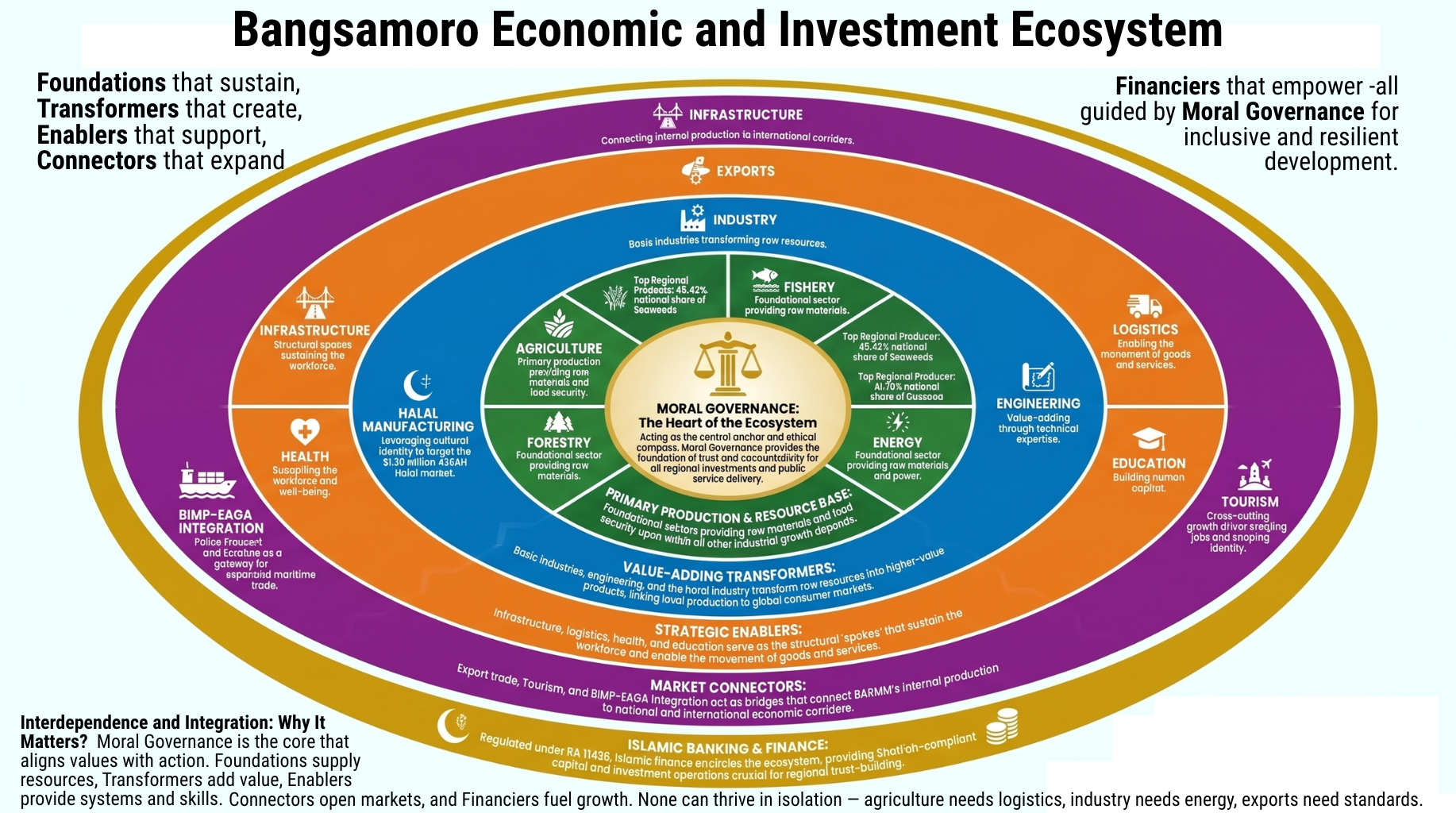
The New Ecosystem-Based Sector Framework
Foundations – The Resource Base
Agriculture, Fishery, Forestry, and Energy
These sectors are the backbone of BARMM's economy. They provide food, raw materials, and energy—the essentials that everything else depends on. Recent investments in bamboo, abaca, and halal livestock production highlight the region's natural comparative advantage.
But being resource-rich isn't enough. Without value addition, raw materials remain low-value exports.
Transformers – Engines of Value Creation
Industrial Development and Engineering
This is where the magic happens—where raw inputs become high-value outputs. Industrial facilities, engineering services, and manufacturing hubs transform agricultural products into export-ready goods.
The halal industry is BARMM's wildcard—and potentially its strongest competitive advantage.
Enablers – Building the Support Systems
Infrastructure, Logistics, and Connectivity
No matter how strong your production is, if you can't move goods efficiently, you're stuck. Infrastructure and logistics are the invisible engines of economic growth.
Projects like the Polloc Freeport aim to transform BARMM into a regional trade gateway, particularly within the BIMP-EAGA corridor.
Connectors – Linking to Global Markets
Export Activities, Trade Services, BIMP-EAGA
Exports are where local value meets global demand. BARMM's integration into the BIMP-EAGA network opens doors to regional trade and investment.
Think of it as BARMM plugging into a larger economic grid.
Financiers – Powering Investment Flows
Islamic Banking and Ethical Finance
Finance is the bloodstream of any economy. In BARMM, Islamic banking offers a unique advantage—aligning financial systems with cultural and religious values.
This isn't just about compliance—it's about inclusion. When financial systems resonate with local communities, participation increases.
Cross-Cutting Drivers
Tourism, Culture, Peace, Security
Tourism in BARMM isn't just about beaches or landscapes—it's about identity. Cultural heritage, Islamic traditions, and historical narratives create a distinct tourism offering.
Without peace and security, investment stalls. Without environmental protection, growth becomes unsustainable.
Interdependence Across the Ecosystem
Here's the big picture: every cluster feeds into another. This isn't linear—it's circular.
| Cluster | Role | Dependency |
|---|---|---|
| Foundations | Provide resources | Depend on environment |
| Transformers | Add value | Depend on foundations |
| Enablers | Support systems | Depend on governance |
| Connectors | Market access | Depend on all sectors |
| Financiers | Provide capital | Depend on trust |
Every cluster feeds into another. This isn't linear—it's circular.
Strategic Implications for Investors and Policymakers
💼 For Investors
Don't look at sectors in isolation—look at ecosystems. The real opportunities lie at the intersections—where agriculture meets logistics, where halal meets exports, where finance meets infrastructure.
📋 For Policymakers
The challenge is coordination. It's not about launching more programs—it's about aligning existing ones into a coherent system.
Conclusion
Reimagining BARMM's priority investment sectors isn't about rewriting a list—it's about redesigning how the economy functions. By organizing sectors into foundations, transformers, enablers, connectors, and financiers, and anchoring everything in moral governance, BARMM can move from fragmented growth to integrated development.
It's the difference between scattered progress and a synchronized ecosystem. And in a region with as much potential as BARMM, that difference is everything.
Frequently Asked Questions
Why is a systems-based approach important for BARMM?
Because sectors in BARMM are deeply interconnected, and treating them as isolated leads to inefficiencies and missed opportunities.
What makes the halal industry strategic for BARMM?
It connects local production to a rapidly growing global Muslim market, offering both economic and cultural advantages.
How does Islamic finance support development?
It provides culturally aligned financial systems that increase trust, participation, and investment.
What role does BIMP-EAGA play in BARMM's growth?
It integrates BARMM into regional trade networks, enhancing connectivity and investment opportunities.
What is the biggest challenge in implementing this framework?
Coordination across sectors and ensuring governance systems effectively align all components.