The Emerging Bangsamoro: A Hub for Resilient and Ethical Growth
Bangsamoro Investment Roadmap Development (BIRD) 2026–2035
© 2026 Bureau of Investments, Ministry of Trade, Investments and Tourism (MTIT), BARMM. All rights reserved, subject to the permissions stated below.
This publication is a strategic planning and investment-coordination document prepared to inform institutional review, investment programming and public discussion. Unless a separate licence is formally authorised by the publisher, no part may be reproduced for commercial distribution without prior written permission. Quotation and non-commercial use for research, education and public policy discussion are permitted where lawful, provided that the source is acknowledged and the meaning is not misrepresented. Any official adoption, budget allocation, investment approval or regulatory effect remains subject to the competent authority and applicable law.
Suggested citation
Silva, A. M. (2026). The Emerging Bangsamoro: A Hub for Resilient and Ethical Growth. Bangsamoro Investment Roadmap Development 2026–2035. Bureau of Investments, Ministry of Trade, Investments and Tourism, BARMM.
ISBN: not assigned. Publication status: strategic planning report for institutional review and validation. Figures marked as proposed, indicative or provisional are not approved appropriations, confirmed investments or adopted government targets.
Acknowledgements
The Bangsamoro Investment Roadmap Development (BIRD) 2026–2035 has been shaped by analytical work, institutional knowledge, technical exchange and the perspectives of people and organisations working across the Bangsamoro economy. The roadmap is offered as a shared planning resource: its value depends on the continued stewardship, validation and implementation of the institutions and communities it is intended to serve.
Appreciation is extended to the leadership of the Bangsamoro Autonomous Region in Muslim Mindanao (BARMM) and the Ministry of Trade, Investments and Tourism (MTIT) for providing the institutional setting for investment strategy and coordination. Particular recognition is due to the Bureau of Investments team for its investment-facilitation mandate, working knowledge of the investor environment and continued engagement with the roadmap’s strategic and operational questions.
The work also acknowledges the contributions of officials, technical personnel and practitioners across BARMM ministries, offices and agencies; provincial, city and municipal local government executives and teams; national government agencies; statistical and planning institutions; chambers of commerce, business associations, investors and entrepreneurs; MSMEs and producer organisations; development agencies and financing partners; universities, researchers and training institutions; civil society organisations; and community representatives. Their respective perspectives help connect regional ambition with the practical realities of service delivery, enterprise development, infrastructure, finance, market access, environmental stewardship and inclusive growth.
Gratitude is extended to participants in the structured workshops and consultations convened at regional, provincial, local and sectoral levels. Their discussions and critical reflections have helped test assumptions, surface implementation barriers and highlight the interdependencies that a systems-led roadmap must address. The contribution of the BIRD Validation Survey participants is also acknowledged. The survey provides diagnostic and validation evidence; it is not treated as a population-representative vote or a replacement for authoritative administrative and statistical baselines.
Engr. Addie T. Unsi is recognised for contributing as a facilitator and technical contributor to the roadmap process, helping structure dialogue and support the integration of stakeholder perspectives. The report’s preparation and systems architecture were led by Alvin M. Silva, MDM, consultant and systems architect. These acknowledgements recognise meaningful participation without implying that every individual or institution endorses each finding, target or recommendation.
The roadmap is strongest when regional leadership, local knowledge, responsible investment and community aspirations are brought together through transparent decisions, shared learning and sustained implementation.
Messages
Messages


Messages

Table of Contents
Preliminary pages and executive summary
Select any preliminary page, executive-summary section or chapter heading to navigate directly. Chapter subheadings link to their corresponding anchor in the published chapter files.
Executive Summary sections
Chapters
Table of Contents
List of Abbreviations
| Abbreviation | Full term |
|---|---|
| ADB | Asian Development Bank |
| ASEAN | Association of Southeast Asian Nations |
| BARMM | Bangsamoro Autonomous Region in Muslim Mindanao |
| BEGMP | Bangsamoro e-Governance Master Plan |
| BEIE | Bangsamoro Economic and Investment Ecosystem |
| BEZA | Bangsamoro Economic Zone Authority |
| BHB | Bangsamoro Halal Board |
| BHIDP | Bangsamoro Halal Industry Development Plan |
| BIF-Net | Bangsamoro Investment Facilitation Network |
| BIMP-EAGA | Brunei Darussalam–Indonesia–Malaysia–Philippines East ASEAN Growth Area |
| BIRD | Bangsamoro Investment Roadmap Development |
| BMOA | Bangsamoro ministries, offices and agencies |
| BMSMED | Bangsamoro MSME Development Plan |
| BOI / MTIT | Bureau of Investments, within the Ministry of Trade, Investments and Tourism (MTIT), BARMM |
| BPDA | Bangsamoro Planning and Development Authority |
| BPLS | Business Permits and Licensing System |
| BSC | Balanced Scorecard |
| BSEMP | Bangsamoro Sustainable Energy Master Plan |
| BSP | Bangko Sentral ng Pilipinas |
| BTDP | Bangsamoro Tourism Development Plan |
| CARD | Center for Agriculture and Rural Development (CARD Islamic Bank) |
| CLP / LP | Critical Leverage Point (LP1 to LP5) |
| CMO / OCM | Office of the Chief Minister |
| CREATE MORE | Corporate Recovery and Tax Incentives for Enterprises to Maximize Opportunities for Reinvigorating the Economy Act (RA 12066) |
| DICT | Department of Information and Communications Technology |
| DOE | Department of Energy |
| DPWH | Department of Public Works and Highways |
List of Abbreviations
| Abbreviation | Full term |
|---|---|
| DRR | Disaster risk reduction |
| ESG | Environmental, social and governance |
| F1–F6 | Financial perspective objectives |
| FDI | Foreign direct investment |
| FLEMMS | Functional Literacy, Education and Mass Media Survey |
| GCC | Gulf Cooperation Council |
| GEMS | Green Economy Monetization Strategy |
| GRDP | Gross regional domestic product |
| HEDS | Halal Economy Dominance Strategy |
| IEDS | Integrated Ecosystem Development Strategy |
| IFES | Infrastructure-First Enabling Strategy |
| IPs | Indigenous Peoples |
| IsDB | Islamic Development Bank |
| JMC | Joint Memorandum Circular |
| KPI | Key performance indicator |
| L1–L7 | Learning and Growth perspective objectives |
| LGU | Local government unit |
| MAFAR | Ministry of Agriculture, Fisheries and Agrarian Reform |
| MBHTE | Ministry of Basic, Higher and Technical Education |
| MEL | Monitoring, evaluation and learning |
| MENRE | Ministry of Environment, Natural Resources and Energy |
| MFBM | Ministry of Finance and Budget Management |
| MICT | Ministry of Information and Communications Technology |
| MILG | Ministry of the Interior and Local Government |
| MOLE | Ministry of Labor and Employment |
| MPW | Ministry of Public Works |
| MRA | Mutual recognition agreement |
| MSME | Micro, small and medium enterprise |
List of Abbreviations
| Abbreviation | Full term |
|---|---|
| MTIT | Ministry of Trade, Investments and Tourism |
| MYIP | Multi-year investment plan |
| NEDA | National Economic and Development Authority (reorganised in 2025 as the Department of Economy, Planning, and Development) |
| NGO | Non-governmental organisation |
| ODA | Official development assistance |
| OIC | Organisation of Islamic Cooperation |
| P1–P7 | Internal Process perspective objectives |
| PAP | Programme, activity and project |
| PDP | Philippine Development Plan |
| PES | Payment for ecosystem services |
| PIFO | Provincial Investment Facilitation Office |
| PPP | Public–private partnership |
| PSA | Philippine Statistics Authority |
| QA | Quality assurance |
| REDD+ | Reducing Emissions from Deforestation and Forest Degradation |
| S1–S7 | Stakeholder perspective objectives |
| SDG | Sustainable Development Goal |
| SGA | Special Geographic Area |
| SIPP | Strategic Investment Priority Plan |
| SMIIC | Standards and Metrology Institute for the Islamic Countries |
| SPDA | Southern Philippines Development Authority |
| TESDA | Technical Education and Skills Development Authority |
| TOWS | Threats, opportunities, weaknesses and strengths matrix |
| TVET | Technical and vocational education and training |
| UAE | United Arab Emirates |
| ZBIP | Zamboanga–Basilan Interconnection Project |
Glossary of Terms
Glossary of Terms
Executive Summary
From investment potential to shared prosperity
The Bangsamoro Investment Roadmap Development (BIRD) 2026–2035 sets out a coordinated strategy to help BARMM turn its human, cultural, natural and geographic strengths into productive investment, decent work and resilient communities. It matters now because the region must convert the gains of peace and autonomy into durable economic opportunity while addressing poverty, weak connectivity, infrastructure gaps, limited market access and fragmented investment-enabling systems.
BARMM is uniquely positioned to build value across halal products and services, agro-industrial production, the green economy, tourism, trade and Islamic finance. Its location within the Brunei Darussalam–Indonesia–Malaysia–Philippines East ASEAN Growth Area (BIMP-EAGA) provides a platform for wider regional connections—provided that logistics, skills, standards, finance and institutions develop together. BIRD therefore recommends an ecosystem approach rather than isolated sector initiatives.
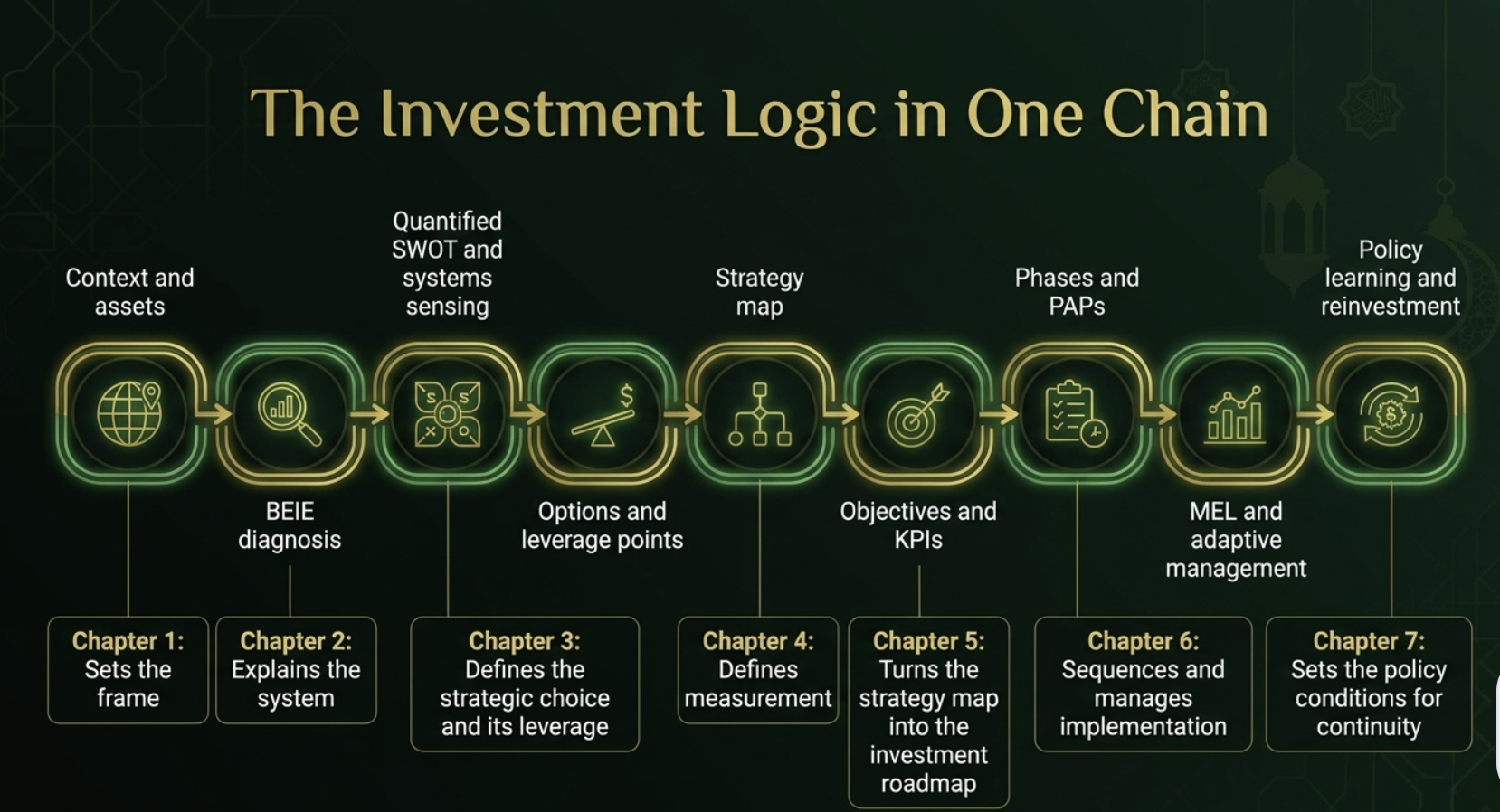
The roadmap is a strategic and coordination framework, not an approved budget or a guarantee of results. It links the diagnosis in Chapter 2, the Integrated Ecosystem Development Strategy (IEDS) selected in Chapter 3, the calibrated measures in Chapter 4, the Balanced Scorecard (BSC) in Chapter 5, implementation in Chapter 6 and policy recommendations in Chapter 7. Its promise depends on accountable leadership, responsible investment, community participation and transparent, evidence-led execution.
At a glance
| Decision area | What the report establishes | What leaders and institutions need to do |
|---|---|---|
| Strategy | IEDS provides the strongest integrated response to the system-wide constraints. | Align sector, infrastructure, finance, market-access and governance actions to common priorities. |
| Performance | Four BSC perspectives and a calibrated KPI architecture connect capability, process, stakeholder value and economic results. | Assign KPI owners; validate baselines, targets, methods and data sources. |
| Investment | ₱120–160 billion in public catalytic capital is an indicative planning envelope. | Confirm fiscal space, financing sources, safeguards, feasibility and approvals project by project. |
| Delivery | Three phases sequence enabling conditions, scale-up and consolidation. | Gate later-phase investment on readiness, evidence of demand and performance reviews. |
| Governance | BIF-Net is proposed as a coordination and facilitation network, not a replacement for statutory mandates. | Harmonise the legal and institutional model and publish clear decision rights. |
The Development Challenge
Opportunities and constraints must be addressed together
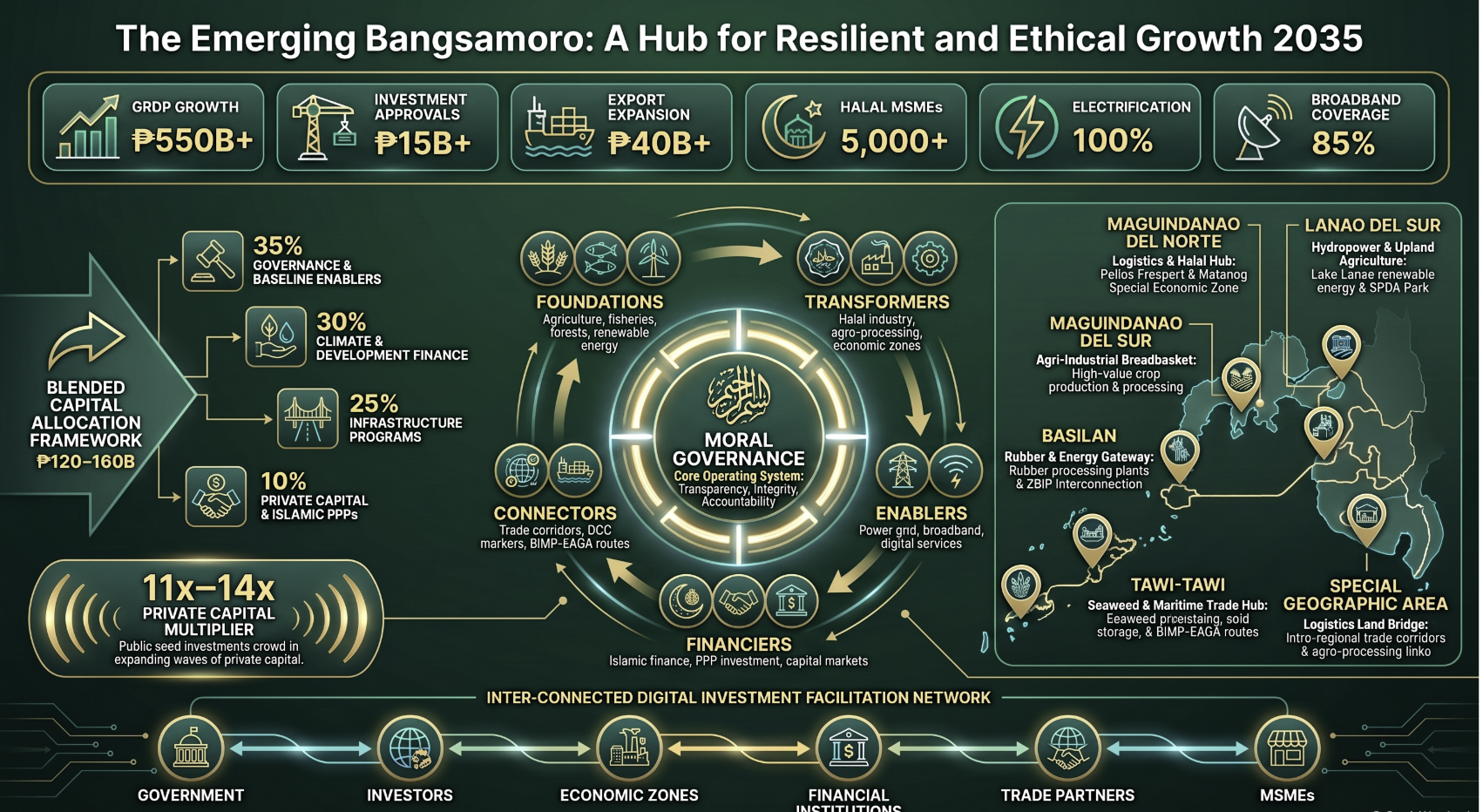
Chapter 2 frames BARMM’s investment economy as five connected clusters: Foundations, Transformers, Enablers, Connectors and Financiers. The system has real assets—young people, agriculture and fisheries, halal enterprise potential, renewable and natural resources, tourism and strategic regional location—but benefits are constrained when infrastructure, standards, market access, finance, skills and public-sector coordination do not develop in step.
Connect regional strengths to investable, inclusive growth
People and enterprise
Opportunity: a youthful population, entrepreneurs, MSMEs and producer communities can deepen local value chains.
Risk: skills, productivity, access to finance and decent-work pathways may not keep pace with labour-force growth.
Halal economy
Opportunity: build trusted halal value chains, services, certification and market access rooted in Bangsamoro identity and enterprise.
Risk: fragmented standards, limited conformity-assessment capacity and weak traceability could constrain market recognition.
Location and connectivity
Opportunity: deepen trade, logistics, tourism and business links through BIMP-EAGA and wider regional corridors.
Risk: ports, roads, inter-island links, energy reliability and digital connectivity raise costs and limit dependable access.
Natural assets and green value
Opportunity: raise value in agriculture, fisheries, forestry, renewable energy and eligible ecosystem services.
Risk: climate hazards, ecosystem degradation, weak project preparation and uncertain revenue pathways threaten returns.
Investment climate
Opportunity: clearer facilitation, aftercare, investment intelligence and ethical governance can improve confidence.
Risk: fragmented responsibilities, administrative barriers, uncertain readiness and limited coordination slow conversion from interest to operating investment.
Poverty and inclusion
Opportunity: value-chain investment can expand jobs, household income and market participation across provinces and communities.
Risk: poverty, market-access limitations and territorial disparities can prevent growth from becoming broad-based.
What the diagnostics imply
Chapter 2’s systems diagnostics caution against treating each constraint in isolation. Enablers—including infrastructure, energy, digital systems, skills and service delivery—are critical because they influence the performance of the other clusters. The report’s survey analysis found institutional readiness to be the lowest of three assessed dimensions in each of the six survey clusters. This is diagnostic survey evidence, not a substitute for formal agency capacity assessments.
Evidence basis: Chapter 2 diagnostics and the BIRD Validation Survey (3–20 August 2026; 76 consented responses). Survey results should be read in light of the sample’s composition and geographic coverage; they are not population-representative estimates.
Strategic Options
Four choices were assessed; an integrated approach ranked first
Chapter 3 assessed four strategic options. Each offers a useful emphasis, but the decision was which approach could address the connected constraints of BARMM’s investment ecosystem rather than improve one sector while leaving binding dependencies unresolved.
| Rank | Option | Analytical score | Strategic contribution | Main limitation if used alone |
|---|---|---|---|---|
| 1 | IEDS Integrated Ecosystem Development Strategy | 8.83 / 10 | Synchronises production, infrastructure, finance, standards, market access, governance and institutional capability. | Requires strong coordination, sequencing and performance discipline. |
| 2 | HEDS Halal Economy Dominance Strategy | 7.53 / 10 | Builds distinctive halal value chains, standards, certification and market positioning. | Needs wider enabling infrastructure, finance, skills and market systems. |
| 3 | IFES Infrastructure-First Enabling Strategy | 7.46 / 10 | Addresses connectivity, energy and core enabling infrastructure. | Infrastructure alone does not guarantee productive use, enterprise growth or market demand. |
| 4 | GEMS Green Economy Monetisation Strategy | 7.16 / 10 | Develops eligible green-economy and ecosystem-service revenue opportunities. | Depends on legal, technical, environmental, financing and buyer/registry conditions. |
Scores reproduce the analytical comparison in the BIRD planning materials. They are decision-support assessments, not measured economic outcomes. HEDS, IFES and GEMS remain strategic engines within the integrated approach.
Why IEDS was selected
Critical leverage points
- Halal certification integrity: build credible standards, conformity assessment and traceability.
- Infrastructure, energy and connectivity: reduce the costs and uncertainty that constrain productive activity.
- Governance and investor confidence: clarify decision rights, publish service standards and improve aftercare.
- Islamic finance ecosystem: connect Shariah-compliant financing and risk-sharing to viable enterprise and investment needs.
- Green-economy revenue: pursue lawful and technically credible mechanisms with environmental safeguards and fair benefit-sharing.
BSC: Strategy and Investment Roadmap
The Balanced Scorecard translates IEDS into linked objectives, measures, initiatives and review routines. The causal logic runs from Learning and Growth to Internal Process, then to Stakeholder outcomes and Financial results. The four perspectives are interdependent; weights shown in Chapter 5 are proposed management weights and do not replace the definitions and validation rules in Chapter 4.
| Perspective | Strategic objective | Strategic measure / KPI | 2035 ambition in the report |
|---|---|---|---|
| Financial (30%) | Increase investment; grow the regional economy; expand exports; activate green revenue; mobilise Islamic finance | Annual investment approvals; GRDP; exports; verified green-economy revenue; Islamic banking assets | ₱15B+ annual approvals; ₱550B+ GRDP; ₱40B+ exports; ₱500M annual green revenue; ₱20B+ Islamic banking assets |
| Stakeholder (25%) | Strengthen investor experience; empower MSMEs; reduce poverty; widen access and quality employment | Investor satisfaction; valid halal certificates; poverty incidence; jobs from investment-approved firms; financial inclusion | 8.0+/10 satisfaction; 5,000+ halal-certified MSMEs; poverty below 20%; 20,000+ jobs as a roadmap-level aspiration |
| Internal Process (25%) | Streamline facilitation; strengthen certification; improve infrastructure delivery; coordinate investment readiness | Business registration time; verified certification/recognition milestones; budget execution; PAP readiness and delivery | Digital, one-day registration ambition; recognised standards pathway; budget execution above 90%; project-specific readiness gates |
| Learning and Growth (20%) | Build sector expertise; strengthen staff capability; foster digital services and institutional learning | Trained/certified staff; digital services deployed; data quality and review-cycle compliance | 100+ halal certification officers; 80% of relevant staff trained or certified; 20+ digital services, all subject to target and baseline verification |
From objectives to portfolio execution
Each strategic measure should connect to an identifiable programme, activity or project (PAP), with a responsible owner, dependencies, financing status, safeguards, timetable and verifiable milestones. The scorecard is a management tool: it supports decisions and learning but does not prove causal effects merely because indicators move together.
The BIRD Growth Strategy
The growth strategy connects the BEIE clusters and five strategic growth engines through a common investment logic: build enabling conditions, strengthen productive value chains, connect firms to finance and markets, and govern delivery through evidence and accountability. The engines reinforce one another; they are not competing standalone strategies.
The 2035 Vision and Implementation Roadmap
The 2035 vision: prosperity that is productive, inclusive and resilient
These figures are strategic ambitions in the current report, not independently verified forecasts or adopted statutory targets. Chapter 4’s calibrated headline indicators additionally include 5,000+ halal-certified MSMEs, a household electrification ambition of 90% by 2035 and broadband connectivity of 85%, with indicator definitions and baselines subject to source-owner verification. Renewable-energy share, access to electricity and investment approvals are different measures and must not be conflated.
Three-phase implementation roadmap
Purpose: remove binding constraints and establish credible delivery conditions.
Priorities: institutional and legal coordination; verified baselines; project preparation; investor service and aftercare; halal standards readiness; priority energy, transport and digital dependencies; capability and safeguards.
Expected outcome: a validated PAP pipeline, clear ownership, reliable reporting and projects that meet documented readiness gates.
Purpose: scale investment only when enabling conditions, demand and project viability are verified.
Priorities: agro-industrial processing, halal value chains, cold chain and logistics, green-economy pilots that meet requirements, Islamic finance, export readiness and market links.
Expected outcome: more productive enterprises, better market access and measurable value addition from projects that demonstrate performance.
Purpose: deepen proven capability and embed institutional continuity.
Priorities: higher-value exports, reliable cross-border market links, institutionalised facilitation, sound green revenue pathways, financial inclusion and independent outcome review.
Expected outcome: stronger economic resilience, a more competitive investment ecosystem and a successor agenda shaped by evaluation findings.
Investment Requirements and Monitoring, Evaluation and Learning
Investment requirements: catalyse, do not overstate
The report’s ₱120–160 billion public catalytic envelope is indicative and phased at ₱35–45 billion, ₱50–65 billion and ₱35–50 billion. The wider ₱1.55–1.77 trillion requirement is derived from an assumed capital-output ratio and the report’s growth path; it is not a list of committed projects, a forecast with guaranteed returns or an approved financing package. The report’s indicative financing scenario allocates potential sources across BARMM public resources, national programmes, development and climate finance, and private, PPP and Islamic finance. Shares must only be reported as financing secured when supported by appropriations, signed agreements or documented commitments.
| Pathway | Potential contribution | Required control before counting |
|---|---|---|
| Public sector | Foundational infrastructure, institutional capability, project preparation and public goods. | Approved appropriations, fiscal-space assessment, procurement and implementation authority. |
| Private sector | Productive assets, processing, logistics, services, tourism and enterprise investment. | Documented investor commitments, feasibility, market demand and safeguards; separate approvals from realised capital. |
| Development financing | Technical assistance, concessional finance, climate and resilience funding where eligible. | Formal programme eligibility, signed financing instruments, agreed co-financing and reporting arrangements. |
| Public–private partnerships (PPPs) | Risk allocation and delivery for eligible infrastructure and service investments. | Legal authority, value-for-money and fiscal-risk assessment, procurement and contract approval. |
| Islamic finance | Shariah-compliant financing and risk-sharing for eligible enterprises and investments. | Regulatory compliance, licensed providers, commercial viability and transparent risk allocation. |
Monitoring, evaluation and learning (MEL)
MEL links strategy to implementation and institutional learning. It should report not only money spent and activities completed, but also whether the programme is removing constraints, changing service quality, increasing productive capacity and delivering outcomes. The BSC gives decision-makers a causal structure; Chapter 4 defines indicators and calibration; Chapter 6 specifies reviews and controls; Chapter 7 addresses policy and institutional continuity.
| Step | Management question | Evidence and response |
|---|---|---|
| Measure | What has changed against the approved baseline and target? | Verified KPI and PAP records, provenance, date, territory and definition. |
| Learn | What explains the change or variance? | Root-cause analysis of delivery, finance, dependency, data quality and external shocks. |
| Adapt | Which response is justified and by whom? | Options appraisal, impact on other perspectives, legal authority and stakeholder considerations. |
| Improve | Was the corrective action implemented and effective? | Named owner, due date, decision log and follow-up verification. |
| Scale | Is the intervention effective, affordable, lawful and replicable? | Evidence of outcomes, costs, safeguards and readiness before scale-up decisions. |
Illustrative review cadence in Chapter 6: monthly operational pipeline review where data allow; quarterly KPI and delivery review; twice-yearly cross-cluster and territorial review; annual performance and investment programming; a 2030 mid-term review; and a 2035 terminal evaluation.
Why This Matters
What success should look like in 2035
Success is not a single headline number. It is a Bangsamoro investment ecosystem in which enterprises can grow, public institutions can deliver, communities participate in the gains of development, and the economy becomes more diversified and resilient.
The decisions that matter now
- Confirm institutional ownership. Agree decision rights, coordination arrangements and roles for MTIT–Bureau of Investments, participating agencies and local government partners.
- Validate the evidence base. Reconcile territorial and price bases; confirm baselines, definitions, source owners and target approval status.
- Prepare bankable investments. Prioritise feasibility, demand, finance, safeguards, resilience, local value creation and implementation capacity.
- Sequence public catalytic support. Make later releases contingent on readiness and verified performance, with transparent records of funding status.
- Review and learn publicly. Publish progress, limitations, corrective action and evaluation findings to sustain trust and improve the next decisions.
The ambition for 2035 is a Bangsamoro where ethical leadership, responsible investment and local ingenuity reinforce one another—where growth is not only larger, but more inclusive, more resilient and more widely shared.
Read the full report
Continue with Chapter 1, then Chapters 2–7 for the full analytical and implementation basis.