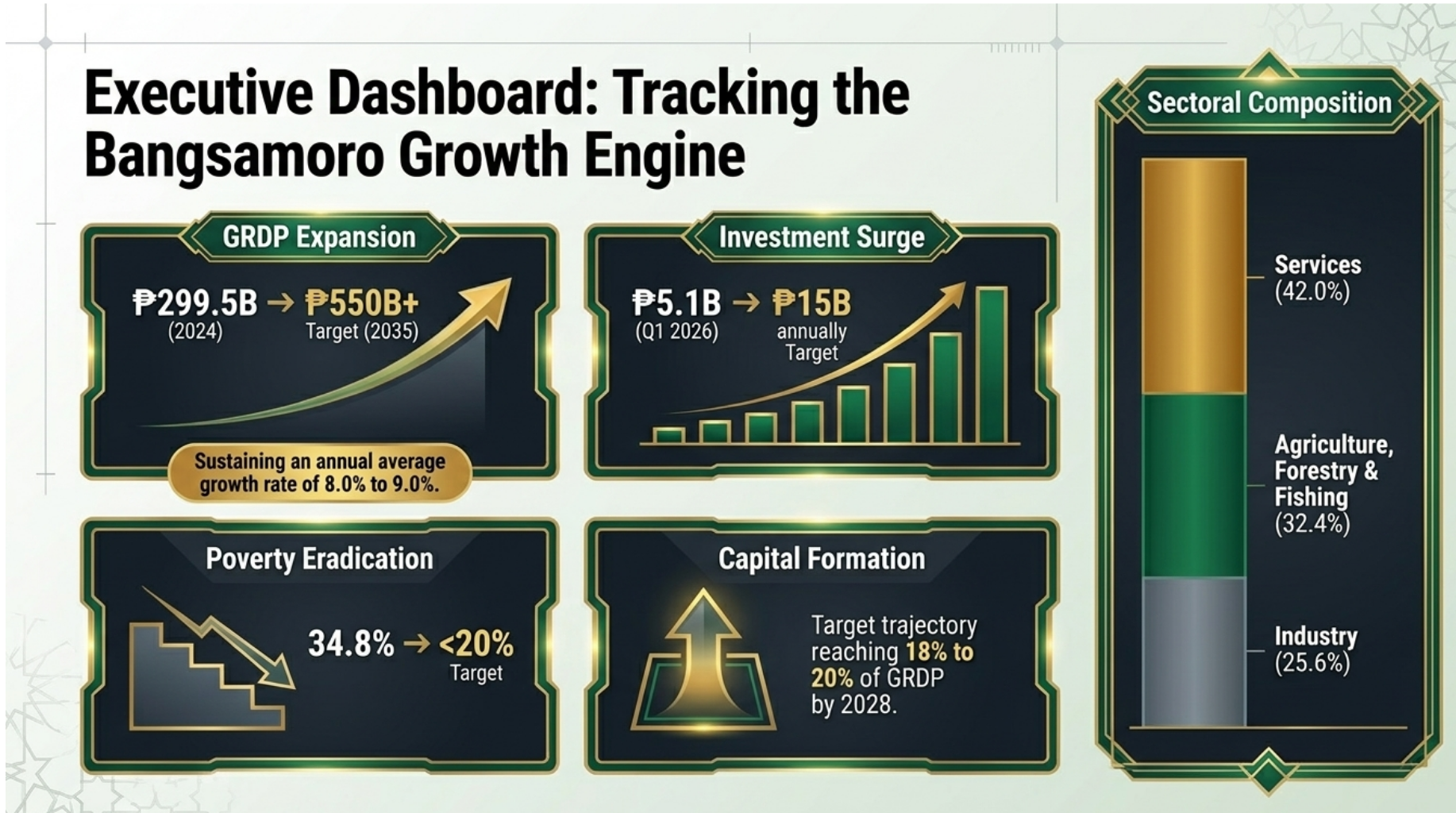
Vision 2035: A Hub for Resilient and Ethical Growth
By 2035, the Bangsamoro Autonomous Region will be recognized as Southeast Asia's premier halal, agro-industrial, and sustainable investment destination—a self-sustaining, export-linked economy delivering inclusive prosperity anchored in Islamic values, cultural identity, and moral governance.
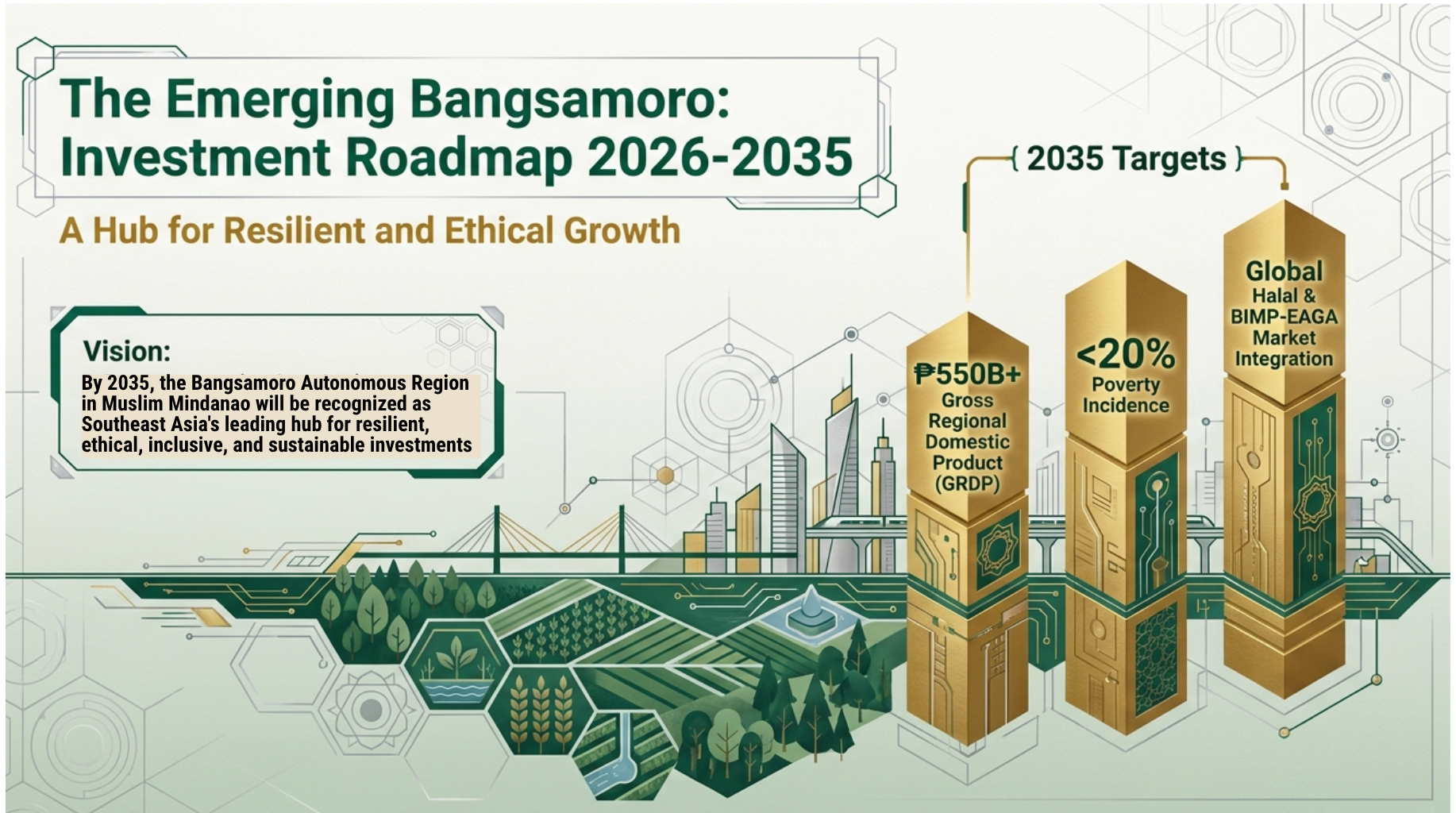
Balanced Scorecard Strategic Perspectives
27 strategic objectives across four interconnected perspectives translate the IEDS into an executable investment management system. Causal weights: Learning & Growth (20%) → Internal Process (25%) → Stakeholder (25%) → Financial (30%), per Chapter 5.
Strategic Objective F1: Scale Investment Approvals
Target: ₱15B Annual Investment Approvals by 2035
From ₱5.1B baseline (Q1 2026), implementing investment promotion roadshows, BIMP-EAGA missions, and enhanced aftercare services to attract quality domestic and foreign investments aligned with halal, agro-industrial, and green economy priorities.
Strategic Objective F2: Expand Export Revenue
Target: ₱40B+ Annual Export Value
From <₱10B baseline, establishing UAE/GCC halal export corridors, BIMP-EAGA trade facilitation mechanisms, and export readiness programs to position BARMM products in premium international markets.
Strategic Objective F3: Mobilize Islamic Finance
Target: ₱20B+ Islamic Banking Assets
From <₱2B baseline, expanding Al-Amanah and CARD Islamic Bank networks, deploying fintech solutions, and developing takaful products to channel Shariah-compliant capital across MSMEs, agro-entrepreneurs, and green enterprises.
Strategic Objective F4: Activate Green Economy Revenue
Target: ₱500M+ Annual Carbon/PES Revenue
From zero baseline, operationalizing REDD+ programs, Payment for Ecosystem Services frameworks, and eco-tourism user fees to monetize BARMM's environmental stewardship and forest endowments.
Strategic Objective S1: Enhance Investor Confidence
Target: 85% Investment Project Retention Rate
Establishing problem resolution mechanisms, expanding one-stop shop services, and ensuring predictable policy environment to maintain investor satisfaction at 8.0+/10 and prevent capital flight after incentive periods expire.
Strategic Objective S2: Empower MSMEs through Halal Certification
Target: 5,000+ Halal-Certified MSMEs
From ~500 baseline, implementing BHB MSME certification programs, BHIDP 2025-2030 rollout, and QA lab deployment to enable small enterprises to access premium halal markets and global value chains.
Strategic Objective S3: Reduce Poverty through Inclusive Investment
Target: <20% Poverty Incidence
From 34.8% (2023), implementing jobs-focused investment facilitation, MSME development programs, and inclusive value chains to ensure economic growth translates into broad-based prosperity and human development, supporting the 20,000+ quality jobs pathway.
Strategic Objective S4: Improve Financial Inclusion
Target: 25% Adult Financial Inclusion
Expanding Islamic banking branches to all provincial capitals, deploying mobile banking solutions for archipelagic communities, and establishing waqf-managed community enterprises to channel capital to underserved populations.
Strategic Objective P1: Streamline Investment Facilitation
Target: 1-Day Digital Business Registration
From multiple days processing, implementing digital BNR system, BEGMP e-governance platform, and one-stop shop expansion to reduce transaction costs and improve ease of doing business rankings.
Strategic Objective P2: Strengthen Halal Certification Infrastructure
Target: Full OIC/SMIIC Accreditation + MRA
From pending status, building BHB capacity, signing international Mutual Recognition Agreements, and establishing QA laboratories to reduce certification time from 45-60 days to 21-day international benchmark.
Strategic Objective P3: Accelerate Infrastructure Delivery
Target: >90% Budget Execution Rate
From <80% baseline, enhancing MPW-BBOI-LGU coordination, resolving ROW issues, implementing PPP frameworks, and deploying trigger-based budgeting to ensure critical infrastructure keeps pace with investment growth.
Strategic Objective P4: Synchronize BMOA Programs
Target: 8/10 Inter-Agency Coordination Score
From ~5.5/10 baseline, institutionalizing Bangsamoro Investment Command Center (BICC) / BIF-Net, establishing inter-agency MOAs, and deploying digital coordination platforms to prevent fragmented delivery and "Tragedy of the Commons" dynamics.
Strategic Objective L1: Build Halal Expertise
Target: 100+ Certified Halal Officers
From <50 baseline, establishing Halal Training Academy, BHB-SMIIC partnerships, and international secondments to build technical capacity in certification, auditing, and quality assurance systems.
Strategic Objective L2: Develop Islamic Finance Professionals
Target: 50+ Certified Islamic Finance Experts
From <20 baseline, implementing BSP-aligned scholarship programs, professional certification pathways, and IsDB training partnerships to build expertise in Shariah-compliant banking, takaful, and sukuk structuring.
Strategic Objective L3: Strengthen IPA Capacity
Target: 80% IPA Staff Certified/Trained
From <50% baseline, implementing capacity building programs, BBOI-MTIT HRD plans, and performance incentives to professionalize investment promotion and aftercare services across all provincial facilitation offices.
Strategic Objective L4: Improve Functional Literacy
Target: 75%+ Functional Literacy Rate
From 59.3% baseline (lowest nationally), deploying TESDA programs, DepEd alternative learning systems, and adult literacy campaigns to resolve the binding human capital constraint on industrial investment viability.
Key Performance Indicators & Metrics
Calibrated targets aligned with OIC/SMIIC standards, ESG frameworks, Philippine Development Plan 2023–2028, BDP 2023–2028, and the six Pareto-style headline KPIs of the Chapter 5 management layer
Four Strategic Options Analysis
Comprehensive evaluation of alternative development pathways through multi-criteria assessment examining economic impact, feasibility, identity alignment, systems leverage, risk-return profile, inclusivity, and sustainability
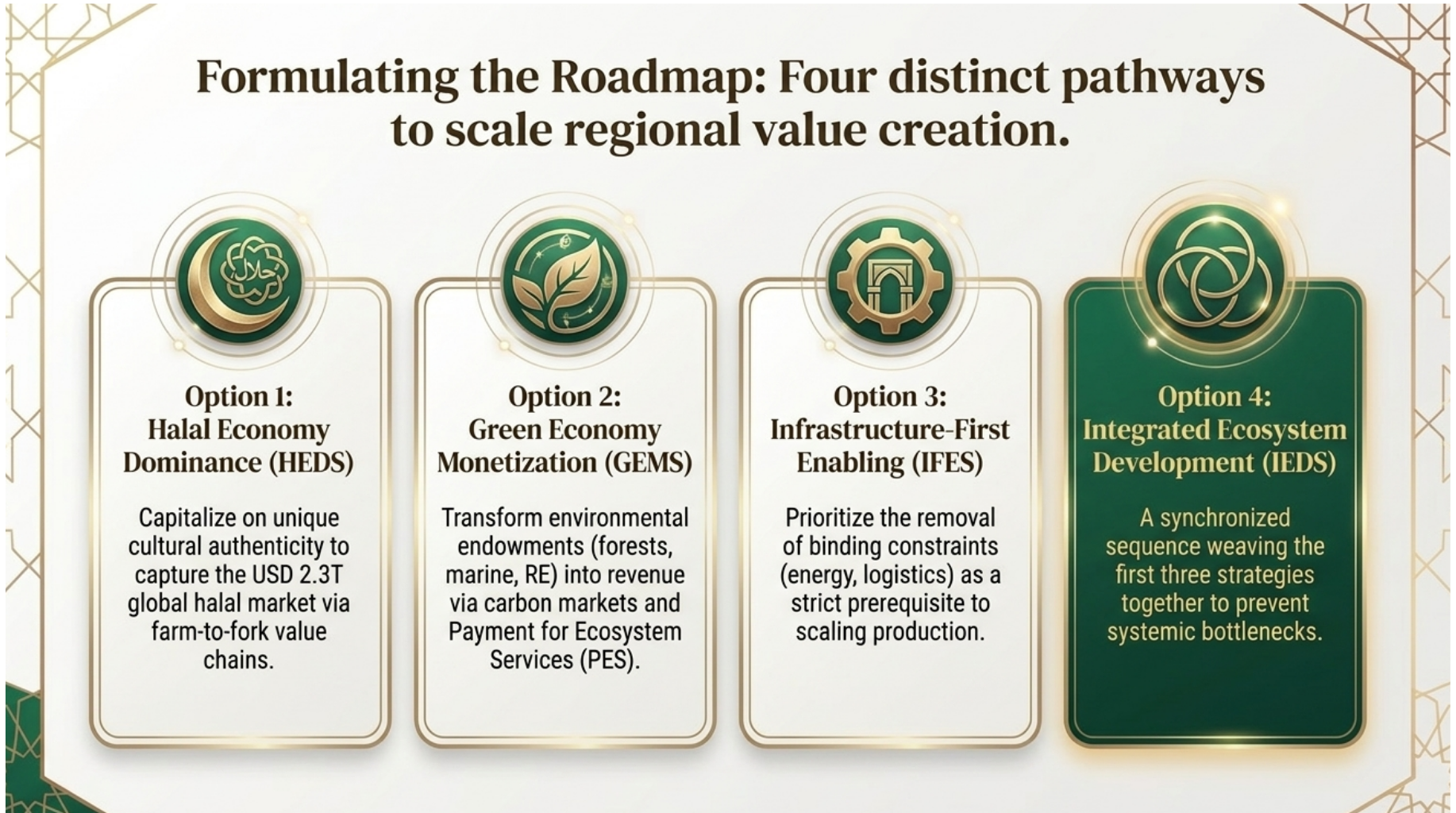
Phased Implementation Roadmap 2026–2035
Three-phase execution strategy (Chapter 6) with budget-calibrated interventions sequenced to match infrastructure readiness, institutional capacity, and market development. Total investment envelope: ₱120–160 billion. Phase 1 deploys 10 priority actions across all 5 Critical Leverage Points (CLPs).
Phase 1: Foundation Building
Establishing the moral governance operating system and deploying foundational enablers that unlock downstream investment viability. This phase prioritizes coherent sequencing logic by ensuring regulatory architecture, digital facilitation, and critical infrastructure are in place before scaling production or export commitments. Aligns with Chapter 5 Phase 1 priority actions and BIF-Net / BICC monitoring.
Key Deliverables:
- BHB operationalized with OIC/SMIIC-aligned processes & digital traceability pilot
- ZBIP construction milestones reached; 80% household electrification
- Bangsamoro Forestry Code enacted; JMC No. 2026-01 signed & LGU capacity building initiated
- 1-day digital business registration launched via BEGMP platform
- Farm-to-market road priorities funded & ROW mechanisms streamlined
- Bangsamoro Investment Command Center (BICC) / BIF-Net established with real-time tracking
Phase 2: Acceleration
Leveraging governance and infrastructure foundations to activate Foundations–Transformers Integration and Financiers–Ecosystem Alignment. With certification systems, energy connectivity, and logistics networks operational, focus shifts to scaling value addition and channeling capital across the ecosystem.
Key Deliverables:
- Bangsamoro Halal Park operational (Matanog); BHB achieves international recognition
- REDD+ program registered; first carbon credit & PES sales executed
- Islamic banking branches in all provincial capitals; takaful & green sukuk launched
- 5,000+ MSMEs halal-certified; 1M annual tourist arrivals; Lake Lanao eco-tourism open
- Cold chain & warehousing hubs operational in priority provinces
- ₱100M/year carbon/PES revenue activated
Phase 3: Consolidation & Global Integration
Consolidating BARMM's position as a self-sustaining, export-linked, and inclusive economic hub. All strategic pillars converge to achieve Foundations–Transformers–Connectors maturity and global market recognition with innovation-driven continuous improvement.
Key Deliverables:
- OIC endorsement secured; SMIIC Mutual Recognition Agreement (MRA) signed
- ₱500M+ annual carbon/PES revenue; eco-tourism reaches 3M visitors
- GRDP ₱550B+; poverty <20%; ₱15B+ annual investment approvals sustained
- BARMM recognized as ASEAN halal hub; cross-border BIMP-EAGA certification harmonized
- Innovation hubs & halal R&D centers operational; green bonds market mature
- 100% electrification & 85% broadband connectivity achieved
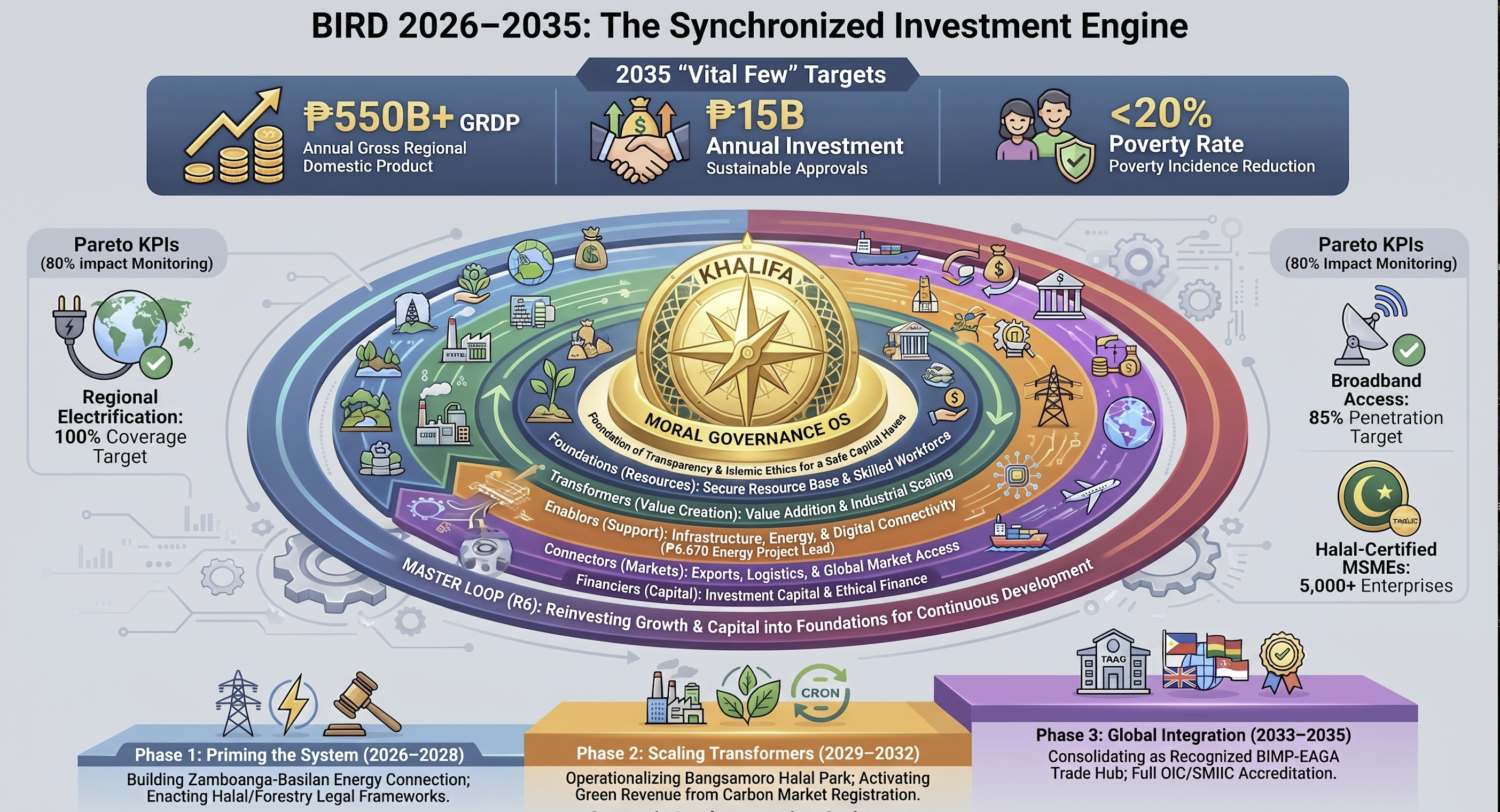
Integrated Roadmap Overview
Comprehensive visual synthesis of the Bangsamoro Investment Roadmap Development 2026–2035 showing strategic architecture, cluster interdependencies, and transformation pathways consistent with Chapters 5 and 6
Shape the Future of Bangsamoro
The data is unambiguous: BARMM's peace dividend is real, investment momentum is structural, and regulatory architecture is maturing. Yet data trends do not determine destinies—execution does. Join us in transforming scattered progress into synchronized ecosystem development. Your partnership, investment, and expertise are critical to building a resilient, ethical, and prosperous Bangsamoro.
Partner With Us →