
Understanding BARMM's Current Economic Landscape
The Bangsamoro Autonomous Region in Muslim Mindanao stands at a pivotal moment — shifting from recovery-focused development toward economic transformation, competitiveness, and sustainable prosperity.
The Bangsamoro Autonomous Region in Muslim Mindanao (BARMM) stands at a pivotal moment in its development journey. Since the establishment of the autonomous government, the region has progressively shifted from a development narrative centered on recovery and institution-building toward one focused on economic transformation, competitiveness, and sustainable prosperity.
The region is endowed with abundant agricultural resources, extensive fisheries, vast renewable energy potential, rich biodiversity, strategic maritime locations, and a strong cultural identity rooted in Islamic values and traditions. Combined with its geographic location within the Brunei–Indonesia–Malaysia–Philippines East ASEAN Growth Area (BIMP-EAGA), BARMM has the potential to become a major gateway for trade, halal industries, tourism, and regional cooperation.
🎯 The Strategic Imperative
Realizing this potential requires more than identifying priority sectors. It requires understanding how those sectors interact, reinforce one another, and collectively contribute to long-term economic resilience. BARMM needs an integrated ecosystem perspective where investments create value across interconnected networks of production, infrastructure, finance, governance, and market access.
Recent Growth Trends and Investment Performance
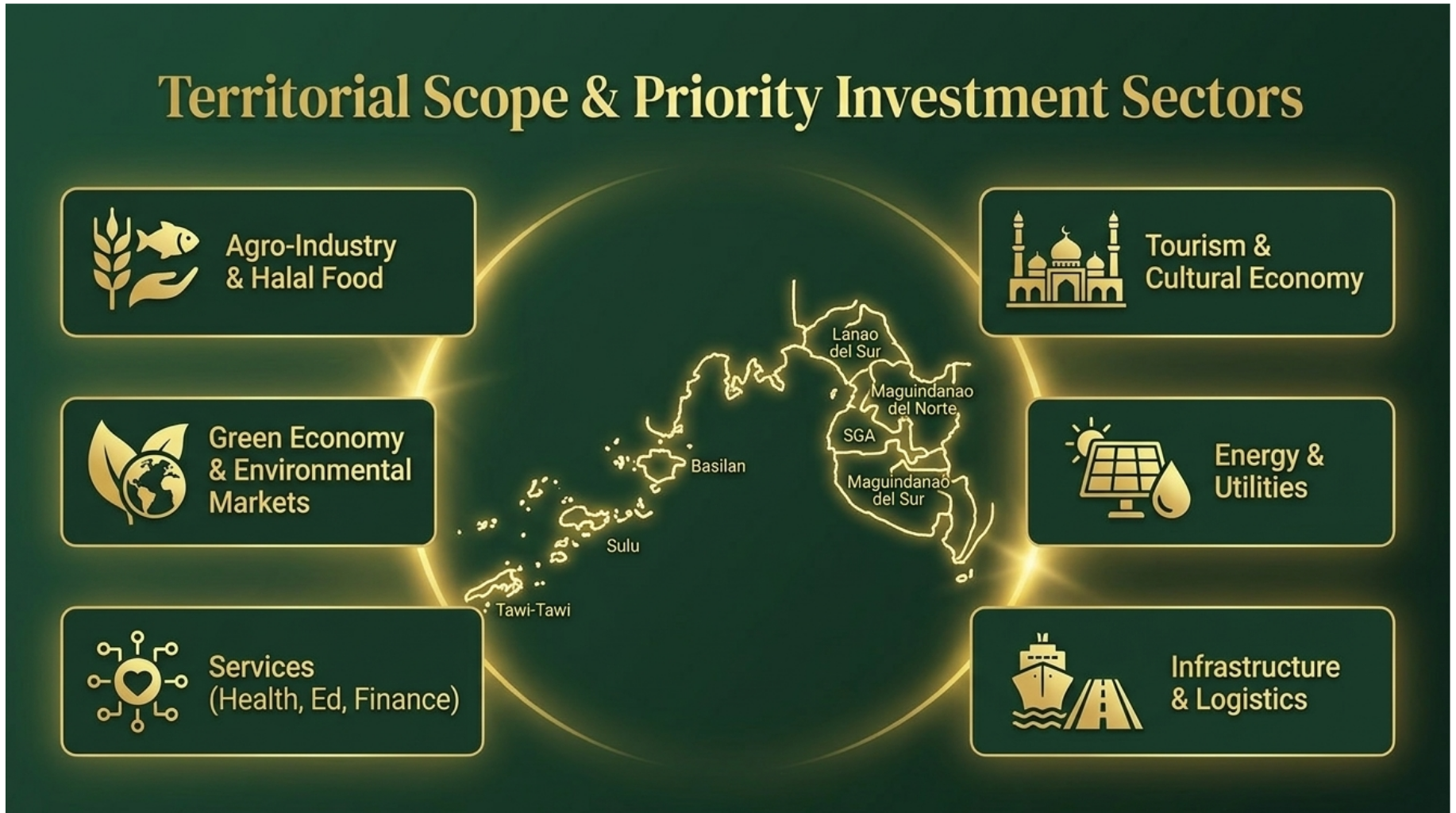
Recent economic indicators suggest that BARMM is gradually gaining momentum. Investment approvals have increased significantly, reflecting growing confidence among both domestic and international investors. Emerging industries such as halal manufacturing, renewable energy, agribusiness processing, tourism, and logistics are attracting greater attention from both public and private stakeholders.
Strategic investments in roads, ports, airports, digital infrastructure, and economic zones are laying the groundwork for future expansion. These developments are complemented by efforts to strengthen local institutions, improve regulatory systems, and enhance the ease of doing business.
What is becoming increasingly evident is that BARMM's future growth will depend not merely on attracting investments but on ensuring that investments create linkages across sectors. The challenge is no longer simply generating economic activity; it is building an ecosystem where economic activities reinforce one another and generate multiplier effects throughout the region.
The Bangsamoro 12-Point Agenda and Investment Sectors
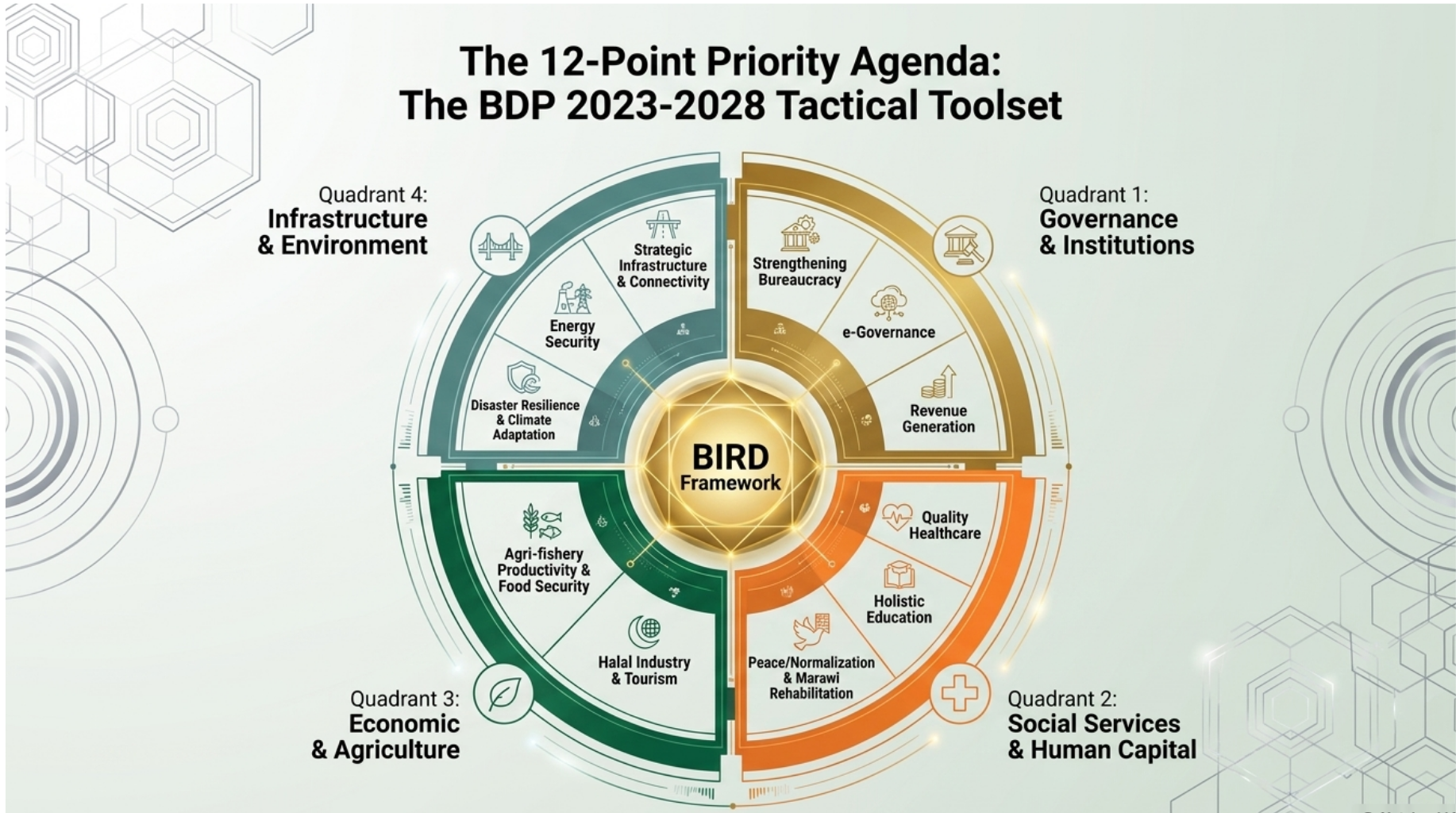
The Bangsamoro Government's 12-Point Agenda provides the strategic framework that guides regional development and investment priorities. Rather than treating economic growth as a standalone objective, the agenda integrates governance, human development, infrastructure, environmental stewardship, social cohesion, and economic transformation into a unified development vision.
Strategic Components
- Strengthening governance institutions
- Enhancing infrastructure connectivity
- Expanding access to quality education and healthcare
- Promoting environmental sustainability
Investment Alignment
- Supporting agricultural modernization
- Developing competitive halal ecosystem
- Peacebuilding and social inclusion
- Poverty reduction and resilience
Viewed through an investment lens, the 12-Point Agenda serves as the strategic bridge between policy objectives and economic outcomes. It ensures that investments contribute not only to growth but also to peacebuilding, poverty reduction, social inclusion, and resilience.
Why a Systems-Based Reframing is Needed
Limitations of Traditional Sectoral Categorization
Historically, investment priorities have been organized into individual sectors such as agriculture, tourism, manufacturing, infrastructure, and finance. While this approach offers administrative simplicity, it often creates fragmented planning and implementation.
⚠️ The Fragmentation Challenge
- Agriculture depends on logistics
- Manufacturing relies on energy
- Tourism requires infrastructure, security, and environmental protection
- Financial institutions need productive industries capable of absorbing capital
When sectors are treated as separate entities, opportunities for synergy are frequently overlooked, resulting in disconnected investments that generate limited long-term impact.
The Case for Interdependence and Integration
Modern economies do not grow through isolated sectors. They grow through networks of relationships among sectors, institutions, and communities. BARMM's development challenges and opportunities are best understood through this systems perspective.
The Interconnected Structure
This interconnected structure means that investments should be evaluated not only based on their individual returns but also on their ability to strengthen the broader ecosystem.
The most successful investments are often those that create positive spillover effects across multiple sectors simultaneously. The Bangsamoro Investment Ecosystem Framework embraces this reality by reorganizing priority sectors into interconnected clusters that reflect how economic systems actually function.
Cross-Cutting Operating Systems: Moral Governance, Resilience, and Peace
At the center of the Bangsamoro Investment Ecosystem lies a set of operating systems that shape how investments are planned, implemented, and sustained.

These are not economic sectors themselves. Rather, they function as the institutional and social conditions that determine whether economic systems can grow, adapt, and sustain themselves over time.
Moral Governance
Moral Governance serves as the ethical compass of the Bangsamoro development agenda and economic transformation. It promotes accountability, transparency, integrity, and service-oriented leadership throughout.
Key Actors:
- Bangsamoro Parliament
- Office of the Chief Minister
- Ministry of the Interior and Local Government (MILG-BARMM)
- Civil Society Organizations
- Academic and Research Institutions
- Development Partners
Moral Governance creates investor confidence by reducing uncertainty and strengthening institutional credibility.
Resilience
Resilience ensures that communities, institutions, and businesses can withstand shocks ranging from climate-related disasters to economic disruptions and social conflicts.
Building Resilience Requires:
- Adaptive infrastructure
- Disaster preparedness systems
- Climate-smart agriculture
- Diversified economic opportunities
Inclusivity
Inclusivity ensures that economic growth benefits all sectors of society, particularly women, youth, indigenous peoples, fisherfolk, farmers, and vulnerable communities.
An inclusive economy broadens participation, strengthens social cohesion, and creates more sustainable development outcomes.
Peace
Peace remains one of BARMM's most valuable development assets. Decades of conflict limited investment, disrupted economic activities, and constrained opportunities for growth.
Key Peace Actors:
- Bangsamoro Peacebuilding and Reconciliation Office (BPRO)
- MILF Transition Committees & MNLF Stakeholders
- Local Peace Councils & Rido Mediation Bodies
- Community Peace Networks
- PNP-BARMM & AFP Joint Task Groups
Peace provides the stability necessary for long-term investment planning and economic expansion.
The Five BEIE Clusters: An Integrated Architecture
The Bangsamoro Investment Ecosystem reorganizes priority sectors into five interconnected clusters that reflect how economic systems actually function.
Foundations: The Resource Base of BARMM

The Foundations Cluster consists of the sectors that provide the raw materials, natural resources, food systems, and energy inputs that support the entire economy.
Key Components
These sectors form the primary production base of BARMM. They generate food, raw materials, ecosystem services, and energy resources that feed directly into manufacturing, trade, tourism, and industrial development.
Key Actors and Players
BARMM Ministries
- Ministry of Agriculture, Fisheries and Agrarian Reform (MAFAR)
- Ministry of Environment, Natural Resources and Energy (MENRE)
- Southern Philippines Development Authority (SPDA)
National Agencies
- Department of Agriculture
- Department of Environment and Natural Resources
- Department of Energy
Other Stakeholders
- Local Government Units
- Farmers' Cooperatives & Fisherfolk Associations
- Agribusiness Firms & Research Institutions
The performance of every other cluster ultimately depends on the sustainability and productivity of these foundational sectors.
Transformers: Engines of Value Creation

While Foundations generate raw resources, Transformers convert those resources into products, services, and economic value.
Key Components
This cluster is responsible for value addition. It transforms agricultural outputs into processed foods, converts raw materials into industrial products, supports supply chains, and creates export-ready goods.
The inclusion of logistics within the transformer cluster recognizes its role in facilitating movement, storage, packaging, cold-chain operations, and supply-chain efficiency.
☪️ The Strategic Role of the Halal Industry
Among all transformation sectors, the halal industry holds particular strategic significance. BARMM possesses a natural comparative advantage in halal production because of its Muslim-majority population, Islamic institutions, and cultural legitimacy.
Halal Food Manufacturing
Halal Livestock Processing
Halal Pharmaceuticals
Halal Cosmetics
Halal Logistics
Halal Certification
Through halal value chains, BARMM can connect local production systems to global Muslim consumer markets valued in the trillions of dollars.
Key Actors and Players
BARMM Institutions
- Ministry of Trade, Investments and Tourism (MTIT)
- Bureau of Investments (BOI-MTIT)
- Bangsamoro Economic Zone Authority (BEZA)
- Bangsamoro Halal Board (BHB)
- Bangsamoro Development Corporation
Private Sector & Partners
- Halal Processors & Manufacturing Firms
- Cold Chain Operators & Logistics Providers
- Anchor Investors (Dole Philippines, Halal Park Tenants)
- IsDB, UNIDO, UAE Trade Promotion Agencies
Enablers: Building the Support Systems
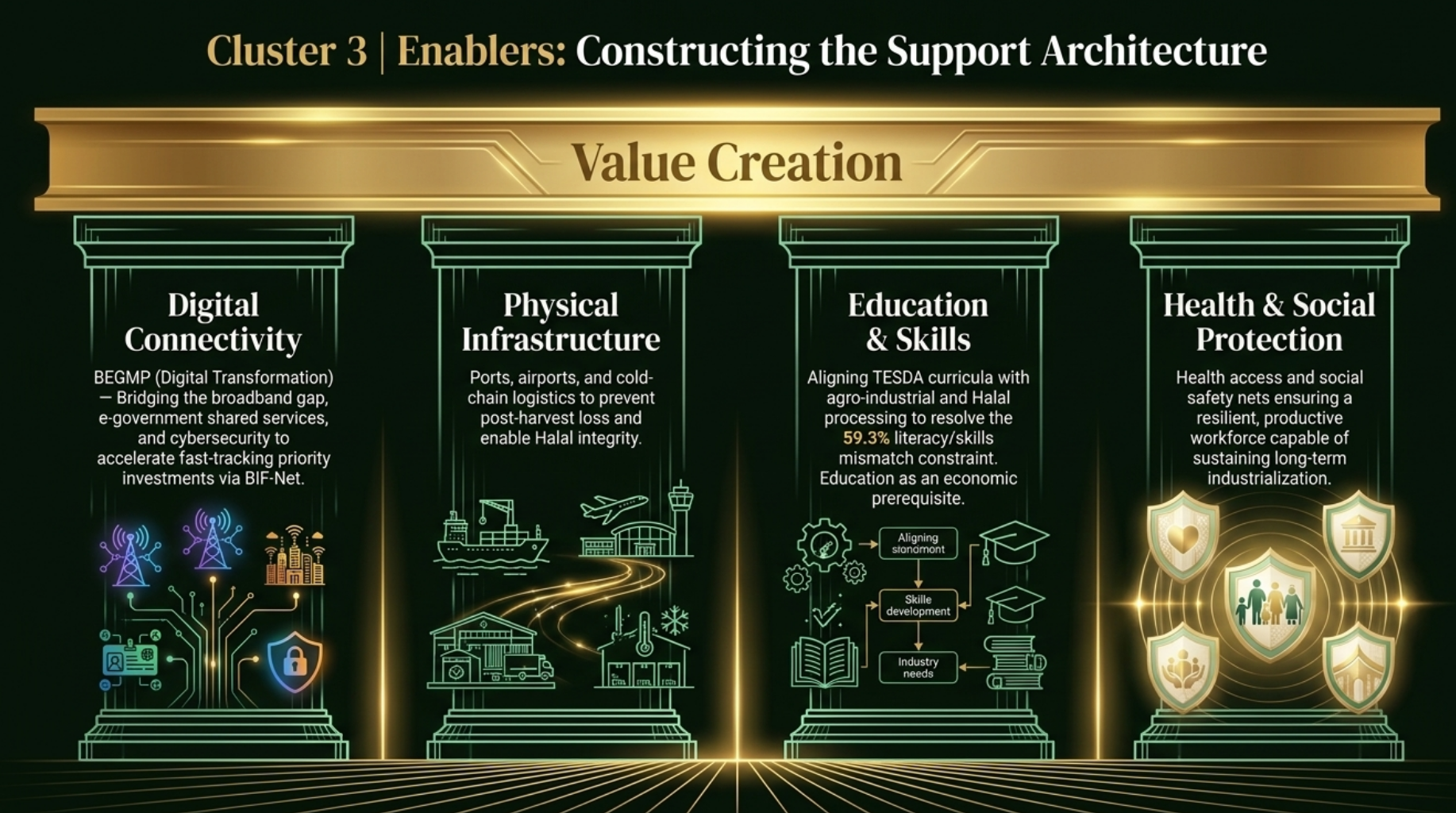
Economic transformation cannot occur without the systems that support production, mobility, human development, and social well-being.
Key Components
The Enablers Cluster provides the physical, social, and institutional infrastructure necessary for economic growth. Roads, bridges, airports, seaports, telecommunications networks, schools, hospitals, social protection systems, and workforce development programs all fall within this category.
🌎 Infrastructure, Logistics, and Connectivity
Infrastructure reduces transaction costs, improves accessibility, and enhances competitiveness. Investments in transportation, digital systems, and utilities create the conditions necessary for businesses to thrive.
👥 Human Capital through Health and Education
Human capital is arguably BARMM's most important long-term investment asset. Quality education develops skills. Healthcare improves productivity. Social protection strengthens resilience.
Key Actors and Players
BARMM Ministries
- Ministry of Public Works (MPW)
- Ministry of Basic, Higher and Technical Education (MBHTE)
- Ministry of Health (MOH)
- Ministry of Social Services (MSSD)
- Ministry of ICT (MICT)
Service Providers
- Private Hospitals
- Educational Institutions
- Technical-Vocational Schools
- Construction Firms & ICT Providers
Professional Organizations
- Medical Associations
- Teachers' Organizations
- Engineering Councils
- TESDA-Accredited Training Institutions
Connectors: Linking BARMM to Markets
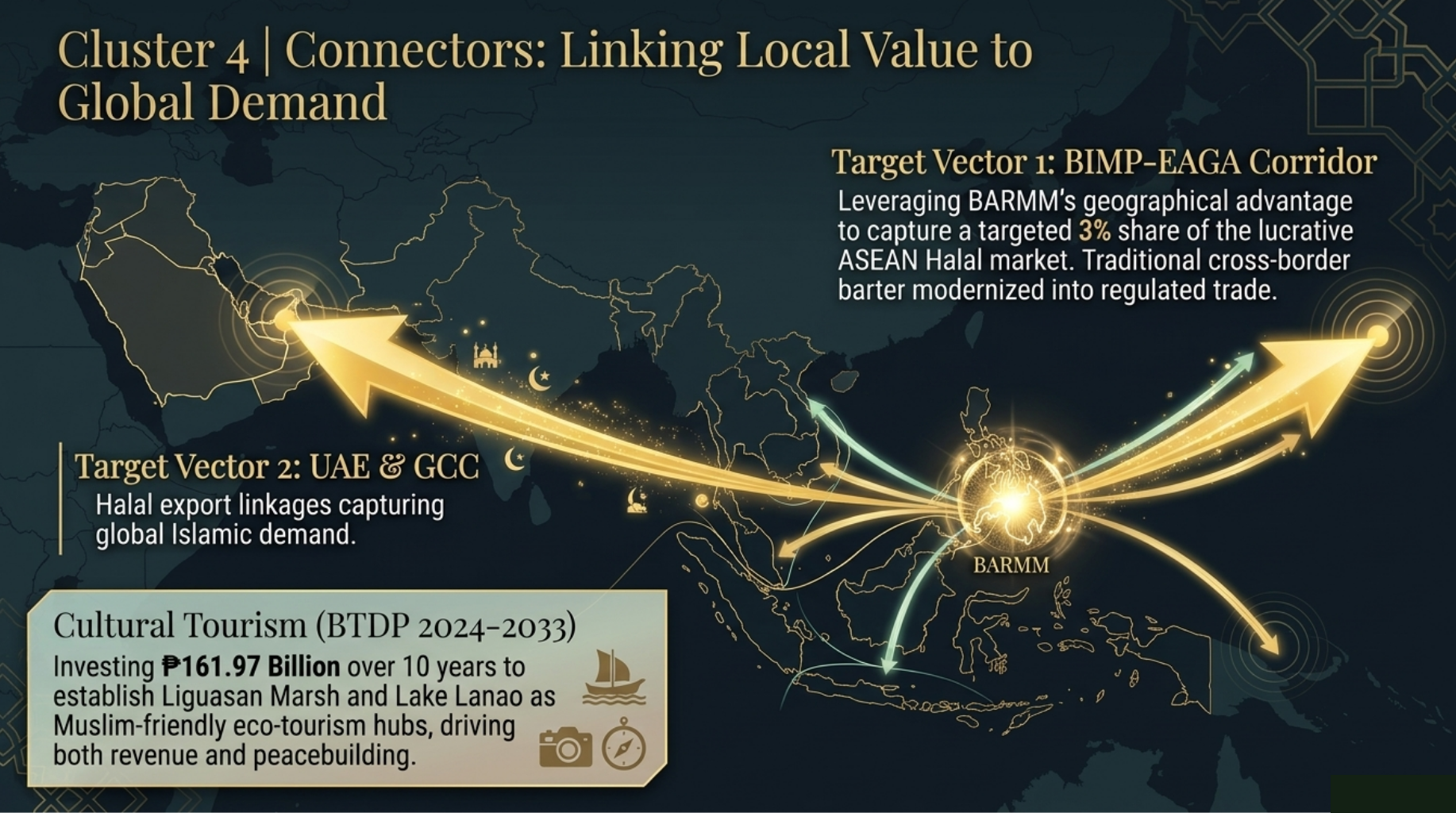
Connectors create access. They connect local economies to national, regional, and international markets.
Key Components
This cluster enables the movement of people, products, services, information, and investments across geographic boundaries.
Tourism, Trade, and Market Access
Tourism serves as both an economic activity and a branding mechanism. It showcases Bangsamoro culture, heritage, natural assets, and hospitality while generating jobs and investment opportunities.
Trade and export systems provide pathways for local products to reach broader markets.
BIMP-EAGA and Regional Integration
BARMM's strategic location within BIMP-EAGA creates opportunities for:
- Cross-Border Trade
- Regional Logistics
- Halal Market Access
- Maritime Connectivity
- Tourism Corridors
- ASEAN Integration
Key Actors and Players
BARMM Institutions & Regional Mechanisms
- MTIT Tourism Bureau
- Ministry of ICT (MICT)
- Bangsamoro Board of Investments
- BEZA Trade Facilitation Units
- BIMP-EAGA National Secretariat & Business Council
- ASEAN Secretariat
Private Sector & Digital Ecosystem
- Tourism Operators & Exporters
- Trade Associations & Logistics Companies
- E-Commerce Platforms
- Internet Service Providers & Fintech Companies
- ADB, ITU, UNWTO
Financiers: Powering Investment Flows

The Financiers Cluster provides access to financial capital while aligning investments with Islamic principles.
Key Components
These financial mechanisms ensure that entrepreneurs, cooperatives, enterprises, and investors can access capital through Shariah-compliant instruments.
Islamic Banking
Islamic finance emphasizes risk-sharing, ethical investment, and asset-backed financing. It creates opportunities for broader financial inclusion while strengthening trust within Muslim communities.
Takaful
Takaful provides cooperative insurance solutions that help businesses and households manage risk while complying with Islamic principles.
Microfinance
Microfinance expands access to capital for small businesses, cooperatives, women entrepreneurs, and community-based enterprises that may otherwise remain excluded from formal financial systems.
Key Actors and Players
Islamic Financial Institutions
- Al-Amanah Islamic Investment Bank
- CARD Islamic Bank
- Islamic Windows of Conventional Banks
- Takaful Operators & Fintech Companies
Regulators & Standards Bodies
- Bangko Sentral ng Pilipinas
- Ministry of Finance, Budget and Management (MFBM)
- Proposed Bangsamoro Central Bank
- IFSB, AAOIFI, IsDB, ICD, UNCDF
Interdependence Across the Bangsamoro Economic and Investment Ecosystem
The BEIE Framework demonstrates that economic development is fundamentally relational — no cluster operates in isolation.
All of these operate within the cross-cutting systems of Moral Governance, Resilience, Inclusivity, and Peace.
Value Chain Integration Across Sectors
The Bangsamoro Investment Ecosystem operates as a dynamic network rather than a collection of isolated sectors.
- • Foundations supply resources to Transformers.
- • Transformers create products that Connectors bring to markets.
- • Enablers support every stage of production and distribution.
- • Financiers provide the capital necessary for expansion and innovation.
- • Moral Governance, Resilience, and Peace guide the entire system.
The result is a circular and self-reinforcing development model where investments generate value beyond individual sectors.
Strategic Implications for Investors and Policymakers
💼 For Investors
The ecosystem approach highlights opportunities that emerge at the intersections of sectors rather than within sectors alone. Investments in halal manufacturing, logistics, renewable energy, agro-processing, digital infrastructure, and Islamic finance can generate multiplier effects throughout the regional economy.
📋 For Policymakers
The framework emphasizes coordination, institutional alignment, and systems thinking. Development outcomes improve when investments are designed to strengthen relationships among sectors rather than maximize performance within individual sectors.
Conclusion
Reimagining BARMM's priority investment sectors requires a shift from sector-based planning to ecosystem-based development. The Bangsamoro Investment Ecosystem Framework provides this new perspective by organizing investments into Foundations, Transformers, Enablers, Connectors, and Financiers, all guided by the cross-cutting operating systems of Moral Governance, Resilience, and Peace.
This approach recognizes that sustainable prosperity emerges not from isolated investments but from interconnected systems that create value, build resilience, and expand opportunities for communities across the region.
As BARMM enters the next phase of its development journey, its greatest competitive advantage may not be any single sector. Rather, it is the region's ability to build an integrated investment ecosystem where governance, resources, infrastructure, finance, culture, and markets work together to create inclusive and lasting growth.
Shape the Future of Bangsamoro Investment
Your insights are critical to validating the strategic direction of the BIRD 2026–2035 Roadmap. Participate in our official Validation Survey to ensure the investment ecosystem reflects the needs and aspirations of the Bangsamoro people.
Frequently Asked Questions
Everything you need to know about the Bangsamoro Economic and Investment Ecosystem Framework.
Because economic sectors are interconnected and depend on one another to create sustainable growth, jobs, and competitiveness. A systems-based approach ensures that investments create synergies and multiplier effects rather than operating in isolated silos. The BEIE Framework maps how Foundations supply resources to Transformers, Enablers support every stage, Connectors open markets, and Financiers provide capital — all within the ethical foundation of Moral Governance.
It serves as the ethical and institutional foundation that promotes transparency, accountability, inclusivity, and investor confidence. Moral Governance reduces uncertainty, strengthens institutional credibility, and creates the trust necessary for long-term investment commitment. As one of the four cross-cutting operating systems, it works alongside Resilience, Inclusivity, and Peace to ensure investments generate sustainable, equitable outcomes for all Bangsamoro communities.
It leverages BARMM's cultural strengths and provides access to rapidly expanding global halal markets valued in the trillions of dollars. BARMM's Muslim-majority population, Islamic institutions, and cultural legitimacy provide a natural comparative advantage that no other Philippine region can credibly replicate. The halal industry spans food manufacturing, livestock processing, pharmaceuticals, cosmetics, logistics, and certification — creating a comprehensive value chain with export potential to OIC countries and BIMP-EAGA markets.
BIMP-EAGA connects BARMM to regional trade, investment, tourism, and logistics networks across Southeast Asia. This subregional cooperation mechanism enables cross-border trade, regional logistics corridors, halal market access to 70 million+ consumers, maritime connectivity, tourism corridors, and deeper ASEAN integration. For investors, BIMP-EAGA represents a strategic gateway to tap into one of the world's fastest-growing economic regions.
It expands financial inclusion, aligns with local values, and provides alternative financing mechanisms for economic growth. Islamic finance emphasizes risk-sharing, ethical investment, and asset-backed financing, creating opportunities for broader participation while strengthening trust within Muslim communities. Instruments like Islamic banking, Takaful (cooperative insurance), and microfinance ensure that capital reaches MSMEs, women entrepreneurs, and community-based enterprises often excluded from conventional financial systems.
The BEIE Framework organizes BARMM's investment ecosystem into five interconnected clusters: Foundations (agriculture, fisheries, forestry, energy, environment) providing raw resources; Transformers (industry, manufacturing, logistics, halal processing) creating value; Enablers (infrastructure, health, education, human capital) building support systems; Connectors (tourism, trade, digital connectivity, BIMP-EAGA) linking to markets; and Financiers (Islamic banking, Takaful, microfinance) powering investment flows. All clusters operate within the cross-cutting systems of Moral Governance, Resilience, Inclusivity, and Peace.
Investors can engage through multiple entry points: the Bangsamoro Economic Zone Authority (BEZA) for investment facilitation; the Bangsamoro Halal Park in Matanog for halal industry ventures; public-private partnership (PPP) frameworks for infrastructure projects; and Islamic finance instruments for Shariah-compliant capital deployment. The BEIE Framework highlights opportunities at the intersections of sectors — where investments in halal manufacturing, logistics, renewable energy, and digital infrastructure generate multiplier effects across the regional economy.
The BIRD Validation Survey is a stakeholder feedback mechanism designed to validate the strategic direction of the Bangsamoro Investment Roadmap 2026–2035. It collects insights from government officials, private sector representatives, academe, civil society, and development partners to ensure the investment ecosystem reflects the actual needs and aspirations of the Bangsamoro people. Your participation directly shapes policy priorities, investment allocations, and program implementation.
Climate resilience is embedded as a cross-cutting operating system throughout the BEIE Framework. The Foundations cluster promotes climate-smart agriculture and sustainable fisheries; Enablers invest in adaptive infrastructure and disaster preparedness systems; Transformers adopt green manufacturing practices; and Financiers develop climate-responsive financial instruments. This integrated approach ensures BARMM's economic growth is resilient to climate shocks while protecting its rich biodiversity and natural resources for future generations.
Inclusivity is one of the four cross-cutting operating systems, ensuring that economic growth benefits all sectors of society. The Framework specifically prioritizes women's participation through MSME development, Islamic microfinance access, and leadership opportunities in halal certification and tourism. For youth, investments in education, technical-vocational training, digital skills, and entrepreneurship programs create pathways for meaningful economic participation. The goal is an inclusive economy that broadens participation and strengthens social cohesion.
Implementation is guided by the Bangsamoro Development Plan (BDP) 2023–2028 and monitored through the Monitoring, Evaluation, and Learning (MEL) Dashboard. The Framework uses a Balanced Scorecard approach tracking KPIs across four perspectives: Financial (PHP 15B annual investments target), Stakeholder (investor satisfaction, MSME growth), Internal Process (halal certification efficiency, business registration time), and Learning & Growth (human capital development). Critical Leverage Points — Halal Certification Integrity, Infrastructure-Energy-Connectivity Nexus, Governance-Investor Confidence, and Islamic Finance Ecosystem — receive focused attention for maximum impact.
The complete Bangsamoro Investment Roadmap 2026–2035 is available through the BIRD digital ecosystem. Explore the Interactive Strategy Map for strategic perspectives and leverage points, the MEL Dashboard for real-time KPI tracking, the Resources Library for reports and policy briefs, and the BIRD App for mobile access. For direct inquiries, contact the MTIT-BARMM Investment Promotion team through the contact portal.
Explore the BIRD Ecosystem
🏠 BIRD Home 📈 Strategy Map 📊 MEL Dashboard 📚 Resources 📱 BIRD App 📨 Contact UsReferences & Data Sources
- Bangsamoro Planning and Development Authority (BPDA). (2023–2028). Bangsamoro Development Plan.
- Ministry of Finance and Budget Management (MFBM). (2025). BARMM Investment Portfolio and Fiscal Data.
- Philippine Statistics Authority (PSA-BARMM). (2025). Regional Economic Accounts and GRDP Data.
- Ministry of Agriculture, Fisheries and Agrarian Reform (MAFAR). (2025). Agro-Industrial Development Programs.
- Ministry of Trade, Investments and Tourism (MTIT-BARMM). (2026). Halal Industry Development Plan 2025–2030.
- Bangsamoro Halal Board (BHB). (2025). Certification Standards and Capacity Assessment.
- BIMP-EAGA Secretariat. (2024). Strategic Plan 2025–2028.
- Islamic Development Bank (IsDB) & Islamic Corporation for the Development of the Private Sector (ICD). (2025). Islamic Finance Market Analysis.
- CARD Islamic Bank & Al-Amanah Islamic Investment Bank. (2026). Financial Inclusion Data.
- Workshop Outputs (2026). BARMM Investment Ecosystem Framework Development.