Four Critical Leverage Points
Halal Industry Ecosystem
Establish internationally recognized certification body and develop Bangsamoro Halal Park in Matanog.
Enabling Infrastructure
100% electrification and 85% broadband penetration with integrated farm-to-market logistics.
Governance Excellence
Streamlined one-stop investment facilitation with OIC/SMIIC international accreditation.
BIMP-EAGA Integration
Premier gateway to 70M+ ASEAN consumers through strategic trade corridors.
SWOT Analysis with Quantification
The SWOT analysis employs robust mathematical formulations to quantify strategic viability, risk exposure, and resilience capacity across all BEIE clusters.
Key Performance Indicators & Benchmarks
Calibrated metrics aligned with OIC/SMIIC international standards, ESG frameworks, Philippine Development Plan 2023–2028, and Bangsamoro-specific KPIs.
Cross-Cutting Operating Systems KPIs
| KPI Dimension | Baseline (2024) | Target 2028 | Target 2030 | Target 2035 | Lead Agency |
|---|---|---|---|---|---|
| Public financial disclosure compliance rate | ~65% (est.) | 80% | 95% | 100% | OCM-BARMM |
| Investor ombudsman operationalization | Not established | Established | Fully functional | 8.0+/10 satisfaction | MTIT-BBOI |
| Functional literacy rate (ages 10+) | 59.3% | 68% | 72% | 75%+ | DepEd-BARMM/TESDA |
| Decommissioned combatant reintegration rate | ~62% | 80% | 100% | Sustained >95% | OPAPRU-BARMM |
Foundations Cluster KPIs
| KPI | Baseline | Target 2028 | Target 2030 | Target 2035 |
|---|---|---|---|---|
| Priority crop yield increase (rice, corn, rubber, seaweed) | Baseline | 10% | 13% | 15% |
| Post-harvest loss reduction | 20–40% | 25% | 30% | 30%+ |
| Renewable energy mix share | 75.86% | 78% | 82% | 85% |
| Household electrification rate | ~39% | 65% | 80% | 90% (100% by 2040) |
Transformers Cluster KPIs
| KPI | Baseline | Target 2028 | Target 2030 | Target 2035 |
|---|---|---|---|---|
| Halal-certified MSMEs | ~500 | 1,500 | 3,000 | 5,000+ |
| BHB OIC/SMIIC accreditation status | Pending | Provisional alignment | Full accreditation | MRA signed |
| Halal export value | <500M | ₱1.5B | ₱3B | ₱5B+ |
| Annual tourist arrivals | <500K | 1M | 2M | 3M |
International Benchmark Alignment
OIC/SMIIC Standard
BSEMP Target 2035
Digital BNR System
BDP 2023-2028
Causal Loop Diagrams & Systems Thinking
Understanding the dynamic interrelationships and feedback loops that drive BARMM's investment ecosystem behavior over time.

Investment-Development Virtuous Cycle
Investment inflows generate employment and income growth, which expands the domestic consumer market, improves business viability, and attracts additional investors—creating a self-reinforcing cycle of economic development.

Governance-Investor Confidence Cycle
Improved governance (transparency, rule of law, investor protection) increases investor confidence, which drives investment, generates economic growth, expands the tax base, and provides resources for further governance improvements.
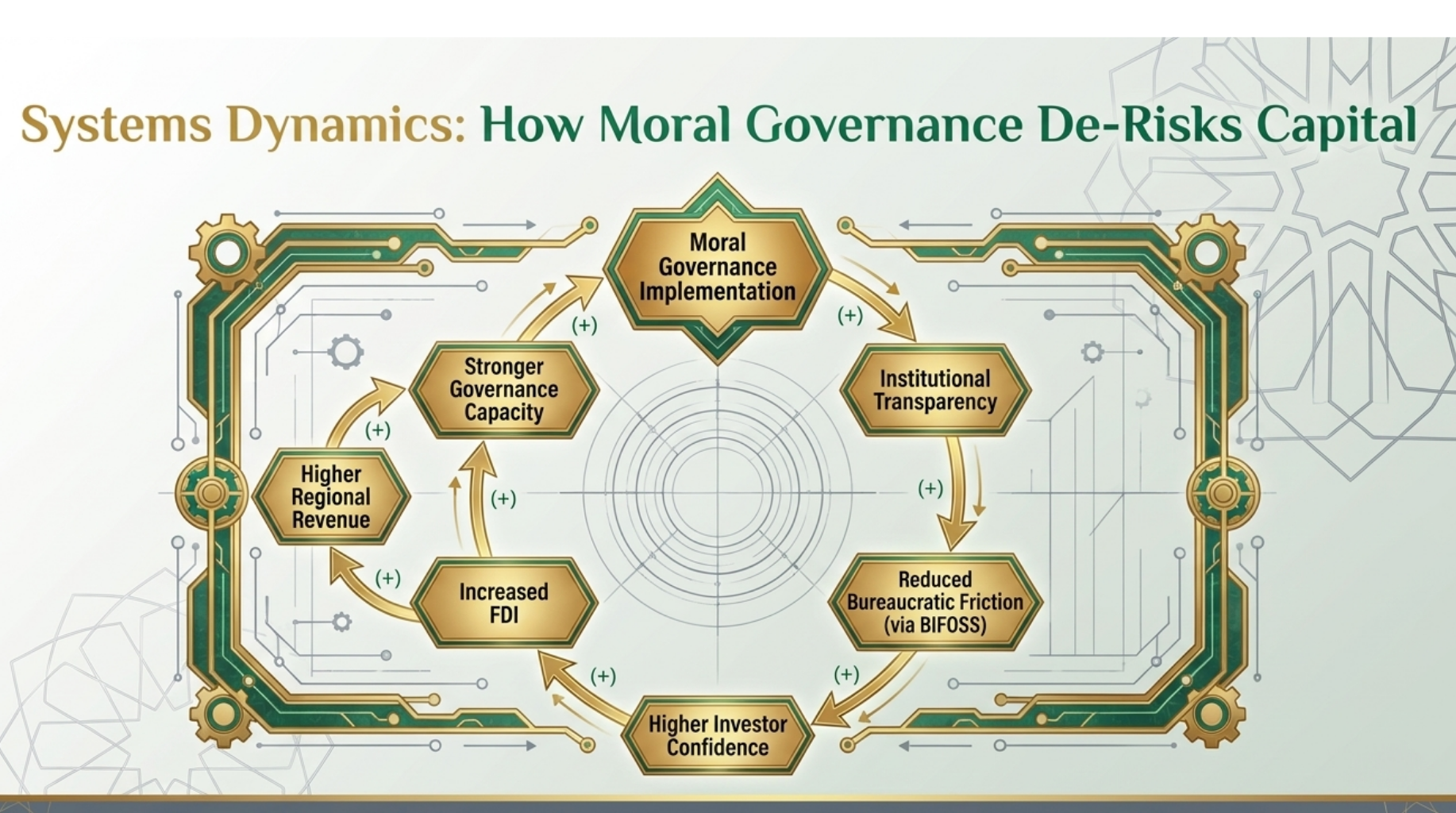
How Moral Governance De-Risks Capital
Moral governance operating systems (transparency, accountability, Islamic ethics) reduce perceived investment risks, lower the cost of capital, and attract long-term, patient capital aligned with BARMM's values and development objectives.
Systems Archetypes & Leverage Points
Recurring patterns of system behavior that help diagnose structural dynamics and identify high-leverage interventions for transformative change.

1. Limits to Growth
Rapid investment growth encounters balancing pressures from infrastructure bottlenecks, skills shortages, and environmental limits. Without proactive capacity investment, growth plateaus.

2. Success to the Successful
Initial advantages in mainland provinces compound, attracting more resources while archipelagic provinces lag behind, deepening regional inequality.

3. Fixes that Fail
Ad-hoc tax incentives without systemic governance reform provide short-term investor relief but generate unintended consequences—revenue loss and weak institutions.
4. Tragedy of the Commons
Fragmented governance across Foundations cluster leads to resource depletion as individual actors maximize short-term yields from shared resources (watersheds, fishing grounds, grid capacity).

5. Growth and Underinvestment
Investment approvals surge (₱5.1B in Q1 2026) but facilitation capacity (BBOI, BHB, aftercare services) remains constrained, creating bottlenecks that could undermine future growth.