Investment Outlook 2026–2035

Tawi-Tawi Economic and
Investment Outlook 2026-2035

Transforming the southernmost island province into a marine-based economic powerhouse and BIMP-EAGA trade gateway through integrated seaweed value chain development and sustainable aquaculture.

Explore the Outlook Investment Opportunities
19.83B GDP 2023
1.1% Growth Rate 2023
40% Seaweed Output
439K Population 2020

Provincial Overview

Understanding the geographical, demographic, and strategic context of Tawi-Tawi, the southernmost province of the Philippines and a key BIMP-EAGA gateway.

Geographic Profile

Tawi-Tawi is an island province located at the southernmost tip of the Philippines, comprising approximately 390 islands and islets with a total land area of 1,087 sq km. The province shares maritime borders with Sabah, Malaysia to the south and North Kalimantan, Indonesia to the southeast. The provincial capital is Bongao, and the main island features diverse ecosystems including coral reefs, mangroves, and seagrass beds.

1,087 Sq Km Land Area
390 Islands & Islets
Bongao Provincial Capital
Demographic Profile

The 2020 Census recorded Tawi-Tawi's population at 439,388, representing 7.74% of BARMM's total population. The province has an annual population growth rate of 2.1%. The Tausug and Sama-Bajau peoples form the dominant cultural communities, with a rich maritime heritage and deep connection to the sea. The province is predominantly Muslim (98%), creating a natural ecosystem for halal industries and Islamic finance.

439K Population 2020
7.74% of BARMM Pop
2.1% Annual Growth Rate

Strategic Location

Tawi-Tawi occupies a strategic position within the BIMP-EAGA (Brunei-Indonesia-Malaysia-Philippines East ASEAN Growth Area) corridor, just 150 kilometers from Sabah, Malaysia. This proximity creates significant trade and investment opportunities, particularly in marine products, seaweed, and cross-border commerce. The province serves as a natural gateway between the Philippines and Southeast Asian markets.

150km Distance to Sabah
BIMP-EAGA Trade Corridor
98% Muslim Population

Macroeconomic Performance

Analysis of GDP growth, sectoral composition, and economic dynamics from 2018 to 2023, highlighting the province's seaweed industry dominance and emerging investment opportunities.

GDP Growth Trajectory (2018-2023)

Tawi-Tawi's GDP expanded from ₱17.45 billion in 2018 to ₱19.83 billion in 2023, representing a cumulative real increase of approximately 13.6%. The province recorded a modest growth rate of 1.1% in 2023, reflecting post-pandemic recovery challenges and infrastructure constraints. Despite slower growth, the province maintains its position as the Philippines' leading seaweed producer.

Year GDP (₱B) Growth Rate (%) AFF (₱B) Services (₱B)
2018 17.45 5.82 5.93
2019 18.12 +3.84% 6.05 6.16
2020 18.34 +1.21% 6.12 6.24
2021 18.89 +3.00% 6.31 6.42
2022 19.61 +3.81% 6.55 6.67
2023 19.83 +1.12% 6.62 6.94

Sectoral Composition & Structural Shift

The province's economic structure is transitioning toward a Services-driven model, with Services contributing 35% of GDP in 2023, followed by Agriculture, Forestry, and Fisheries (AFF) at 33% and Industry at 32%. The AFF sector remains critical, dominated by seaweed production which accounts for 40% of national output. The Services sector includes wholesale and retail trade, transportation, and emerging tourism activities.

Services (35%)

  • Wholesale & Retail Trade
  • Transportation & Storage
  • Public Administration
  • Tourism Services

AFF (33%)

  • Seaweed Farming (40% national)
  • Marine Fisheries
  • Aquaculture
  • Coconut & Abaca

Industry (32%)

  • Seaweed Processing
  • Construction
  • Utilities
  • Manufacturing

Seaweed Industry Dominance

Tawi-Tawi is the Philippines' leading seaweed producer, accounting for approximately 40% of national carrageenan-producing seaweed output. The industry supports over 50,000 direct and indirect livelihoods across the province. In 2023, seaweed production reached approximately 180,000 metric tons, with significant export potential to BIMP-EAGA markets and the global halal industry. The sector faces challenges including climate vulnerability, disease outbreaks, and limited processing infrastructure.

Production 2023

180K MT

National Share

40%

Livelihoods

50K+

Poverty and Development Challenges

Tawi-Tawi faces significant development challenges, with a poverty incidence of 39.5% in 2023—the highest in BARMM. The province also records the lowest functional literacy rate in the region at 54.2%. These human capital deficits, combined with infrastructure gaps and geographic isolation, constrain economic transformation. However, recent investments in port infrastructure, bridge construction, and digital connectivity signal a turning point.

Poverty Incidence

39.5%

Functional Literacy

54.2%

BARMM Rank

Lowest

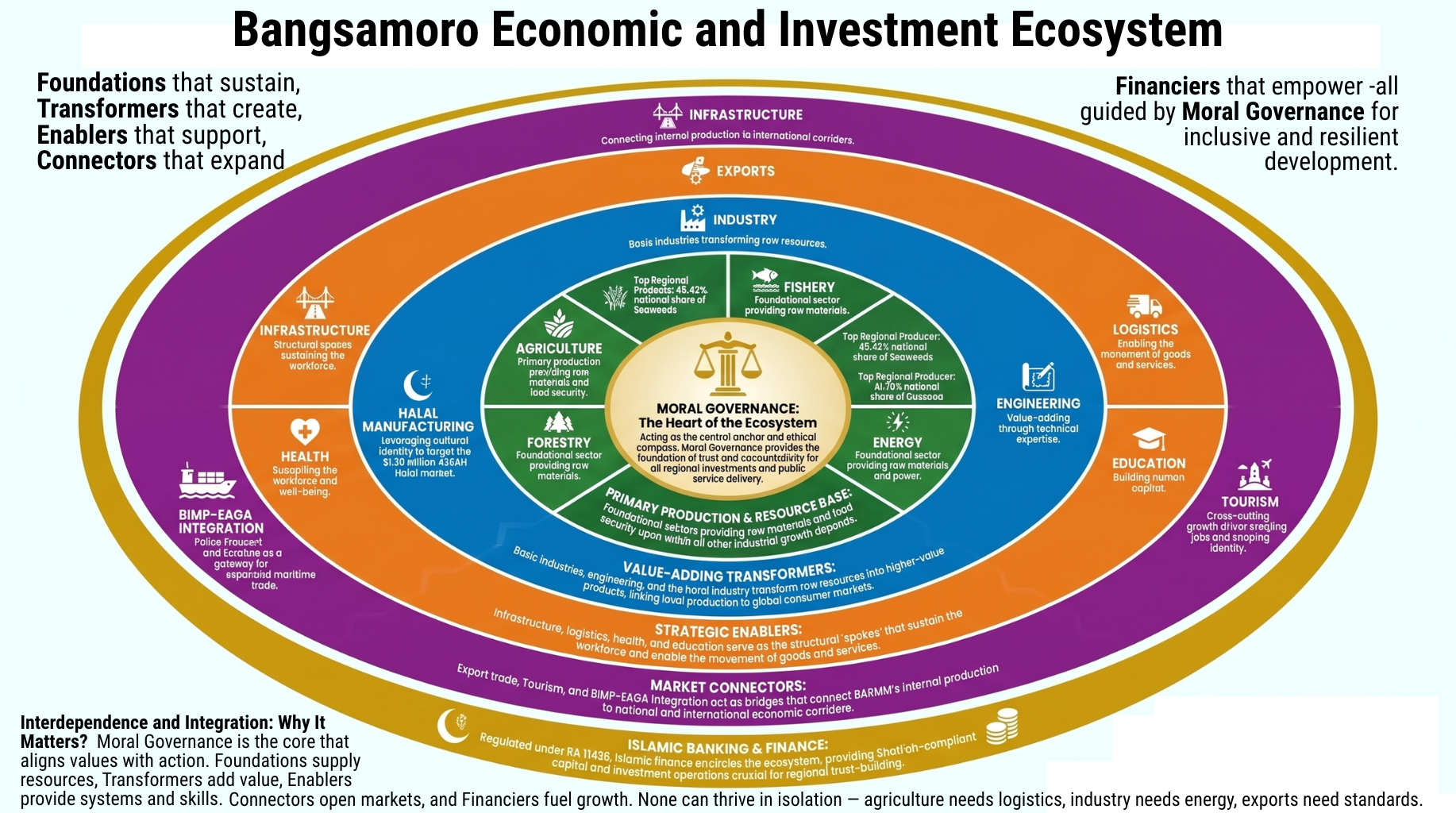
Bangsamoro Economic and Investment Ecosystem (BEIE) Framework

Applying the integrated systems model to analyze sectoral interlinkages and identify priority investment corridors in Tawi-Tawi.

How the BEIE Framework works: The BEIE Framework organizes economic activity into five functional clusters—Foundations, Transformers, Enablers, Connectors, and Financiers—anchored by Moral Governance and driven by four cross-cutting enablers: Tourism and Culture, Peace and Security, Human Capital, and Environmental Sustainability. This systems lens reveals investment opportunities that a conventional sectoral analysis would miss.
Bangsamoro Economic and Investment Ecosystem (BEIE) Framework diagram showing the five clusters: Foundations, Transformers, Enablers, Connectors, Financiers, with cross-cutting drivers of Moral Governance, Tourism/Culture, Peace/Security, Human Capital, and Environmental Sustainability

Bangsamoro Economic and Investment Ecosystem (BEIE) Framework

The BEIE Framework visualizes the interconnected nature of economic clusters in BARMM. Each cluster supports and reinforces the others, creating a holistic ecosystem for sustainable development.

Cluster 1

Foundations — Seaweed, Fisheries & Marine Resources

The resource base on which Tawi-Tawi's entire economic ecosystem depends. This cluster feeds raw materials into Transformers and commodities into Connectors.

  • Seaweed Farming: The province produces 40% of national carrageenan seaweed output, supporting over 50,000 livelihoods. Modernization programs focus on disease-resistant varieties and climate-adaptive cultivation methods.
  • Marine Fisheries: Tawi-Tawi's extensive coral reefs and seagrass beds support diverse fish stocks. The province is developing sustainable aquaculture and marine protected areas to ensure long-term resource viability.
Investment Opportunities: Seaweed farm modernization, climate-resilient aquaculture, marine fisheries cold chain, sustainable mariculture zones, and coral reef conservation tourism.
Cluster 2

Transformers — Seaweed Processing & Halal Marine Products

If Foundations provide the raw material, Transformers create the value. This cluster includes seaweed processing and the strategically significant halal marine products industry.

  • Seaweed Processing: Currently, most seaweed is exported as raw dried material. Investment in processing facilities for carrageenan, refined carrageenan, and semi-refined carrageenan would significantly increase value capture.
  • Halal Marine Products: The province's Muslim majority population and cultural authority in Islamic practice create a natural ecosystem for halal-certified marine products targeting BIMP-EAGA and GCC markets.
Investment Opportunities: Modern seaweed processing plants, halal marine product certification facilities, carrageenan extraction facilities, and value-added seaweed product manufacturing.
Cluster 3

Enablers — Port Infrastructure & Digital Connectivity

No production capability can generate export value without physical infrastructure to move goods. Infrastructure gaps remain key investment constraints for Tawi-Tawi.

  • Port Infrastructure: The Bongao Port and other municipal wharves require significant upgrades to handle increased trade volumes. The Bongao Bridge project will enhance intra-provincial connectivity.
  • Digital Connectivity: Broadband penetration remains limited in rural areas. Investment in digital infrastructure is essential for e-commerce, digital financial services, and modern supply chain management.
Investment Opportunities: Port modernization, Bongao Bridge completion, digital connectivity expansion, renewable energy for island communities, and cold chain logistics facilities.
Cluster 4

Connectors — BIMP-EAGA Trade & Export Corridors

This cluster links Tawi-Tawi's production to regional and global markets through BIMP-EAGA integration and strategic export corridors.

  • BIMP-EAGA Integration: Tawi-Tawi's proximity to Sabah (150km) and North Kalimantan creates natural trade corridors. The province is positioned as a gateway for marine products entering Southeast Asian markets.
  • Export Markets: BARMM is pursuing the UAE and GCC as major export destinations for halal marine and seaweed products. Tawi-Tawi's halal certification infrastructure will be critical for accessing these premium markets.
Investment Opportunities: BIMP-EAGA trade facilitation services, halal export certification, cross-border logistics hubs, and digital trade platforms connecting Tawi-Tawi to regional markets.
Cluster 5

Financiers — Islamic Banking & Microfinance

The Financiers cluster is strategically important given the province's 98% Muslim population and alignment with Islamic finance principles.

  • Islamic Banking: The province has minimal formal financial service penetration. Expansion of Islamic banking services, particularly Al-Amanah Islamic Bank, is essential for capital access by seaweed farmers and MSMEs.
  • Microfinance & Digital Payments: Mobile banking and digital payment platforms can overcome geographic isolation and provide financial services to remote island communities.
Investment Opportunities: Islamic banking branch expansion, takaful (Islamic insurance) for seaweed farmers, waqf instruments for community development, and digital financial services for island communities.
Cross-Cutting

Cross-Cutting Drivers — Marine Tourism & Climate Adaptation

These drivers operate across all clusters and determine the effectiveness of the entire ecosystem.

  • Marine Eco-Tourism: Tawi-Tawi's pristine coral reefs, diverse marine life, and Sama-Bajau cultural heritage create significant tourism potential. Development must balance conservation with economic opportunity.
  • Climate Adaptation: As an island province, Tawi-Tawi is highly vulnerable to climate change, sea-level rise, and extreme weather events. Climate-resilient infrastructure and adaptation planning are essential.
Investment Opportunities: Marine eco-tourism infrastructure, coral reef conservation, climate-resilient seaweed varieties, early warning systems, and sustainable fisheries management.

Investment Climate and Recent Performance

Tracking BARMM's investment momentum and highlighting significant projects in Tawi-Tawi that demonstrate the province's emerging attractiveness to investors.

BARMM Investment Momentum

BARMM's investment climate has undergone a structural upswing. The Bangsamoro Board of Investments (BBOI) had set a 2025 target of ₱3 billion in new investment approvals. This target was breached in April 2025, with ₱3.2 billion in registered investments by mid-year. By October 2025, total 2025 investments had reached ₱5 billion, generating 2,029 jobs across BARMM.

The momentum accelerated dramatically into 2026. In the first quarter of 2026 alone, BARMM registered ₱2.4 billion in investments, projected to generate 930 jobs. By April 2026, the region had already surpassed its entire 2025 full-year record, with total approved investments reaching ₱5.1 billion—exceeding the ₱3.2 billion annual target in just four months. These investments are expected to create 2,583 jobs for Bangsamoro constituents.

Philippine Statistics Authority data confirmed that BARMM ranked second in Mindanao in approved investments, behind only the Davao Region, and placed within the top 10 regions nationally for Q2 2025. BBOI Chairperson Mohamad Omar Pasigan attributed the achievement to growing investor confidence in BARMM "as a rising hub for sustainable, inclusive, and high-impact investments," reflecting the business community's trust in the Bangsamoro government's commitment to transparency, ease of doing business, and investor protection under Chief Minister Abdulraof Macacua's Mas Matatag na Bangsamoro agenda and the Economic Jihad campaign anchored on moral governance.

Tawi-Tawi Investment Highlights (2022–2025)

Project/Investor Location Value/ Jobs Sector
Bongao Bridge Construction Bongao ₱795.7M (MPW) Infrastructure
Port and Wharf Development Multiple municipalities MPW infrastructure projects Maritime/Logistics
Seaweed Industry Modernization Province-wide MAFAR programs Agriculture/Aquaculture
Tourism Master Plan Implementation Bongao and island municipalities ₱467.8M (PNA 2024) Tourism
Al-Amanah Islamic Bank Expansion Multiple municipalities Branch network expansion Islamic Finance
Climate Resilience Program Coastal communities ₱10M (DOF adaptation fund) Climate Adaptation
BBOI Q1 2026 Portfolio (Multi-Sector) BARMM-wide ₱2.4B / 930 jobs Multi-Sector
BBOI April 2026 Approvals (6 Projects) Cotabato City, Mainland & Island Provinces ₱2.6B / 1,657 jobs Health, Tourism, Agri, Industry

Strategic Investment Priority Areas

Based on the BEIE Framework analysis, existing investment momentum, and the province's structural endowments, the following priority investment corridors are identified for Tawi-Tawi through 2035:

April 2026 BBOI Approved Projects

The April 30, 2026 BBOI approvals demonstrate the breadth of emerging opportunities across BARMM, including a major ₱2.2 billion flagship project for an island province (likely Tawi-Tawi or Basilan) projected to generate 1,330 jobs:

  • Health and Wellness + Tourism Facilities (Cotabato City): ₱177 million investment generating 69 jobs in the region capital.
  • Agriculture and Agribusiness Project 1 (Mainland Province): ₱167 million investment projected to create 113 jobs.
  • Agriculture and Agribusiness Project 2 (Mainland Province): ₱58 million investment expected to employ 143 workers.
  • Major Island Province Investment (Basilan or Tawi-Tawi): ₱2.2 billion flagship project projected to generate 1,330 jobs.

Priority Investment Corridors

  • Seaweed Value Chain Development Zone (Province-wide): Integrated seaweed cultivation, modern processing facilities, and value-added product manufacturing for domestic and export markets.
  • Marine Fisheries and Aquaculture Corridor (Coastal municipalities): Development of fish ports, cold chain facilities, and sustainable aquaculture projects.
  • Bongao Commercial and Tourism Hub: Mixed-use commercial development, halal tourism infrastructure, and MSME support facilities.
  • BIMP-EAGA Trade Gateway: Logistics hubs, port infrastructure, and trade facilitation services linking Tawi-Tawi to Sabah, Malaysia, and eastern Indonesia.
  • Marine Eco-Tourism Circuit: Development of pristine island destinations, Sama-Bajau cultural heritage sites, and halal-certified hospitality infrastructure.
  • Renewable Energy for Island Communities: Solar and marine renewable energy projects to address high power costs and improve energy access in remote islands.

Challenges, Risks, and Structural Constraints

Identifying the key obstacles and vulnerabilities that must be addressed to realize the investment outlook and ensure sustainable development.

Poverty and Human Development

Tawi-Tawi records the highest poverty incidence in BARMM at 39.5% (2023) and the lowest functional literacy rate at 54.2%. These human capital deficits constrain the province's capacity to supply skilled labor for modern seaweed processing, tourism, and services investment. Addressing these gaps requires sustained investment in education, health, and vocational training.

Infrastructure Gaps

Despite recent investments in the Bongao Bridge and port facilities, significant infrastructure gaps remain. Road networks in interior municipalities limit market access for seaweed farmers. Digital connectivity is uneven, with broadband penetration in rural areas remaining limited. Power supply is unreliable and expensive, constraining industrial development.

Climate Vulnerability

As an island province, Tawi-Tawi is highly vulnerable to climate change impacts including sea-level rise, extreme weather events, and ocean acidification. The seaweed industry faces climate-related risks including disease outbreaks (ice-ice disease) and changing ocean temperatures. Climate adaptation and resilient infrastructure are critical for long-term viability.

Limited Financial Services

Despite a 98% Muslim population, formal financial service penetration remains minimal. Most seaweed farmers and MSMEs lack access to formal credit, insurance, and savings products. This constrains investment capacity and forces reliance on informal lending at high interest rates. Islamic banking expansion is essential for inclusive economic development.

Value Chain Constraints

Most seaweed is exported as raw dried material, capturing minimal value. Limited processing infrastructure means the province does not benefit from higher-value carrageenan and refined products. Developing processing capabilities requires significant capital investment, technical expertise, and market linkages to international buyers.

Security and Governance

While BARMM's peace framework has broadly held, Tawi-Tawi's proximity to conflict-affected areas in Sulu creates security concerns. Cross-border crime, including smuggling and illegal fishing, requires enhanced maritime security cooperation with neighboring countries. Governance capacity must be strengthened to manage complex development challenges.

Strategic Outlook and Investment Recommendations

Defining the ten-year economic vision and prioritizing ecosystem-based investments to transform Tawi-Tawi into a self-sustaining, export-linked, and inclusive marine-based economic hub.

Vision Statement: Transform Tawi-Tawi from a frontier island province into a self-sustaining, export-linked, and inclusive marine-based economic hub within BARMM, grounded in its comparative advantages—seaweed industry dominance, strategic BIMP-EAGA location, cultural heritage, and alignment with the global halal economy.

Policy Recommendations for Policymakers

Strategic actions to create an enabling environment for investment and sustainable development.

  • Establish a dedicated Tawi-Tawi Investment Facilitation Office within the BBOI to serve as a one-stop shop for investors, reducing transaction costs and coordination delays.
  • Fast-track the seaweed industry modernization program integrating MAFAR support, climate adaptation measures, and value-addition infrastructure into a coherent seaweed development strategy.
  • Prioritize completion of port and bridge infrastructure projects including the Bongao Bridge and key wharf developments to enhance intra-provincial and international connectivity.
  • Develop a Tawi-Tawi Halal Marine Products Roadmap focusing on halal certification infrastructure, quality assurance systems, and export market linkages to BIMP-EAGA and GCC markets.
  • Accelerate Islamic banking licensing and expand the Al-Amanah Islamic Investment Bank of the Philippines network in Tawi-Tawi municipalities to improve capital access for seaweed farmers, fisherfolk, and MSMEs.
  • Strengthen climate adaptation programs for the seaweed and fisheries sectors, including disease-resistant varieties, adaptive management systems, and early warning systems for extreme weather events.

Investment Recommendations for Investors

Strategic opportunities and priority zones for private sector investment.

  • Seaweed processing investors: Look at Tawi-Tawi as a priority zone for carrageenan and refined carrageenan extraction facilities, where 40% of national raw material is produced but minimal processing occurs.
  • Halal marine products sector: The province presents a first-mover advantage for halal-certified marine products targeting BIMP-EAGA and GCC markets, leveraging its Muslim majority population and cultural authority.
  • Infrastructure investors: Assess the port development, bridge construction, and digital connectivity gaps as high-priority, high-return infrastructure corridors with significant development impact.
  • Renewable energy investors: Recognize Tawi-Tawi as a significant underserved market: an island province with growing electricity demand, high power costs, and abundant solar and marine renewable energy resources.
  • Tourism investors: Conduct feasibility studies for marine eco-tourism, cultural heritage circuits, and halal hospitality in anticipation of the province's continued tourism development under the Tourism Master Plan.

Ecosystem-Based Investment Priorities (2026–2035)

Integrated investment matrix aligned with the BEIE Framework clusters.

  • Foundations: Seaweed farming modernization, climate-resilient aquaculture (Target: 2026–2030) - Expanded AFF output, export-ready supply chains.
  • Transformers: Modern seaweed processing plants, halal marine products (Target: 2026–2032) - Value-added exports, MSME employment.
  • Enablers: Port infrastructure, digital connectivity, renewable energy (Target: 2026–2030) - Reduced logistics costs, market access.
  • Connectors: BIMP-EAGA trade linkages, halal export certification (Target: 2026–2035) - Export revenue, regional market integration.
  • Financiers: Islamic banking expansion, microfinance, digital payments (Target: 2026–2030) - Inclusive capital access, MSME financing.
  • Cross-Cutting: Marine eco-tourism, cultural heritage, climate adaptation (Target: 2026–2035) - Diversified income, resilient communities.

Invest in Tawi-Tawi

Connect with our investment facilitation team and explore opportunities in the emerging marine-based economic hub of BARMM.

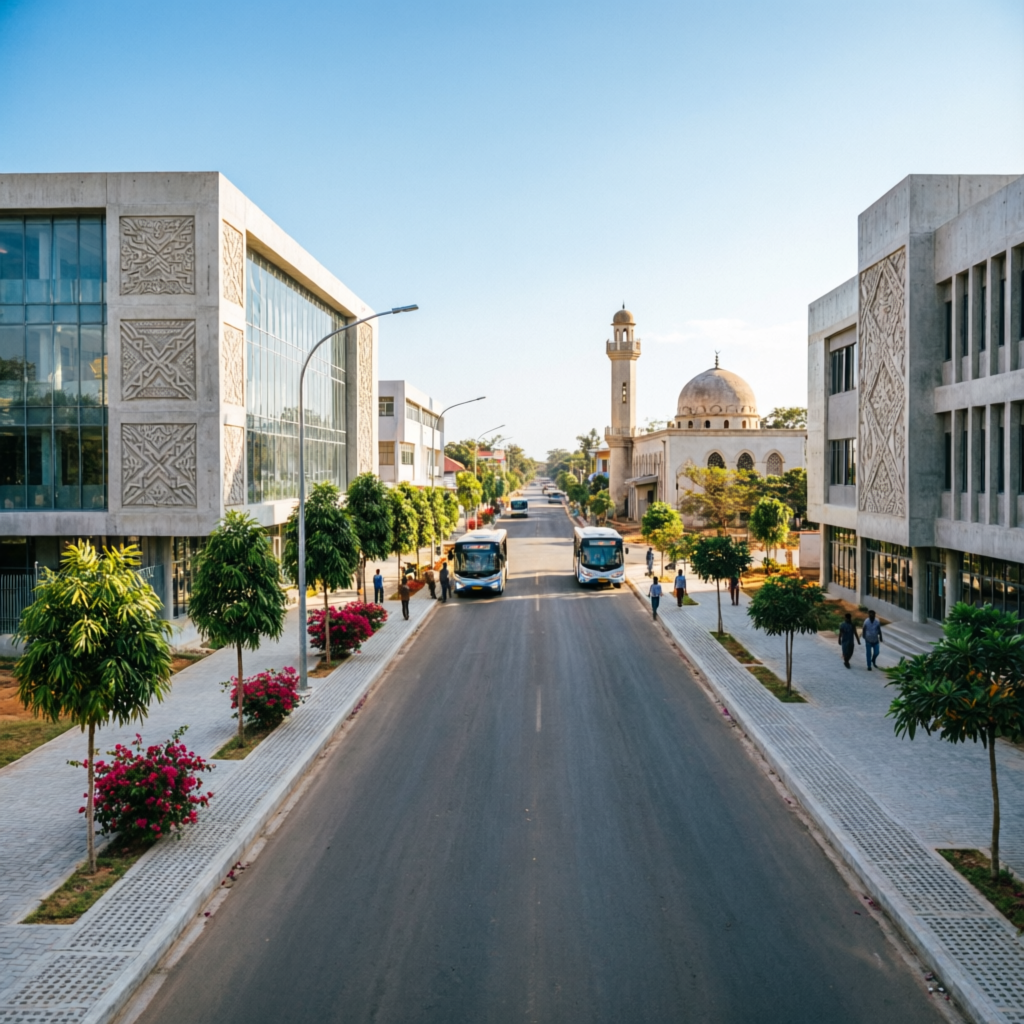
Tawi-Tawi island landscape and Bongao development

Investment Facilitation

MinistryMinistry of Trade, Investments and Tourism (MTIT)
Bangsamoro Autonomous Region in Muslim Mindanao

AddressMTIT Building, Capitol Compound
Cotabato City, 9600 Philippines

Key Investment Agencies

Bangsamoro Board of Investments (BBOI)
Bangsamoro Economic Zone Authority (BEZA)
Bangsamoro Halal Board (BHB)
Polloc Freeport & Ecozone (PFEZ)
BPDA – Planning & Development
WOW Matanog Special Ecozone

🕐 Office HoursMonday – Friday, 8:00 AM – 5:00 PM (PHT)
Investment inquiries responded to within 3 business days.

Send an Investment Inquiry

Your information is kept confidential and used solely for investment facilitation purposes.