Investment Outlook 2026–2035

Special Geographic Area Economic and
Investment Outlook 2026-2035

Transforming the 63 barangays into 8 newly created municipalities: An emergent standalone agro-industrial corridor and cross-provincial trade hub connecting BARMM to the broader Mindanao economy.

Explore the Outlook Investment Opportunities
63 Barangays
8 New Municipalities
Central Mindanao Corridor
Agri Industrial Base

Provincial Overview

Understanding the unique geographic, demographic, and historic governance context of the Special Geographic Area (SGA), now transitioning into 8 formal municipalities.

Geographic Profile

The SGA comprises 63 barangays geographically scattered across the province of Cotabato (North Cotabato), bordering the BARMM mainland provinces of Maguindanao del Norte and Maguindanao del Sur. Despite being geographically dispersed, the SGA forms a continuous economic and cultural corridor along the Rio Grande de Mindanao basin and upland agricultural zones, featuring fertile plains ideal for high-value crops.

63 Barangays
Scattered Geographic Layout
Rio Grande River Basin
The 2023 Governance Milestone

In August 2023, the Bangsamoro Parliament approved bills converting the 63 barangays into 8 regular municipalities. This historic legislation transitions the SGA from an administrative anomaly under direct regional governance into formal Local Government Units (LGUs) with their own mayors, councils, and Internal Revenue Allotments (IRA). This milestone unlocks standalone economic planning, local permit issuance, and direct investment facilitation.

Aug 2023 Parliament Approval
8 New LGUs Created
IRA/NTA Fiscal Autonomy

Demographic & Cultural Profile

The SGA is characterized by a diverse demographic profile, featuring peaceful coexistence between Bangsamoro (Maguindanaon) and Indigenous Peoples (Lumad), as well as Christian settlers. This diversity is a unique strength, fostering a resilient labor force and a broad cultural base for inclusive agro-industrial development. The 2019 plebiscite affirmed the residents' desire to be part of the Bangsamoro, anchoring the region's identity in the BARMM's Moral Governance framework.

Diverse Cultural Demographics
2019 Plebiscite Affirmation
Inclusive Social Fabric

Macroeconomic Performance

Analysis of the SGA's transition from a direct-governance transitional zone into a formalized, standalone agro-industrial powerhouse integrated with the broader Mindanao economy.

Standalone Agro-Industrial Potential

The SGA is no longer merely a transitional zone; it is an emergent standalone investment hub. With the creation of 8 regular municipalities, the SGA can now directly issue business permits, zone economic areas, and attract private capital. The region's fertile plains make it a top producer of rice, corn, coconut, banana, and rubber in Mindanao. The formalization of LGUs provides the institutional stability required for large-scale agro-industrial processing investments.

Key Crops

  • Rice & Corn
  • Banana (Export-grade)
  • Coconut & Rubber

LGU Status

  • 8 Formal Municipalities
  • Local Permit Issuance
  • Fiscal Autonomy (IRA)

Investment Climate

Emerging

Cross-Provincial Trade Hub

Geographically embedded within North Cotabato, the SGA serves as the critical "Mindanao Central Corridor." It bridges the BARMM mainland (Maguindanao, Cotabato City) with the non-BARMM SOCCSKSARGEN region and Davao. This unique position allows the SGA to function as a logistics and aggregation hub, channeling agricultural output from both BARMM and non-BARMM territories toward the Polloc Freeport and BIMP-EAGA export corridors.

Strategic Role

  • BARMM-SOCCSKSARGEN Bridge
  • Logistics Aggregation
  • Inter-regional Trade

Export Access

  • Polloc Freeport Link
  • General Santos Port
  • Davao Gateway

Corridor Status

Active

Land Tenure & Formalization

A defining economic characteristic of the SGA is the complex overlay of land tenure systems, including Ancestral Domain (CADT), private titles, and public land. The transition to 8 municipalities accelerates the need for comprehensive land mapping and titling. Resolving land tenure is the primary catalyst for unlocking capital, as formalized land titles enable farmers and MSMEs to access conventional and Islamic banking credit for expansion.

Tenure Systems

  • CADT (Ancestral)
  • Private Titles
  • Public Land

Priority Action

  • One Map Policy
  • Titling Programs
  • Conflict Resolution

Capital Unlock

High

Investment Momentum & BARMM Integration

The SGA is rapidly integrating into the BARMM investment ecosystem. The Bangsamoro Board of Investments (BBOI) is establishing satellite facilitation protocols for the new municipalities. As the 8 LGUs adopt the Bangsamoro Investment Code and align with the BIRD 2026-2035 roadmap, the SGA is positioned to capture a share of the record β‚±5.1B in BARMM investments approved in Q1 2026, particularly in agro-processing and logistics infrastructure.

BBOI Integration

  • Satellite Offices
  • One-Stop Shop
  • Aftercare Services

Target Sectors

  • Agro-Processing
  • Logistics
  • Halal Manufacturing

Growth Trajectory

Accelerating

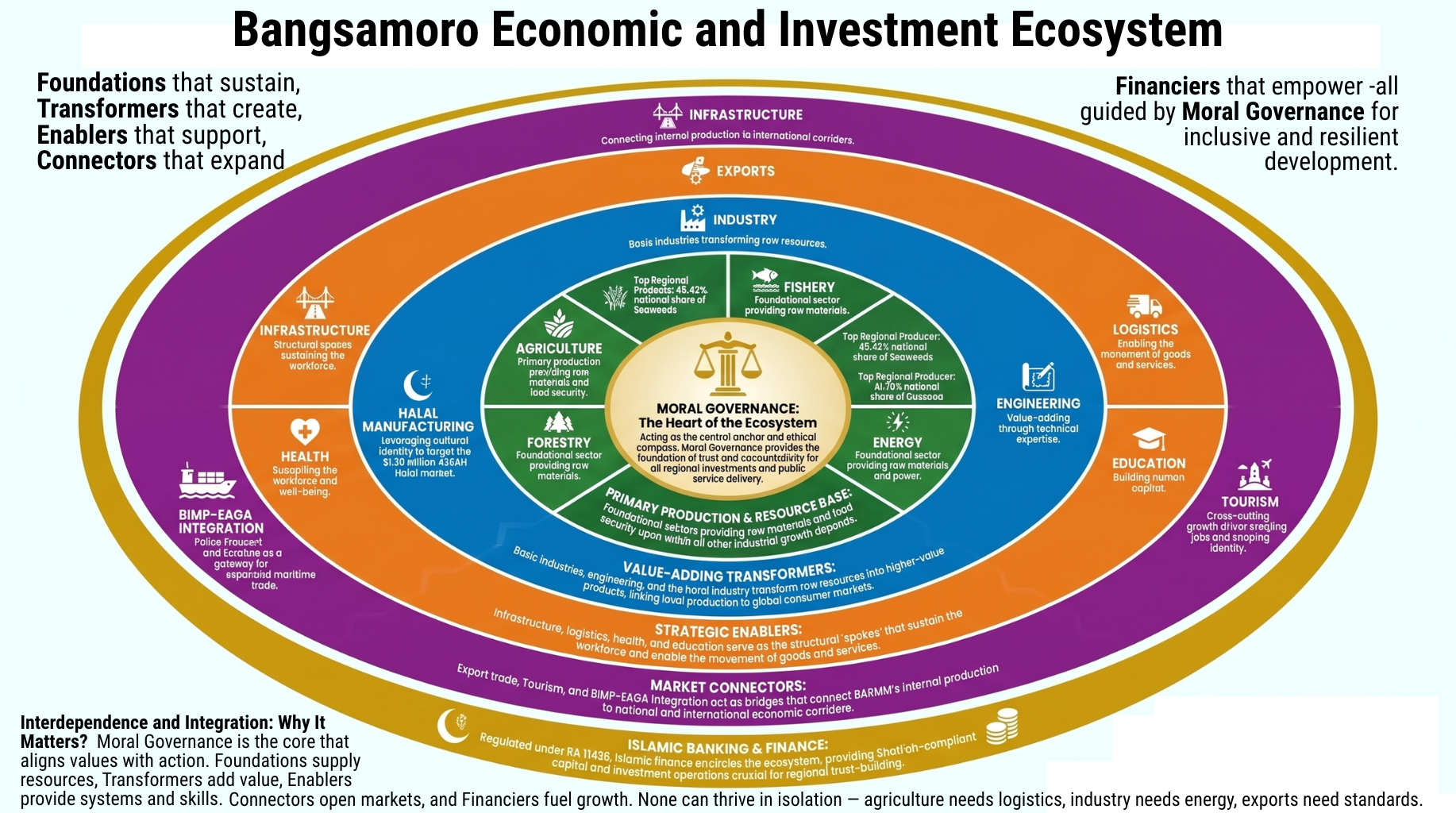
Bangsamoro Economic and Investment Ecosystem (BEIE) Framework

Applying the integrated systems model to analyze the SGA's standalone potential and its critical cross-provincial linkages across Mindanao.

How the BEIE Framework applies to the SGA: The SGA is not an isolated zone; it is the connective tissue of the BARMM mainland. The BEIE Framework reveals how the SGA's 8 new municipalities can synchronize agricultural production (Foundations) with processing (Transformers), leverage its unique geographic position for logistics (Enablers & Connectors), and integrate Islamic finance (Financiers), all anchored by the historic transition to formal Moral Governance.
Bangsamoro Economic and Investment Ecosystem (BEIE) Framework diagram

Bangsamoro Economic and Investment Ecosystem (BEIE) Framework

The BEIE Framework visualizes the interconnected nature of economic clusters. For the SGA, this framework is vital for mapping how its 8 municipalities integrate with neighboring BARMM provinces and the broader Mindanao economy.

Cluster 1

Foundations β€” Rice, Corn, Coconut, Banana & Rubber

The SGA's fertile river basins and uplands make it a primary production zone for Mindanao's staple and export crops. The formalization of the 8 municipalities provides the local governance stability needed to support large-scale farming cooperatives and climate-smart agriculture.

  • Rice & Corn: High-yield production along the Rio Grande de Mindanao, ensuring regional food security.
  • Banana & Coconut: Export-grade plantations and smallholder farms providing raw materials for processing.
Investment Opportunities: Climate-smart agriculture, seed technology, large-scale cooperative farming, and organic certification programs.
Cross-Provincial Linkage: Feeds the massive rice and corn value chains of Maguindanao del Sur and supplies raw bananas/coconuts to the processing hubs of Lanao del Sur and Davao.
Cluster 2

Transformers β€” Agro-Processing & Halal Manufacturing

The SGA's greatest standalone potential lies in value addition. With 8 new municipalities capable of zoning industrial areas, the SGA can host rice mills, coconut oil extraction plants, banana packing facilities, and halal food manufacturing. This prevents the historical leakage of value, where raw crops were shipped out of the region for processing.

  • Agro-Processing: Rice milling, corn processing, and coconut derivatives (VCO, desiccated coconut, coir).
  • Halal Manufacturing: Leveraging the BARMM halal ecosystem to produce certified food products for export.
Investment Opportunities: Agro-industrial parks, halal slaughterhouses, banana packing plants, and coconut oil mills.
Cross-Provincial Linkage: Processed goods from the SGA feed directly into the Basilan and Tawi-Tawi halal export corridors, ultimately targeting the UAE/GCC markets via the Polloc Freeport.
Cluster 3

Enablers β€” Infrastructure, Land Tenure & Digital Governance

The transition to 8 municipalities requires robust enablers. Farm-to-market roads (FMRs) are critical to connect scattered barangays to processing hubs. Equally important is the resolution of land tenure (CADT vs. private titles) and the deployment of the Bangsamoro e-Governance Master Plan (BEGMP) to ensure the new LGUs can issue digital permits and collect local revenues efficiently.

  • Physical Infrastructure: FMRs, Rio Grande de Mindanao flood control, and irrigation systems.
  • Digital Governance: Integration into the BBOI one-stop shop and BEGMP digital LGU systems.
Investment Opportunities: FMR construction, cold chain logistics, digital LGU software deployment, and land mapping/surveying services.
Cross-Provincial Linkage: Connects the Maguindanao road networks to the SOCCSKSARGEN highway system, creating a seamless logistics corridor across Mindanao.
Cluster 4

Connectors β€” The Mindanao Central Logistics Corridor

The SGA is the ultimate connector. Geographically embedded in North Cotabato, it bridges the BARMM region with the rest of Mindanao. The 8 municipalities can develop warehousing, logistics hubs, and dry ports that aggregate goods from both BARMM and non-BARMM territories, funneling them toward the Polloc Freeport, General Santos City, and the BIMP-EAGA network.

  • Logistics Hubs: Warehousing, consolidation centers, and inter-modal transport facilities.
  • Trade Facilitation: Streamlining cross-border trade between BARMM and non-BARMM LGUs.
Investment Opportunities: Industrial closed warehouses, logistics parks, digital customs clearance platforms, and freight forwarding services.
Cross-Provincial Linkage: Serves as the primary land bridge connecting Cotabato City/Polloc Freeport (BARMM) with General Santos City (SOCCSKSARGEN) and the Davao export gateways.
Cluster 5

Financiers β€” Islamic Banking & Land-Backed Credit

The formalization of land titles in the SGA unlocks a massive opportunity for Islamic finance. As farmers and MSMEs secure titles, institutions like Al-Amanah Islamic Bank and CARD Islamic Bank can provide Shariah-compliant credit for agro-industrial expansion. The 8 new municipal LGUs can also utilize Islamic finance instruments (like Sukuk) for local infrastructure projects.

  • Islamic Banking: Expanding branch networks into the 8 new municipalities.
  • Microfinance: Shariah-compliant credit for smallholder farmers and MSMEs.
Investment Opportunities: Islamic rural banking, agricultural takaful (insurance), and waqf-based community development funds.
Cross-Provincial Linkage: Integrates with the Maguindanao del Norte Islamic finance hub in Cotabato City, creating a unified BARMM financial corridor.
Cross-Cutting

Cross-Cutting Drivers β€” Moral Governance & Peace Consolidation

The creation of 8 municipalities is the ultimate expression of Moral Governance in the SGA. It transitions the region from direct regional rule to participatory local democracy. Consolidating this peace dividend requires inclusive local planning, transparent revenue management, and the integration of Indigenous Peoples (Lumad) and Bangsamoro communities into the new municipal economic councils.

  • Moral Governance: Transparent LGU operations, anti-corruption frameworks, and participatory budgeting.
  • Peace & Security: Maintaining the peaceful coexistence that allowed the 2019 plebiscite to succeed.
Investment Opportunities: LGU capacity building, civil service digitalization, and community-based peace and development programs.

Investment Climate and Recent Performance

Tracking the SGA's historic governance transition and its integration into BARMM's record-breaking investment momentum.

The 2023 Governance Milestone

In August 2023, the Bangsamoro Parliament made history by approving bills creating 8 new municipalities out of the 63 barangays of the Special Geographic Area. This legislative act resolved years of administrative uncertainty, granting the residents formal Local Government Unit (LGU) status. The new municipalities are now entitled to their own Internal Revenue Allotments (IRA) / National Tax Allotments (NTA), local chief executives, and legislative councils. This milestone is the foundational prerequisite for all future economic development, as it provides the institutional architecture required to issue business permits, zone industrial areas, and directly engage with investors.

SGA & BARMM Investment Highlights (2023–2026)

Project/Initiative Location Value/ Status Sector
Creation of 8 New Municipalities SGA (63 Barangays) Approved Aug 2023 Governance/LGU
BBOI Satellite Facilitation Protocols SGA & Cotabato City Active Integration Investment Promotion
Farm-to-Market Road Networks SGA Municipalities MPW/DPWH Projects Infrastructure
Land Tenure Mapping & Titling SGA (CADT/Private) Ongoing (MBHMC/DENR) Land Administration
BBOI Q1 2026 Portfolio (Multi-Sector) BARMM-wide β‚±2.4B / 930 jobs Multi-Sector
BBOI April 2026 Approvals (6 Projects) Cotabato City, Mainland & Island Provinces β‚±2.6B / 1,657 jobs Health, Tourism, Agri, Industry

Strategic Investment Priority Areas

Based on the BEIE Framework analysis and the historic transition to 8 municipalities, the following priority investment corridors are identified for the SGA through 2035:

Priority Investment Corridors

  • SGA Agro-Industrial Processing Zone: Leveraging the abundant rice, corn, coconut, and banana production to establish modern milling, packing, and halal food processing facilities within the new municipal jurisdictions.
  • Mindanao Central Logistics Hub: Developing warehousing, cold chain facilities, and dry ports that aggregate goods from both BARMM and SOCCSKSARGEN, funneling them toward the Polloc Freeport and General Santos City.
  • Land Tenure & Capital Unlocking Program: Investment in land surveying, mapping, and titling services to formalize property rights, enabling farmers and MSMEs to access Islamic and conventional banking credit.
  • Digital LGU & E-Governance Rollout: Deploying the Bangsamoro e-Governance Master Plan (BEGMP) across the 8 new municipalities to streamline business registration, tax collection, and public service delivery.
  • Climate-Smart Agriculture & Irrigation: Modernizing the Rio Grande de Mindanao irrigation systems and introducing drought-resistant crop varieties to protect the region's agricultural base from El NiΓ±o.

Challenges, Risks, and Structural Constraints

Identifying the unique obstacles facing the SGA's transition from a transitional zone to a formalized economic hub.

Land Tenure Complexity

The SGA features a complex overlay of Ancestral Domain (CADT), private land titles, and public land. This complexity creates friction for large-scale investors seeking contiguous land for agro-industrial parks. Accelerating the "One Map Policy" and resolving overlapping claims between the MBHMC, DENR, and private claimants is the single most critical enabler for investment.

LGU Institutional Capacity

The transition from direct BARMM governance to 8 independent municipalities requires massive capacity building. The new local chief executives and councils must rapidly develop expertise in local revenue generation, investment promotion, zoning, and integration into the Bangsamoro Investment Code. Without this, the SGA risks administrative bottlenecks.

Infrastructure Fragmentation

Because the 63 barangays are geographically scattered across North Cotabato, infrastructure development is inherently fragmented. Farm-to-market roads, irrigation systems, and digital connectivity must be prioritized to connect remote production zones to the new municipal centers and the broader Mindanao highway network.

Climate Vulnerability & Flooding

The SGA's agricultural zones along the Rio Grande de Mindanao are highly susceptible to seasonal flooding and El NiΓ±o-induced droughts. Climate-resilient infrastructure, including flood control systems and modern irrigation, is essential to protect the region's status as a primary food production zone for Mindanao.

Financial Inclusion Gaps

Despite the abundance of agricultural wealth, many farmers and MSMEs in the SGA remain unbanked or rely on informal lending. The integration of Islamic banking (Al-Amanah, CARD Islamic) into the new municipalities is critical to provide Shariah-compliant credit that unlocks capital for expansion and modernization.

Social Integration & Inclusivity

The SGA's diverse demographic of Bangsamoro, Lumad, and Christian settlers requires deliberate, inclusive economic planning. Ensuring that the benefits of the 8 new municipalities and agro-industrial investments are equitably shared across all cultural communities is vital for sustaining the region's hard-won peace and stability.

Strategic Outlook and Investment Recommendations

Defining the ten-year economic vision to transform the SGA's 8 new municipalities into a standalone agro-industrial powerhouse and Mindanao's central logistics corridor.

Vision Statement: Transform the Special Geographic Area from a historically transitional zone into a self-sustaining, formalized, and inclusive economic hub. By leveraging the creation of 8 regular municipalities, the SGA will serve as BARMM's premier agro-industrial processing zone and the critical logistics bridge connecting the Bangsamoro to the broader Mindanao and BIMP-EAGA economies.

Policy Recommendations for Policymakers

Strategic actions to consolidate the governance transition and create an enabling environment for investment.

  • Establish a dedicated SGA Investment Facilitation Desk within the BBOI to serve as a one-stop-shop for the 8 new municipalities, reducing transaction costs and guiding investors through local and regional permit requirements.
  • Fast-track the "One Map Policy" and comprehensive land tenure resolution between the MBHMC, DENR, and LGUs to formalize property rights, unlocking capital for farmers and enabling large-scale agro-industrial zoning.
  • Accelerate the capacity building of the 8 new municipal LGUs, focusing on local revenue generation, investment promotion, and integration into the Bangsamoro e-Governance Master Plan (BEGMP).
  • Develop the "SGA Agro-Industrial Corridor Master Plan" that synchronizes agricultural production (Foundations) with processing facilities (Transformers) and logistics hubs (Connectors) across the 8 municipalities.
  • Mandate the inclusion of Indigenous Peoples (Lumad) and all cultural communities in the local economic councils of the 8 municipalities to ensure inclusive and peaceful development.

Investment Recommendations for Investors

Strategic opportunities and priority zones for private sector investment in the emerging SGA economy.

  • Agro-Industrial Investors: Position early in the SGA to acquire land and establish rice mills, coconut oil extraction plants, and banana packing facilities. The formalization of the 8 municipalities provides the regulatory stability required for long-term capital deployment.
  • Logistics & Warehousing Developers: Capitalize on the SGA's role as the "Mindanao Central Corridor" by developing industrial closed warehouses, cold chain facilities, and dry ports that aggregate goods from both BARMM and SOCCSKSARGEN.
  • Islamic Finance & Fintech: Partner with the 8 new municipal LGUs and Al-Amanah/CARD Islamic Bank to deploy Shariah-compliant microfinance and digital payment platforms for the region's vast agricultural sector.
  • Land Surveying & Digital Mapping: Provide technical services to accelerate land tenure resolution, a critical bottleneck that, once solved, will unlock billions in agricultural and real estate capital.
  • Climate-Smart Agriculture: Invest in modern irrigation systems, flood control infrastructure, and drought-resistant crop technologies to protect and enhance the region's high-yield agricultural base.

Ecosystem-Based Investment Priorities (2026–2035)

Integrated investment matrix aligned with the BEIE Framework clusters and the SGA's unique cross-provincial position.

  • Foundations: Climate-smart agriculture, land tenure formalization (Target: 2026–2030) - Secured property rights, resilient crop yields.
  • Transformers: SGA Agro-Industrial Parks, halal processing (Target: 2026–2032) - Value-added exports, MSME employment.
  • Enablers: FMRs, digital LGU systems, flood control (Target: 2026–2030) - Reduced logistics costs, institutional capacity.
  • Connectors: Mindanao Central Logistics Hub (Target: 2026–2035) - Integration of BARMM and SOCCSKSARGEN supply chains.
  • Financiers: Islamic rural banking, agricultural takaful (Target: 2026–2030) - Inclusive capital access for farmers.
  • Cross-Cutting: Inclusive local governance, peace consolidation (Target: 2026–2035) - Sustainable, multi-cultural development.

Invest in the Special Geographic Area

Connect with our investment facilitation team and explore opportunities in the SGA's 8 newly created municipalities and the Mindanao Central Corridor.

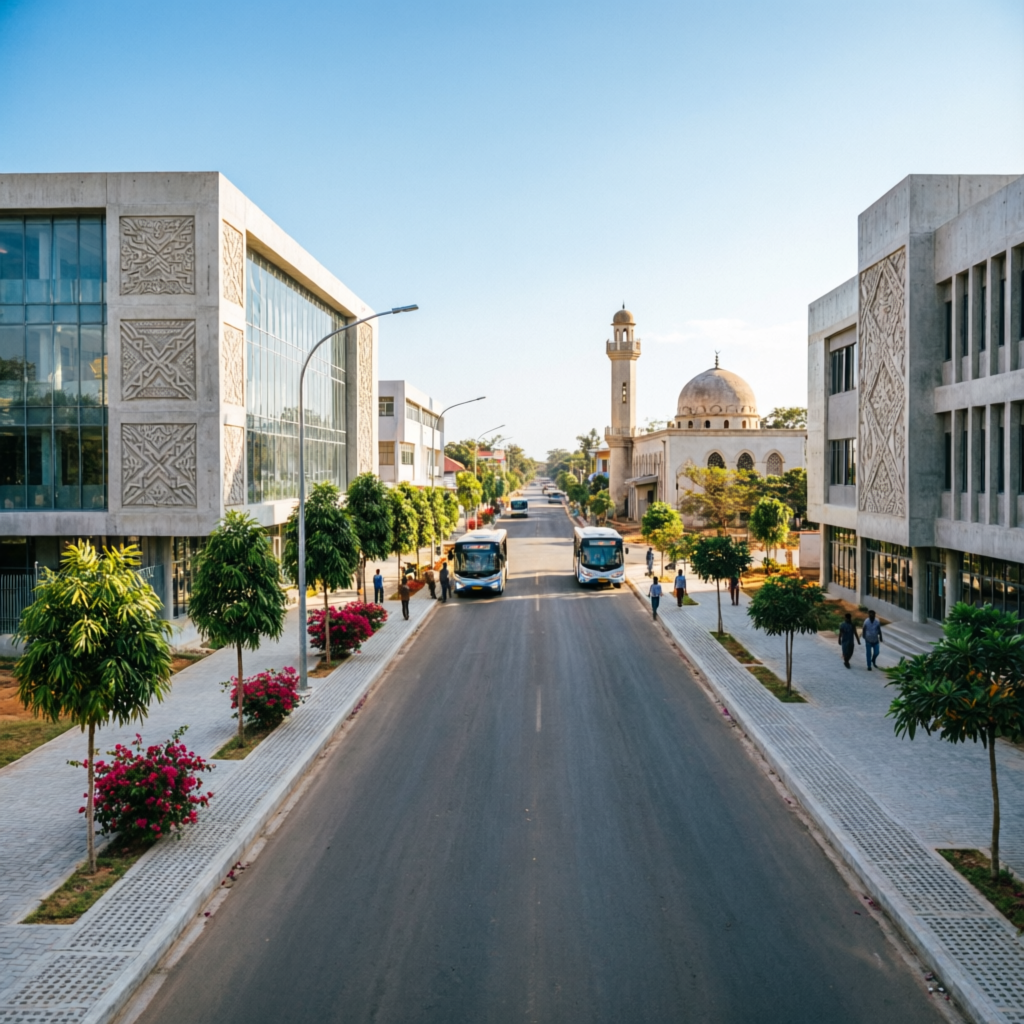
SGA agricultural landscape and municipal development

Investment Facilitation

MinistryMinistry of Trade, Investments and Tourism (MTIT)
Bangsamoro Autonomous Region in Muslim Mindanao

AddressMTIT Building, Capitol Compound
Cotabato City, 9600 Philippines

Key Investment Agencies

Bangsamoro Board of Investments (BBOI)
Bangsamoro Economic Zone Authority (BEZA)
Bangsamoro Halal Board (BHB)
Polloc Freeport & Ecozone (PFEZ)
BPDA – Planning & Development
MBHMC / DENR-BARMM

πŸ• Office HoursMonday – Friday, 8:00 AM – 5:00 PM (PHT)
Investment inquiries responded to within 3 business days.

Send an Investment Inquiry

Your information is kept confidential and used solely for investment facilitation purposes.