Investment Outlook 2026–2035

Maguindanao del Sur Economic and
Investment Outlook 2026-2035

Transforming BARMM's agricultural heartland into a modern agro-industrial hub through integrated rice, corn, and coconut value chain development anchored on moral governance and inclusive growth.

Explore the Outlook Investment Opportunities
800K+ Population 2020
24 Municipalities
2022 Province Created
53.0% Poverty Incidence

Provincial Overview

Understanding the geographical, demographic, and strategic context of Maguindanao del Sur, the newly created agricultural powerhouse of BARMM.

Geographic Profile

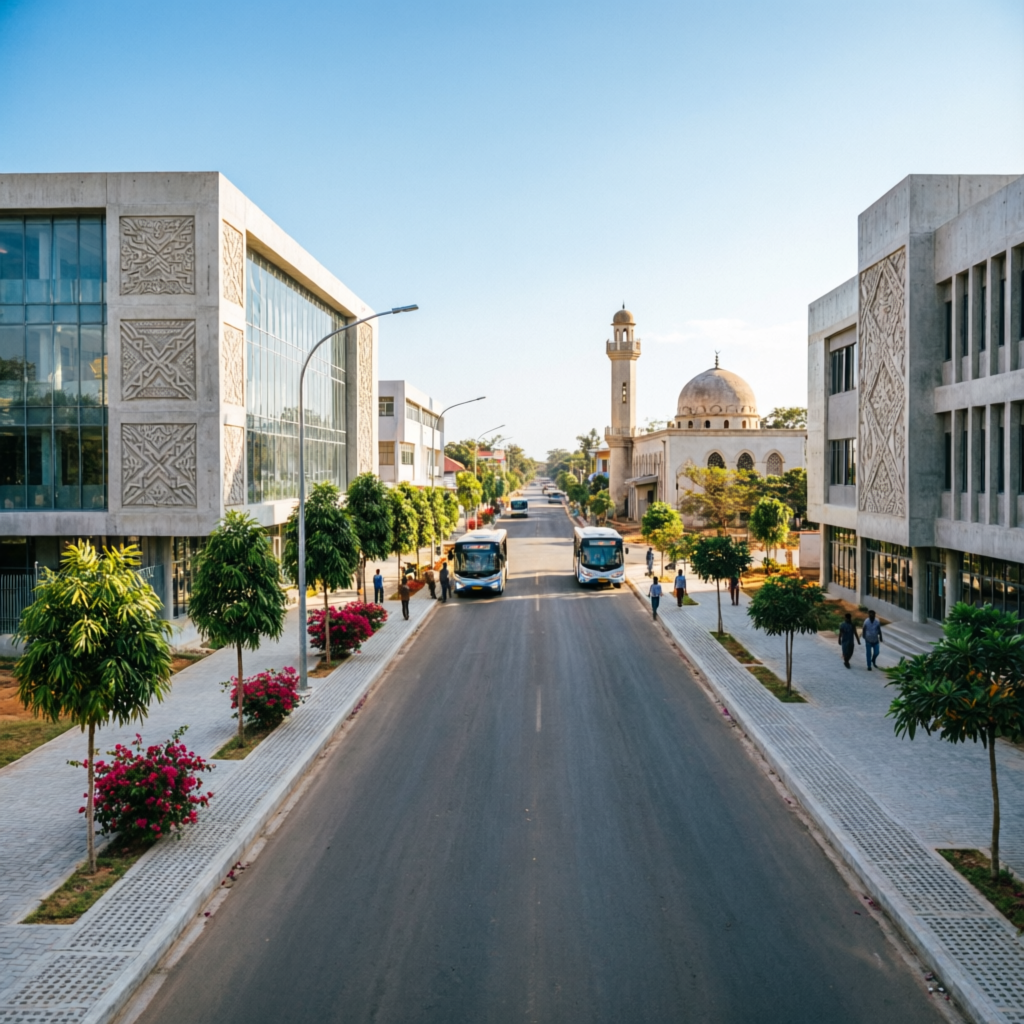
Maguindanao del Sur occupies the southern portion of the former Maguindanao province, encompassing fertile river basins and extensive agricultural lands. The province features 24 municipalities with Datu Piang serving as the capital. The terrain is predominantly flat with river systems supporting rice, corn, and coconut production. The province's strategic location in central Mindanao provides access to regional markets and trade corridors.

24 Municipalities
Datu Piang Provincial Capital
Central Mindanao Location
Demographic Profile

The 2020 Census recorded Maguindanao del Sur's population at over 800,000, representing a significant portion of BARMM's total population. The province has a youthful demographic profile with a predominantly Muslim population (95%+), creating a natural ecosystem for halal industries and Islamic finance. The Maguindanao people form the dominant cultural community, known for their rich agricultural traditions and Islamic scholarship.

800K+ Population 2020
95%+ Muslim Population
Youthful Demographic Profile

Newly Created Province

Maguindanao del Sur was officially created in 2022 following the plebiscite that ratified Republic Act 11550, which divided the former province of Maguindanao into two provinces: Maguindanao del Norte and Maguindanao del Sur. The province's formation marked a new chapter in governance and development, with enhanced administrative capacity to address local development needs. The province has benefited from various government programs including OPAPRU-PAMANA infrastructure projects.

RA 11550 Creating Law
2022 Year Created
OPAPRU Infrastructure Support

Macroeconomic Performance

Analysis of GDP growth, sectoral composition, and economic dynamics highlighting the province's agricultural base and emerging development trajectory.

Agriculture-Based Economy

Maguindanao del Sur's economy is fundamentally anchored on agriculture, with rice, corn, and coconut as the primary crops. The province's fertile river basins and favorable climate conditions support extensive agricultural production. Agriculture, Forestry, and Fisheries (AFF) remains the dominant sector, providing livelihoods for the majority of the population and contributing significantly to BARMM's food security. The sector faces challenges including climate vulnerability, limited processing infrastructure, and post-harvest losses.

Rice Production

  • Primary Crop
  • Food Security Base
  • Climate-Smart Programs

Corn Production

  • Secondary Crop
  • Animal Feed Base
  • Processing Potential

Coconut Industry

  • Export Crop
  • Value-Addition Potential
  • MSME Integration

Climate Vulnerability & Challenges

Maguindanao del Sur faces significant climate-related challenges. The province declared a state of calamity in 2024 due to El Niño-induced drought, which caused ₱346 million in crop losses. The river basins are highly flood-prone, posing risks to agricultural production and infrastructure. Climate-related risks, including drought, flooding, and changing rainfall patterns, require investment in climate-resilient crop varieties, irrigation systems, and adaptation planning. These vulnerabilities constrain agricultural productivity and investment viability.

El Niño Impact 2024

₱346M

State of Calamity

2024

Flood Risk

High

Infrastructure Development

The province has benefited from various government infrastructure programs, particularly OPAPRU-PAMANA projects in municipalities such as Datu Piang and other areas. These projects focus on roads, water systems, and community infrastructure to support economic activities and improve quality of life. However, significant infrastructure gaps remain, particularly in farm-to-market roads, warehouse facilities, and digital connectivity. Addressing these gaps is essential for connecting agricultural production areas to markets and reducing post-harvest losses.

OPAPRU-PAMANA

  • Road Infrastructure
  • Water Systems
  • Community Facilities

Priority Needs

  • Farm-to-Market Roads
  • Warehouse Facilities
  • Digital Connectivity

Investment Gap

Significant

Investment Momentum & BARMM Performance

BARMM's investment climate has undergone a structural upswing. The Bangsamoro Board of Investments (BBOI) surpassed its 2025 target of ₱3 billion in the first quarter alone, with ₱3.2 billion in registered investments. By October 2025, total investments reached ₱5 billion, generating 2,029 jobs. In Q1 2026, BARMM registered ₱2.4 billion in investments, and by April 2026, the region had already surpassed its entire 2025 record with ₱5.1 billion in approved investments, creating 2,583 jobs. Maguindanao del Sur stands to benefit from this momentum as agricultural and agro-industrial investments increase.

Q1 2026 Investments

₱2.4B

April 2026 Total

₱5.1B

Jobs Created

2,583

Bangsamoro Economic and Investment Ecosystem (BEIE) Framework

Applying the integrated systems model to analyze sectoral interlinkages and identify priority investment corridors in Maguindanao del Sur.

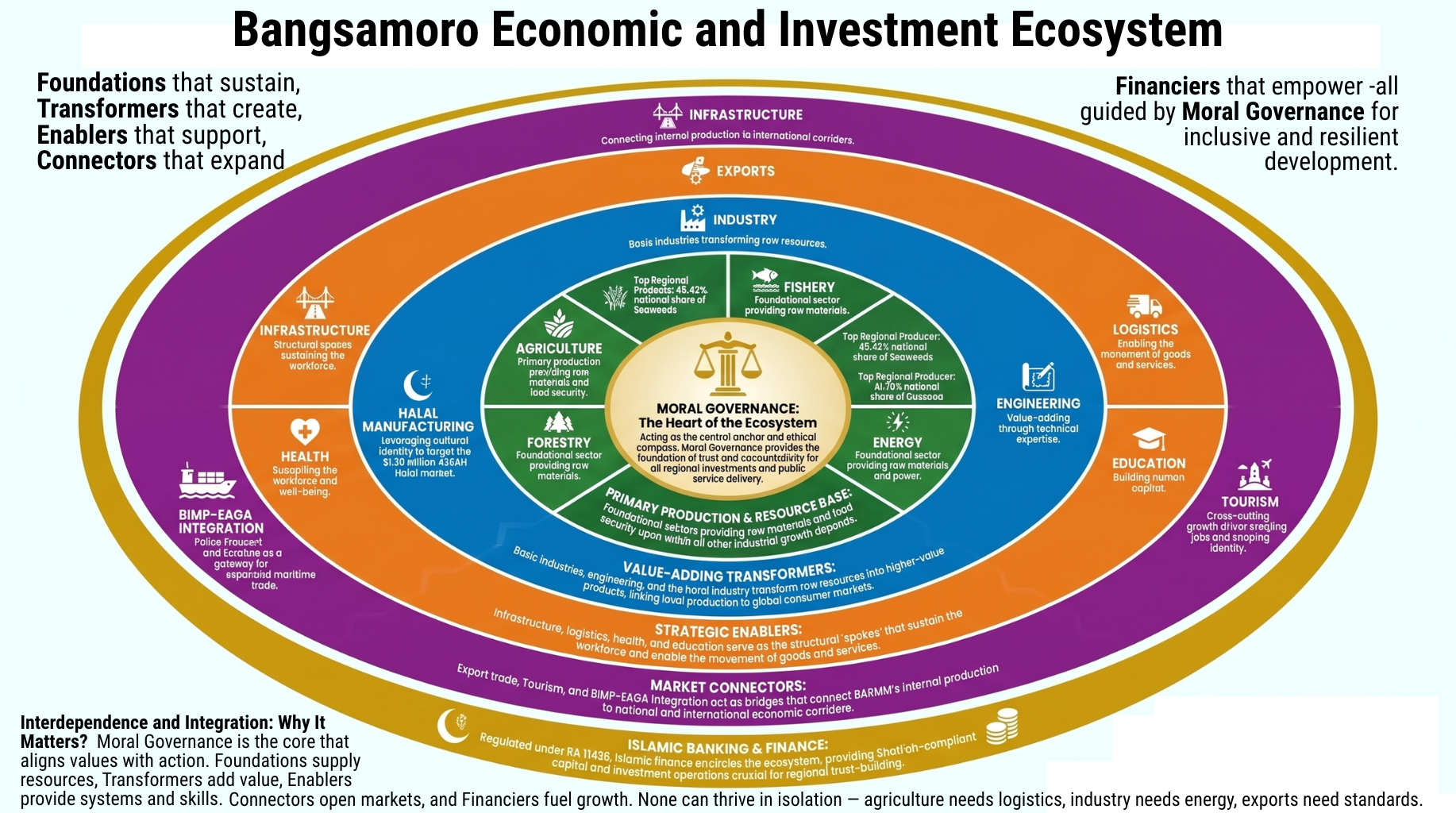
How the BEIE Framework works: The BEIE Framework organizes economic activity into five functional clusters—Foundations, Transformers, Enablers, Connectors, and Financiers—anchored by Moral Governance and driven by four cross-cutting enablers: Tourism and Culture, Peace and Security, Human Capital, and Environmental Sustainability. This systems lens reveals investment opportunities that a conventional sectoral analysis would miss.
Bangsamoro Economic and Investment Ecosystem (BEIE) Framework diagram

Bangsamoro Economic and Investment Ecosystem (BEIE) Framework

The BEIE Framework visualizes the interconnected nature of economic clusters. For Maguindanao del Sur, this framework is vital for mapping how its agricultural abundance can be synchronized with processing, logistics, and financial services.

Cluster 1

Foundations — Rice, Corn, Coconut & Fisheries

The resource base on which Maguindanao del Sur's entire economic ecosystem depends. This cluster feeds raw materials into Transformers and commodities into Connectors.

  • Rice & Corn: High-yield production along the Pulangi River basin, ensuring regional food security and providing raw materials for agro-processing.
  • Coconut & Fisheries: Extensive coconut plantations and Illana Bay fisheries provide export-grade raw materials and protein for local communities.
Investment Opportunities: Climate-smart agriculture, seed technology, large-scale cooperative farming, and organic certification programs.
Cluster 2

Transformers — Agro-Processing & Halal Manufacturing

If Foundations provide the raw material, Transformers create the value. This cluster includes agro-industrial processing and halal food manufacturing that adds value to agricultural production.

  • Agro-Processing: Rice milling, corn processing, and coconut product manufacturing facilities add value to raw agricultural output and create employment opportunities.
  • Halal Manufacturing: The province's Muslim majority population and cultural authority in Islamic practice create a natural ecosystem for halal food production targeting domestic and export markets.
Investment Opportunities: Rice and corn milling facilities, coconut oil extraction plants, halal food processing plants, and agro-industrial parks.
Cluster 3

Enablers — Infrastructure, Logistics & Connectivity

No production capability can generate export value without physical infrastructure to move goods. Infrastructure development is critical for connecting production areas to markets.

  • OPAPRU-PAMANA Projects: The province has benefited from OPAPRU-PAMANA infrastructure projects focusing on roads, water systems, and community facilities.
  • Farm-to-Market Roads: Investment in rural road networks is essential for connecting agricultural production areas to processing facilities and export nodes.
Investment Opportunities: Farm-to-market road construction, warehouse facilities, cold chain infrastructure, and digital logistics platforms.
Cluster 4

Connectors — Trade, Exports & Regional Market Integration

This cluster links Maguindanao del Sur's production to regional and global markets through trade corridors and export facilitation.

  • Regional Market Access: The province's strategic location in central Mindanao provides access to regional markets and trade corridors connecting to BIMP-EAGA partners.
  • Export Markets: BARMM is pursuing the UAE and GCC as major export destinations for halal agricultural products. Maguindanao del Sur's halal certification infrastructure will be critical for accessing these premium markets.
Investment Opportunities: Trade facilitation services, halal export certification, logistics hubs, and digital trade platforms connecting producers to international buyers.
Cluster 5

Financiers — Islamic Banking & MSME Finance

The Financiers cluster is strategically important given the province's 95%+ Muslim population and alignment with Islamic finance principles.

  • Islamic Banking: The province represents a significant underserved market: over 800,000 primarily Muslim residents with a growing economy but minimal formal financial service penetration.
  • MSME Financing: Micro, small, and medium enterprises require access to capital for growth. Islamic microfinance, takaful (Islamic insurance), and waqf (Islamic endowment) instruments can channel capital to entrepreneurs.
Investment Opportunities: Islamic banking branch expansion, takaful products for agricultural risk, waqf instruments for community development, and digital financial services.
Cross-Cutting

Cross-Cutting Drivers — Cultural Tourism, Human Capital & Climate Adaptation

These drivers operate across all clusters and determine the effectiveness of the entire ecosystem.

  • Cultural Tourism: Maguindanao del Sur's rich cultural heritage, including traditional weaving, metalwork, and Islamic scholarship, creates tourism potential.
  • Human Capital Development: Investment in education, vocational training, and healthcare is essential for building a skilled workforce capable of supporting modern agro-industrial and services investment.
  • Climate Adaptation: Given the province's vulnerability to El Niño and flooding, climate-resilient infrastructure and adaptation planning are critical for long-term economic viability.
Investment Opportunities: Cultural heritage tourism, vocational training centers, halal hospitality infrastructure, educational institutions, and climate adaptation programs.

Investment Climate and Recent Performance

Tracking BARMM's investment momentum and highlighting significant projects in Maguindanao del Sur that demonstrate the province's emerging attractiveness to investors.

BARMM Investment Momentum

BARMM's investment climate has undergone a structural upswing. The Bangsamoro Board of Investments (BBOI) had set a 2025 target of ₱3 billion in new investment approvals. This target was breached in April 2025, with ₱3.2 billion in registered investments by mid-year, focusing on healthcare, agriculture, and agribusiness. By October 2025, total 2025 investments had reached ₱5 billion, generating 2,029 jobs across BARMM.

The momentum accelerated dramatically into 2026. In the first quarter of 2026 alone, BARMM registered ₱2.4 billion in investments, projected to generate 930 jobs. By April 2026, the region had already surpassed its entire 2025 full-year record, with total approved investments reaching ₱5.1 billion—exceeding the ₱3.2 billion annual target in just four months. These investments are expected to create 2,583 jobs for Bangsamoro constituents. On April 30, 2026, the BBOI approved six new projects worth ₱2.6 billion during its 3rd Regular Board Meeting, projected to generate 1,657 jobs.

Philippine Statistics Authority data confirmed that BARMM ranked second in Mindanao in approved investments, behind only the Davao Region, and placed within the top 10 regions nationally for Q2 2025. BBOI Chairperson Mohamad Omar Pasigan attributed the achievement to growing investor confidence in BARMM "as a rising hub for sustainable, inclusive, and high-impact investments," reflecting the business community's trust in the Bangsamoro government's commitment to transparency, ease of doing business, and investor protection under Chief Minister Abdulraof Macacua's Mas Matatag na Bangsamoro agenda and the Economic Jihad campaign anchored on moral governance.

Maguindanao del Sur Investment Highlights (2022–2026)

Project/Investor Location Value/ Jobs Sector
OPAPRU-PAMANA Projects Datu Piang and others Multiple infrastructure Infrastructure/Water
Agricultural Modernization Programs Province-wide MAFAR/SPDA initiatives Agriculture
Halal Agriculture Roadmap Development Province-wide Emerging framework Halal/Agri
Al-Amanah Islamic Bank Expansion Multiple municipalities Branch network expansion Islamic Finance
BBOI Q1 2026 Portfolio (Multi-Sector) BARMM-wide ₱2.4B / 930 jobs Multi-Sector
BBOI April 2026 Approvals (6 Projects) Cotabato City, Mainland & Island Provinces ₱2.6B / 1,657 jobs Health, Tourism, Agri, Industry

Strategic Investment Priority Areas

Based on the BEIE Framework analysis, existing investment momentum, and the province's structural endowments, the following priority investment corridors are identified for Maguindanao del Sur through 2035:

April 2026 BBOI Approved Projects

The April 30, 2026 BBOI approvals demonstrate the breadth of emerging opportunities across BARMM, including a major ₱2.2 billion flagship project for an island province projected to generate 1,330 jobs:

  • Health and Wellness + Tourism Facilities (Cotabato City): ₱177 million investment generating 69 jobs in the region capital.
  • Agriculture and Agribusiness Project 1 (Mainland Province): ₱167 million investment projected to create 113 jobs.
  • Agriculture and Agribusiness Project 2 (Mainland Province): ₱58 million investment expected to employ 143 workers.
  • Major Island Province Investment (Basilan or Tawi-Tawi): ₱2.2 billion flagship project projected to generate 1,330 jobs.

Priority Investment Corridors

  • Halal Food Manufacturing and Export Hub: Leveraging the province's agricultural abundance and strategic location to create opportunities for halal-certified products targeting BIMP-EAGA and Middle Eastern markets.
  • Agro-Industrial Processing Zone: Development of rice, corn, and coconut processing facilities to add value to agricultural production and prevent value leakage.
  • Services and Administrative Center: Expansion of financial services, education, healthcare, and government services infrastructure in the newly created provincial capital.
  • Islamic Finance and MSME Ecosystem: Expansion of Islamic banking, takaful, and microfinance to channel capital to enterprises and informal sector workers.
  • Infrastructure and Logistics Corridor: Development of road networks, warehouse facilities, and connectivity infrastructure linking production areas to markets and BARMM's coastal export nodes.
  • Cultural Tourism and Heritage Circuit: Development of cultural tourism, heritage circuits, and halal hospitality in anticipation of the province's continued development as part of the BARMM mainland cluster.

Challenges, Risks, and Structural Constraints

Identifying the key obstacles and vulnerabilities that must be addressed to realize the investment outlook and ensure sustainable development.

Climate Vulnerability & Flooding

Maguindanao del Sur faces significant climate-related challenges. The province declared a state of calamity in 2024 due to El Niño-induced drought, which caused ₱346 million in crop losses. The river basins are highly flood-prone, posing risks to agricultural production and infrastructure. Climate-related risks, including drought, flooding, and changing rainfall patterns, require investment in climate-resilient crop varieties, irrigation systems, and adaptation planning.

Poverty and Human Development

Despite improvements, poverty remains a defining structural challenge. Maguindanao del Sur recorded a poverty incidence of 53.0% in the first semester of 2023. The Bangsamoro's functional literacy rate stands at just 59.3% as of 2025, and 45% of children under five are affected by stunting. These human capital deficits constrain the province's capacity to supply skilled labor for modern agro-industrial and services investment.

Infrastructure Gaps

While infrastructure investment is improving through projects like OPAPRU-PAMANA, significant gaps remain. Farm-to-market roads in interior municipalities limit market access for farmers, increase logistics costs, and constrain the viability of agro-industrial investment. Water supply systems in many municipalities remain inadequate. Digital connectivity is uneven, with broadband penetration in rural areas remaining limited.

LGU Institutional Capacity

As a newly created province, Maguindanao del Sur is still building institutional capacity. The Bangsamoro Government acknowledges that coordination capacity remains a constraint. The BEIE Framework identifies this as the central challenge: "It's not about launching more programs—it's about aligning existing ones into a coherent system." Inter-agency coordination between various government units is essential for synchronized development.

Financial Inclusion Gaps

Despite the abundance of agricultural wealth, many farmers and MSMEs in Maguindanao del Sur remain unbanked or rely on informal lending. The integration of Islamic banking (Al-Amanah, CARD Islamic) into the new municipalities is critical to provide Shariah-compliant credit that unlocks capital for expansion and modernization.

Investment Perception Risks

The historical conflict legacy may deter cautious investors despite significant recent improvements in stability and governance. Residual negative reputation can activate the Security-Investment Tensions balancing loop, requiring proactive efforts to communicate the province's new reality and investment potential.

Strategic Outlook and Investment Recommendations

Defining the ten-year economic vision and prioritizing ecosystem-based investments to transform Maguindanao del Sur into a self-sustaining, export-linked, and inclusive economic hub.

Vision Statement: Transform Maguindanao del Sur from a newly created province into a self-sustaining, export-linked, and inclusive economic hub within BARMM, grounded in its comparative advantages—abundant agricultural resources, strategic location in central Mindanao, youthful population, and alignment with the global halal economy.

Policy Recommendations for Policymakers

Strategic actions to create an enabling environment for investment and sustainable development.

  • Establish a dedicated Maguindanao del Sur Investment Facilitation Office within the BBOI to serve as a one-stop-shop for investors in the province, reducing transaction costs and coordination delays.
  • Fast-track agricultural modernization programs integrating MAFAR support, SPDA initiatives, and climate adaptation measures into a coherent agricultural development strategy for the province.
  • Develop a Maguindanao del Sur Halal Agriculture Roadmap focusing on halal certification infrastructure, quality assurance systems, and export market linkages to the UAE and GCC markets.
  • Accelerate Islamic banking licensing and expand the Al-Amanah Islamic Investment Bank of the Philippines network in Maguindanao del Sur municipalities to improve capital access for MSMEs and agro-entrepreneurs.
  • Strengthen institutional capacity building for the newly created provincial government to enhance service delivery, investment facilitation, and inter-agency coordination.
  • Prioritize completion of infrastructure projects including road networks, water systems, and warehouse facilities to support economic activities and improve market access.

Investment Recommendations for Investors

Strategic opportunities and priority zones for private sector investment.

  • Halal food and consumer goods investors: The halal food and consumer goods sector in Maguindanao del Sur presents a first-mover advantage: the province's agricultural abundance and strategic location create opportunities for halal-certified products targeting BIMP-EAGA and Middle Eastern markets.
  • Agro-industrial investors: Look at the province as a priority zone for rice, corn, and coconut processing facilities, where abundant raw materials and growing demand create favorable conditions for value-chain agriculture.
  • Infrastructure investors: Assess the farm-to-market road and cold chain gap between Maguindanao del Sur's agricultural interior and BARMM's coastal export nodes as a high-priority, high-return infrastructure corridor.
  • Islamic finance and fintech investors: Recognize Maguindanao del Sur as a significant underserved market: a province of over 800,000 primarily Muslim residents with a growing economy but minimal formal financial service penetration.
  • Renewable energy investors: Recognize Maguindanao del Sur as a significant underserved market: a province with growing electricity demand, high power costs in remote areas, and abundant solar and biomass resources.
  • Tourism investors: Conduct feasibility studies for cultural tourism, heritage circuits, and halal hospitality in anticipation of the province's continued development as part of the BARMM mainland cluster.

Ecosystem-Based Investment Priorities (2026–2035)

Integrated investment matrix aligned with the BEIE Framework clusters.

  • Foundations: Climate-smart agriculture, rice/corn/coconut processing (Target: 2026–2030) - Expanded AFF output, export-ready supply chains.
  • Transformers: Halal food processing hub, agro-industrial parks (Target: 2026–2032) - Value-added exports, MSME employment.
  • Enablers: Farm-to-market roads, warehouse facilities, digital infrastructure (Target: 2026–2030) - Reduced logistics costs, market access.
  • Connectors: UAE/GCC halal export linkages, BIMP-EAGA trade corridors (Target: 2026–2035) - Export revenue, regional market integration.
  • Financiers: Islamic banking expansion, microfinance, digital payments (Target: 2026–2030) - Inclusive capital access, MSME financing.
  • Cross-Cutting: Cultural tourism, human capital development, climate adaptation (Target: 2026–2035) - Diversified income, skilled workforce, resilient communities.

Invest in Maguindanao del Sur

Connect with our investment facilitation team and explore opportunities in BARMM's agricultural heartland and emerging agro-industrial hub.

Maguindanao del Sur agricultural landscape and development

Investment Facilitation

MinistryMinistry of Trade, Investments and Tourism (MTIT)
Bangsamoro Autonomous Region in Muslim Mindanao

AddressMTIT Building, Capitol Compound
Cotabato City, 9600 Philippines

Key Investment Agencies

Bangsamoro Board of Investments (BBOI)
Bangsamoro Economic Zone Authority (BEZA)
Bangsamoro Halal Board (BHB)
Polloc Freeport & Ecozone (PFEZ)
BPDA – Planning & Development
MAFAR – BARMM

🕐 Office HoursMonday – Friday, 8:00 AM – 5:00 PM (PHT)
Investment inquiries responded to within 3 business days.

Send an Investment Inquiry

Your information is kept confidential and used solely for investment facilitation purposes.